
Question 975 marksEasy
Define or explain the terms :
(a) vapour density,
(b) molar volume,
(c) relative atomic mass,
(d) relative molecular mass,
(e) Avogadro's number,
(f) Gram atom,
(g) Mole.
Confirming your payment
Sign up now and get 250 free tokens.
Mole Concept and Stoichiometry · Question 97 of 159
Define or explain the terms :
(a) vapour density,
(b) molar volume,
(c) relative atomic mass,
(d) relative molecular mass,
(e) Avogadro's number,
(f) Gram atom,
(g) Mole.
Solution:
Concept: These terms are the basic units for counting and weighing particles in chemistry; each is defined below with an example.
Step 1 — (a) Vapour density.
Vapour density is the ratio of the mass of a certain volume of a gas (or vapour) to the mass of the same volume of hydrogen, under the same conditions of temperature and pressure.
For example, CO₂ has vapour density 22, and relative molecular mass = 2 × V.D.
Step 2 — (b) Molar volume.
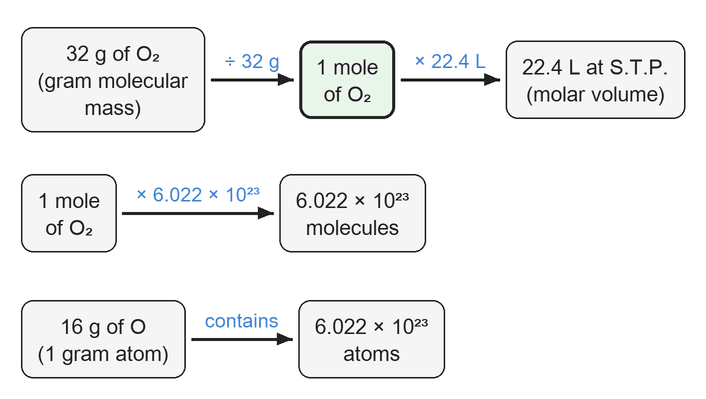
Molar volume is the volume occupied by one mole (one gram-molecule) of any gas at S.T.P. It is 22.4 litres (22.4 dm³). For example, 2 g of H₂, 32 g of O₂ and 44 g of CO₂ each occupy 22.4 L at S.T.P.
Step 3 — (c) Relative atomic mass.
Relative atomic mass is the number of times one atom of an element is heavier than 1/12 of the mass of an atom of carbon-12. For example, the relative atomic mass of oxygen is 16.
Step 4 — (d) Relative molecular mass.
Relative molecular mass is the number of times one molecule of a substance is heavier than 1/12 of the mass of an atom of carbon-12. It is the sum of the relative atomic masses of the atoms in the molecule; for example, H₂O has 2 × 1 + 16 = 18.
Step 5 — (e) Avogadro's number.
Avogadro's number is the number of atoms in exactly 12 g of carbon-12, that is, the number of particles in one mole: 6.022 × 10²³.
Step 6 — (f) Gram atom.
A gram atom is the atomic mass of an element expressed in grams. It contains 6.022 × 10²³ atoms; for example, 1 gram atom of oxygen is 16 g of oxygen.
Step 7 — (g) Mole.
A mole is the amount of a substance that contains as many particles (atoms, molecules or ions) as there are atoms in exactly 12 g of carbon-12, that is, 6.022 × 10²³ particles. For example, 1 mole of water is 18 g and contains 6.022 × 10²³ molecules.
Watch out: Relative atomic and molecular masses have no unit; only the gram atomic and gram molecular masses are in grams.
Therefore, each term is defined above: vapour density compares a gas with hydrogen, molar volume is 22.4 L at S.T.P., relative atomic/molecular masses compare with 1/12 of C-12, Avogadro's number is 6.022 × 10²³, a gram atom is the atomic mass in grams, and a mole is 6.022 × 10²³ particles.