Solution:
Concept: Stoichiometry: the coefficients of a balanced equation give the ratio of moles in which substances react and form. So we change the given quantity to moles (mass ÷ molar mass, or volume at S.T.P. ÷ 22.4 L), use the mole ratio, and change back to mass (moles × molar mass) or volume (moles × 22.4 L at S.T.P.). For gases, Gay-Lussac's law lets us use volumes in the same ratio.
Step 1 — (a)(i) Volumes of the two gases.
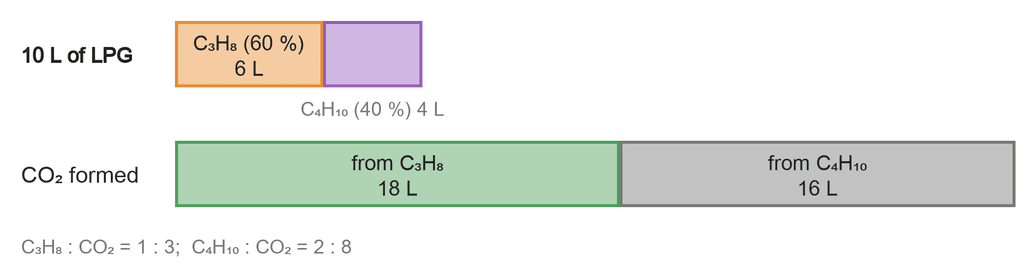
LPG is 60% propane and 40% butane, so 10 L holds 6 L of propane and 4 L of butane.
Step 2 — (a)(i) CO₂ from each gas.
From the equations, 1 volume of propane gives 3 volumes of CO₂, and 2 volumes of butane give 8.
C3H8+5O2→3CO2+4H2O
2C4H10+13O2→8CO2+10H2O
CO2 from propane=6×3 L=18 L
CO2 from butane=4×28 L=16 L
total CO2=18+16 L=34 L
Step 3 — (a)(ii) Percentages in ammonium nitrate.
NH₄NO₃ (80) has 2 N atoms (28) and 3 O atoms (48).
% N=8028×100=35%
% O=8048×100=60%
Step 4 — (b)(i) Equation.
Calcium carbonate reacts with dilute hydrochloric acid:
CaCO3+2HCl→CaCl2+H2O+CO2
So CaCO₃ : HCl : CaCl₂ : CO₂ = 1 : 2 : 1 : 1.
Step 5 — (b)(ii) Mass of calcium carbonate.
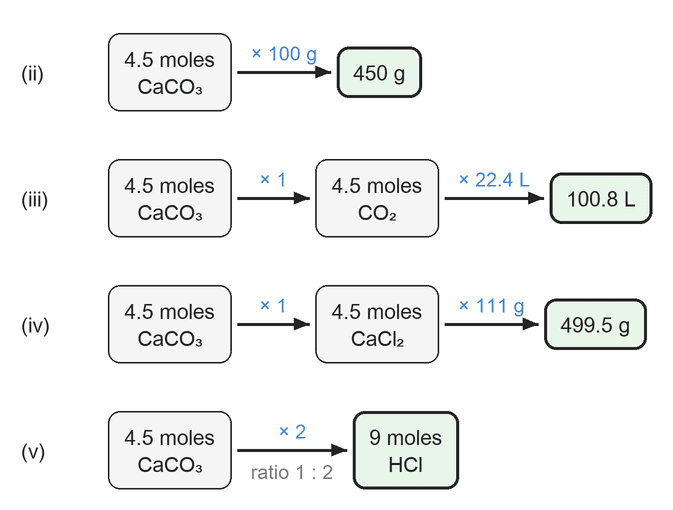
We multiply the moles by 100 g.
mass=4.5×100 g=450 g
Step 6 — (b)(iii) Volume of CO₂.
The ratio is 1 : 1, so 4.5 moles of CO₂ form.
volume=4.5×22.4 L=100.8 L
Step 7 — (b)(iv) Mass of calcium chloride.
The ratio is 1 : 1, and CaCl₂ weighs 111 g per mole.
mass=4.5×111 g=499.5 g
Step 8 — (b)(v) Moles of HCl.
Two moles of HCl are used per mole of CaCO₃.
moles of HCl=2×4.5=9
Watch out: For butane the ratio is 2 : 8, so 4 L gives 16 L of CO₂, not 32 L.
Therefore, (a)(i) 34 litres of CO₂; (ii) 35% nitrogen and 60% oxygen; (b)(i) CaCO₃ + 2HCl → CaCl₂ + H₂O + CO₂; (ii) 450 g; (iii) 100.8 litres; (iv) 499.5 g; (v) 9 moles of HCl.
