Solution:
Concept: Each part uses one tool: Gay-Lussac's volume ratio (a), the empirical-formula method with n = molecular mass ÷ empirical formula mass (b), the mole (c), the mole ratio of an equation (d), and molar volume, 22400 cm³ at S.T.P. (e).
Step 1 — (a) Read the volume ratio.
Calcium carbide and moisture give the acetylene, which then burns:
CaC2+2H2O→Ca(OH)2+C2H2
2C2H2+5O2→4CO2+2H2O
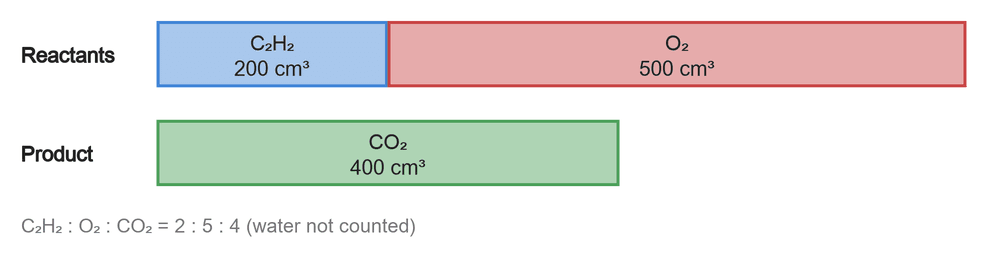
So C₂H₂ : O₂ : CO₂ = 2 : 5 : 4 by volume.
Step 2 — (a) Oxygen and carbon dioxide.
We multiply 200 cm³ by 5/2 and by 4/2.
oxygen required=200×25 cm3=500 cm3
CO2 formed=200×24 cm3=400 cm3
Step 3 — (b) Empirical formula.
Nitrogen is 100 − 12.5 = 87.5%. We divide by the atomic masses, then by the smallest value, 6.25.
| Element | % | Atomic mass | Gram atoms (÷ atomic mass) | ÷ smallest |
|---|
| N | 87.5 | 14 | 87.5 ÷ 14 = 6.25 | 1 |
| H | 12.5 | 1 | 12.5 | 2 |
So the empirical formula is NH₂, with mass 14 + 2 = 16.
Step 4 — (b) Molecular formula.
We divide the given molecular mass by 16.
n=1637=2.3≈2
So the molecular formula is N₂H₄ (hydrazine).
Step 5 — (c) Moles of nitrogen.
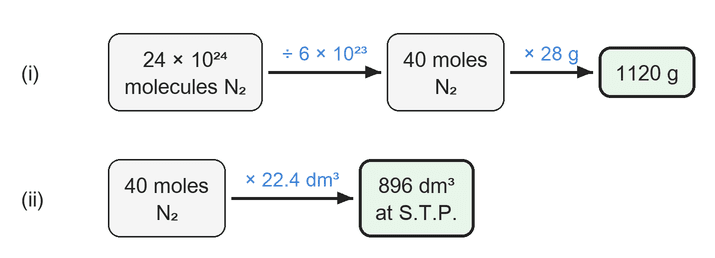
We divide the number of molecules by the Avogadro number (given as 6 × 10²³).
moles of N2=6×102324×1024=40
Step 6 — (c) Mass and volume.
N₂ weighs 28 g per mole and occupies 22.4 dm³ per mole at S.T.P.
mass=40×28 g=1120 g
volume=40×22.4 dm3=896 dm3
Step 7 — (d) Moles of NaCl.
Only NaCl gives a precipitate, in the ratio NaCl : AgCl = 1 : 1. The given molecular masses are 58 for NaCl and 143 for AgCl.
NaCl+AgNO3→AgCl↓+NaNO3
moles of AgCl=14314.3=0.1
mass of NaCl=0.1×58 g=5.8 g
Step 8 — (d) Percentage of NaCl.
We divide by the 30 g sample.
% NaCl=305.8×100=19.33%
Step 9 — (e) Relative molecular mass of X.
Since 100 cm³ at S.T.P. weighs 0.5 g, we scale up to 22400 cm³.
molar mass=1000.5×22400 g=112 g
Watch out: In (c) nitrogen gas is N₂, so use 28 g per mole, not 14 g.
Note: in (b) the printed molecular mass, 37, does not give a whole-number n (37 ÷ 16 ≈ 2.3). It is a misprint for 32, the molecular mass of N₂H₄, which gives n = 2 exactly.
Therefore, (a) 500 cm³ of oxygen and 400 cm³ of CO₂; (b) N₂H₄; (c)(i) 1120 g and (ii) 896 dm³; (d) 19.33% NaCl; (e) 112.
