Solution:
Concept: Stoichiometry: the coefficients of a balanced equation give the ratio of moles in which substances react and form. So we change the given quantity to moles (mass ÷ molar mass, or volume at S.T.P. ÷ 22.4 L), use the mole ratio, and change back to mass (moles × molar mass) or volume (moles × 22.4 L at S.T.P.). To find an empirical formula (the simplest whole-number ratio of atoms): divide each element's percentage (or mass) by its atomic mass to get the relative number of gram atoms, divide every value by the smallest one, and, if needed, multiply by a small whole number to clear fractions. The molecular formula is n × (empirical formula), where n = molecular mass ÷ empirical formula mass, and molecular mass = 2 × vapour density.
Step 1 — (a)(i) Volume of 320 g of SO₂.
The molar mass of SO₂ is 32 + 32 = 64 g.
moles=64320=5
volume=5×22.4 L=112 L
Step 2 — (a)(ii) Gay-Lussac's law.
When gases react, they do so in volumes which bear a simple whole-number ratio to one another and to the volumes of the gaseous products, provided all volumes are measured at the same temperature and pressure.
Step 3 — (a)(iii) Oxygen for 8.8 g of propane.
Propane burns as shown, and the molar mass of C₃H₈ is 36 + 8 = 44 g.
C3H8+5O2→3CO2+4H2O
moles of C3H8=448.8=0.2
moles of O2=5×0.2=1
volume of O2=1×22.4 dm3=22.4 dm3
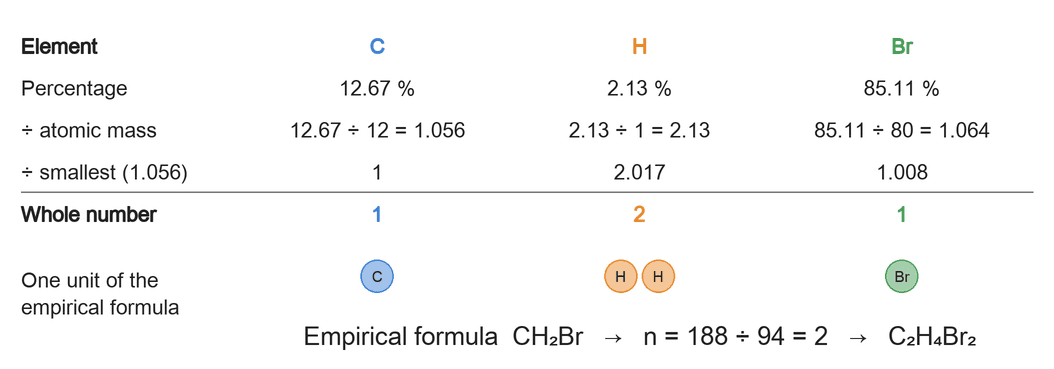
Step 4 — (b)(i) Empirical formula.
We divide by the atomic masses (C = 12, H = 1, Br = 80), then by the smallest value, 1.056.
| Element | % | Atomic mass | Gram atoms (÷ atomic mass) | ÷ smallest |
|---|
| C | 12.67 | 12 | 12.67 ÷ 12 = 1.056 | 1 |
| H | 2.13 | 1 | 2.13 | 2.02 |
| Br | 85.11 | 80 | 85.11 ÷ 80 = 1.064 | 1.01 |
So the empirical formula is CH₂Br, with mass 12 + 2 + 80 = 94.
Step 5 — (b)(i) Molecular formula.
The molecular mass is twice the vapour density.
molecular mass=2×94=188
n=94188=2
So the molecular formula is C₂H₄Br₂.
Step 6 — (b)(ii) Masses.
We change the number of sulphur atoms to moles using the given Avogadro number.
mass of S=6×10231022×32 g=0.533 g
mass of CO2=0.1×44 g=4.4 g
Watch out: In (a)(iii) the oxygen is 5 times the moles of propane, not equal to it.
Therefore, (a)(i) 112 litres; (ii) as stated above; (iii) 22.4 dm³ of oxygen; (b)(i) C₂H₄Br₂; (ii) (1) 0.533 g of sulphur and (2) 4.4 g of CO₂.
