
Question 455 marksEasy
Give the empirical formula of :
(a) ,
(b) ,
(c) ,
(d) .
Confirming your payment
Sign up now and get 250 free tokens.
Mole Concept and Stoichiometry · Question 45 of 159
Give the empirical formula of :
(a) ,
(b) ,
(c) ,
(d) .
Solution:
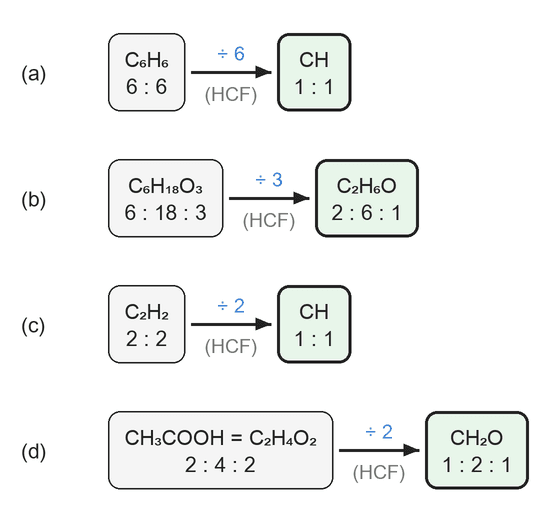
Concept: The empirical formula shows the simplest whole-number ratio of the atoms in a compound. We write the number of each kind of atom and divide all of them by their highest common factor (HCF).
Step 1 — (a) C₆H₆.
The ratio C : H is 6 : 6. The HCF is 6, so dividing by 6 gives 1 : 1. The empirical formula is CH.
Step 2 — (b) C₆H₁₈O₃.
The ratio C : H : O is 6 : 18 : 3. The HCF is 3, so dividing by 3 gives 2 : 6 : 1. The empirical formula is C₂H₆O.
Step 3 — (c) C₂H₂.
The ratio C : H is 2 : 2. The HCF is 2, so dividing by 2 gives 1 : 1. The empirical formula is CH.
Step 4 — (d) CH₃COOH.
First we count all the atoms: 2 C, 4 H and 2 O, so the formula is C₂H₄O₂. The ratio 2 : 4 : 2 has HCF 2, and dividing gives 1 : 2 : 1. The empirical formula is CH₂O.
Watch out: In acetic acid count every atom, including the H in –COOH; it has 4 H, not 3.
Therefore, the empirical formulae are (a) CH, (b) C₂H₆O, (c) CH and (d) CH₂O.