Solution:
Concept: Vapour density (V.D.) is the ratio of the mass of a certain volume of a gas to the mass of the same volume of hydrogen at the same temperature and pressure. Since one molecule of hydrogen has mass 2, relative molecular mass=2×V.D. Stoichiometry: the coefficients of a balanced equation give the ratio of moles in which substances react and form. So we change the given quantity to moles (mass ÷ molar mass, or volume at S.T.P. ÷ 22.4 L), use the mole ratio, and change back to mass (moles × molar mass) or volume (moles × 22.4 L at S.T.P.).
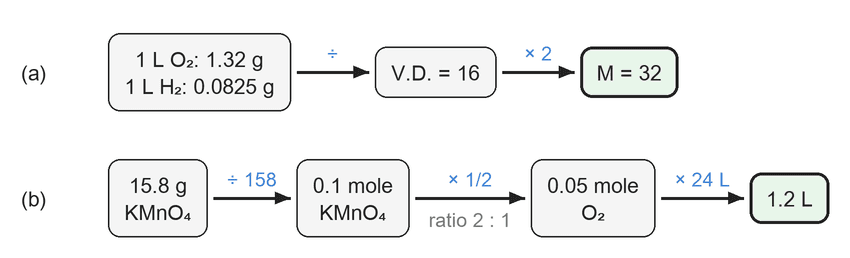
Step 1 — (a) Find the vapour density of oxygen.
The loss in mass, 1.32 g, is the mass of the one litre of oxygen given off. One litre of hydrogen under the same conditions weighs 0.0825 g.
V.D.=0.08251.32=16
Step 2 — (a) Find the relative molecular mass.
It is twice the vapour density.
relative molecular mass=2×16=32
Step 3 — (b) Read the mole ratio.
From the balanced equation:
2KMnO4→K2MnO4+MnO2+O2
So 2 moles of KMnO₄ give 1 mole of O₂.
Step 4 — (b) Find the moles.
We divide the mass by the molecular mass, 158, then halve it for oxygen.
moles of KMnO4=15815.8=0.1
moles of O2=20.1=0.05
Step 5 — (b) Find the volume at room temperature.
The molar volume at room temperature is given as 24 L.
volume of O2=0.05×24 L=1.2 L
Watch out: In (b) use the given molar volume, 24 L at room temperature, not 22.4 L (which is for S.T.P.).
Therefore, (a) the relative molecular mass of oxygen is 32; (b) 1.2 litres of oxygen are obtained at room temperature.
