Solution:
Concept: Stoichiometry: the coefficients of a balanced equation give the ratio of moles in which substances react and form. So we change the given quantity to moles (mass ÷ molar mass, or volume at S.T.P. ÷ 22.4 L), use the mole ratio, and change back to mass (moles × molar mass) or volume (moles × 22.4 L at S.T.P.). Vapour density (V.D.) is the ratio of the mass of a certain volume of a gas to the mass of the same volume of hydrogen at the same temperature and pressure. Since one molecule of hydrogen has mass 2, relative molecular mass=2×V.D.
Step 1 — (a)(i) Oxygen for 90 dm³ of butane.
Two volumes of butane need 13 volumes of oxygen.
2C4H10+13O2→8CO2+10H2O
volume of O2=90×213 dm3=585 dm3
Step 2 — (a)(ii) Volume of 24.0 g of the gas.
The molecular mass is twice the vapour density.
molecular mass=2×8=16
moles=1624=1.5
volume=1.5×22.4 L=33.6 L
Step 3 — (a)(iii) Molecules of nitrogen.
The same vessel at the same temperature and pressure holds the same number of molecules of any gas (Avogadro's law), so it holds X molecules of nitrogen.
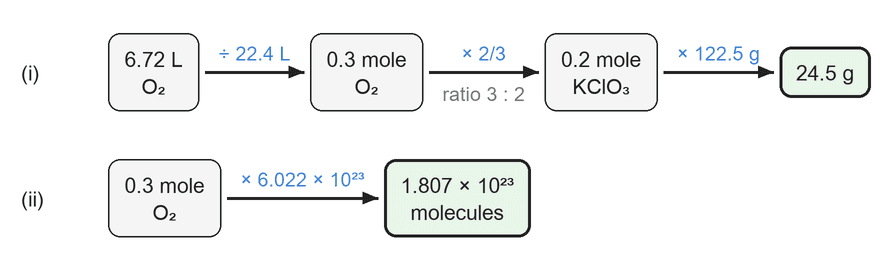
Step 4 — (b)(i) Mass of KClO₃.
From the equation, 2 moles of KClO₃ give 3 moles of O₂.
2KClO3→2KCl+3O2
moles of O2=22.46.72=0.3
moles of KClO3=0.3×32=0.2
mass of KClO3=0.2×122.5 g=24.5 g
Step 5 — (b)(ii) Moles and molecules of oxygen.
There are 0.3 mole of oxygen, so we multiply by the Avogadro number.
molecules=0.3×6.022×1023=1.807×10²³
Step 6 — (b)(iii) Volume of 0.01 mole of CO₂.
Each mole occupies 22.4 L at S.T.P.
volume=0.01×22.4 L=0.224 L
Watch out: MnO₂ is only a catalyst; it is not counted in the mole ratio.
Therefore, (a)(i) 585 dm³ of oxygen; (ii) 33.6 litres; (iii) X molecules; (b)(i) 24.5 g of KClO₃; (ii) 0.3 mole, that is 1.807 × 10²³ molecules (1.806 × 10²³ with 6.02 × 10²³); (iii) 0.224 litre.
