Solution:
Concept: Three gas laws are used: Gay-Lussac's law (gases react in simple volume ratios at the same temperature and pressure), Boyle's law (at constant temperature, P1V1=P2V2, so volume falls as pressure rises) and Charles's law (at constant pressure, T1V1=T2V2, with T in kelvin).
Step 1 — (a) Read the volume ratio.
The equation shows that 2 volumes of hydrogen are formed with 1 volume of oxygen.
2H2O→2H2+O2
So the oxygen is half the volume of the hydrogen.
volume of oxygen=22500 cm3=1250 cm3
Step 2 — (b) Write down the data.
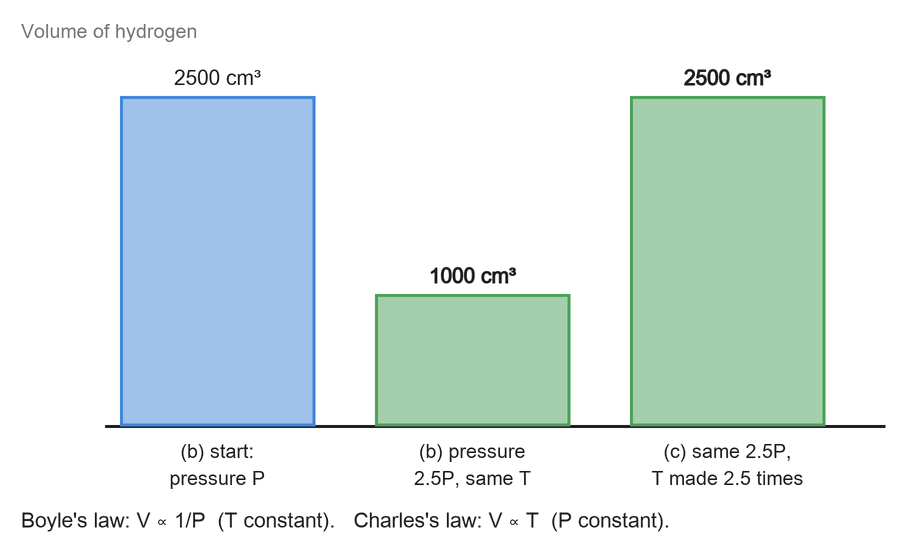
The pressure is made 221 times its first value, so if the first pressure is P, the new pressure is 2.5P. The temperature does not change, so Boyle's law applies.
V2=P2P1V1
Step 3 — (b) Find the new volume.
We substitute the values.
V2=2.5PP×2500 cm3=1000 cm3
Step 4 — (c) Use Charles's law.
To bring 1000 cm³ back to 2500 cm³ at the same pressure, the kelvin temperature must rise in the same ratio as the volume.
T1T2=V1V2=10002500=2.5
Watch out: Boyle's and Charles's laws work only with kelvin (absolute) temperature, never °C.
Note: this follows the book's reading, that the pressure becomes 2.5 times its first value. If "increase" is read as the pressure rising by 2.5P (to 3.5P), the volume in (b) is 2500 ÷ 3.5 ≈ 714.3 cm³, and in (c) the kelvin temperature must be made 3.5 times.
Therefore, (a) 1250 cm³ of oxygen is liberated; (b) the hydrogen now occupies 1000 cm³; (c) the kelvin temperature must be increased to 2.5 times its original value.
