Solution:
Concept: Avogadro's law: equal volumes of all gases, under the same conditions of temperature and pressure, contain an equal number of molecules. So, at fixed temperature and pressure, the number of molecules is proportional to the volume.
Step 1 — Find the molecules in one litre.
Since 20 litres of nitrogen contain x molecules, one litre of any of these gases (same temperature and pressure) contains one-twentieth of that.
molecules in 1 litre=20x
Step 2 — Chlorine (10 litres).
We multiply the molecules per litre by 10.
molecules=10×20x=2x
Step 3 — Ammonia (20 litres).
Ammonia has the same volume as the nitrogen, so by Avogadro's law it has the same number of molecules, x.
Step 4 — Sulphur dioxide (5 litres).
We multiply the molecules per litre by 5.
molecules=5×20x=4x
Step 5 — Complete the table.
The completed table is:
| Gas | Volume (in litres) | Number of molecules |
|---|
| Chlorine | 10 | 2x |
| Nitrogen | 20 | x |
| Ammonia | 20 | x |
| Sulphur dioxide | 5 | 4x |
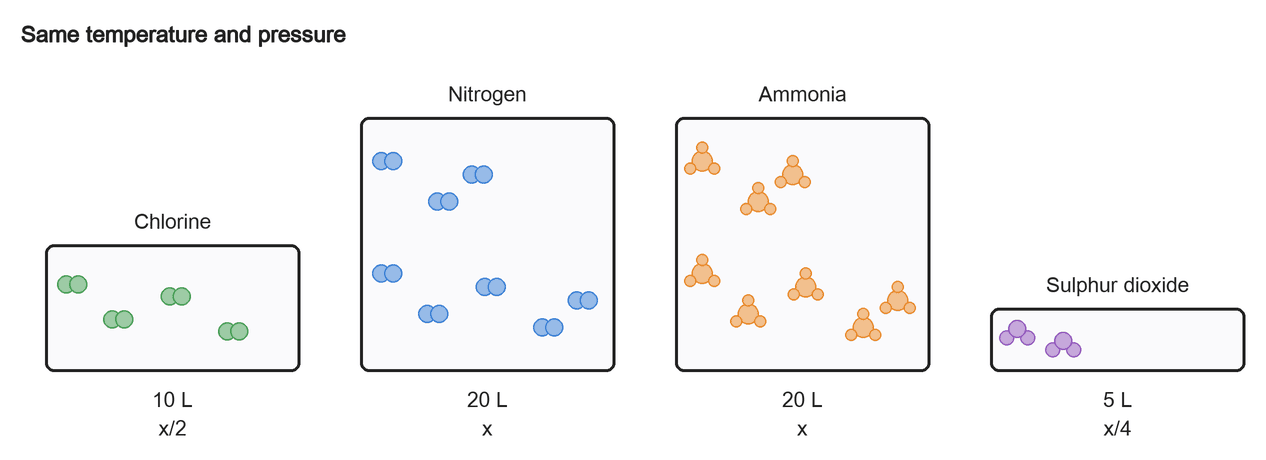
Watch out: The kind of gas (and its molecular mass) does not matter here; only the volume does.
Therefore, chlorine has x/2 molecules, ammonia has x molecules and sulphur dioxide has x/4 molecules.
