Solution:
Concept: To find an empirical formula (the simplest whole-number ratio of atoms): divide each element's percentage (or mass) by its atomic mass to get the relative number of gram atoms, divide every value by the smallest one, and, if needed, multiply by a small whole number to clear fractions. The molecular formula is n × (empirical formula), where n = molecular mass ÷ empirical formula mass, and molecular mass = 2 × vapour density.
Step 1 — Find the simplest ratio.
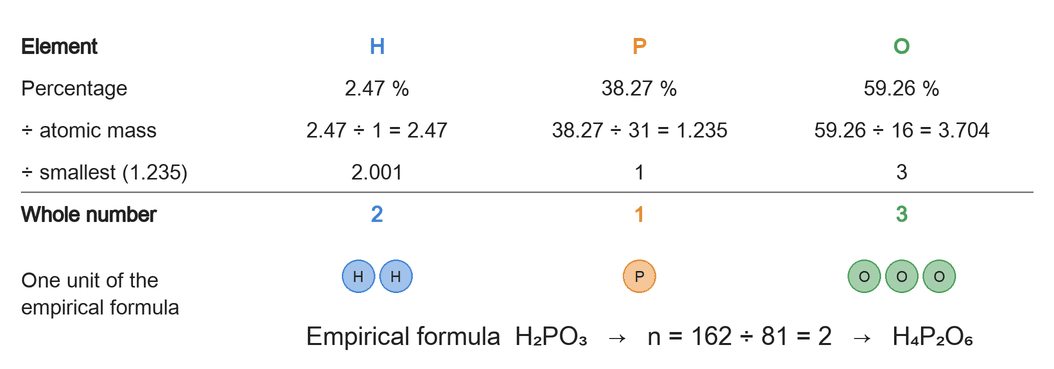
We divide by the atomic masses (P = 31, H = 1, O = 16), then by the smallest value, 1.235.
| Element | % | Atomic mass | Gram atoms (÷ atomic mass) | ÷ smallest |
|---|
| P | 38.27 | 31 | 38.27 ÷ 31 = 1.235 | 1 |
| H | 2.47 | 1 | 2.47 | 2 |
| O | 59.26 | 16 | 59.26 ÷ 16 = 3.704 | 3 |
So P : H : O = 1 : 2 : 3, and the empirical formula is H₂PO₃.
Step 2 — Find the empirical formula mass.
We add the atomic masses in H₂PO₃.
H2PO3=2+31+3×16=81
Step 3 — Find n.
We divide the relative molecular mass by the empirical formula mass.
n=81162=2
Step 4 — Write the molecular formula.
We double every subscript of H₂PO₃, giving H₄P₂O₆.
Therefore, the empirical formula of the acid is H₂PO₃ and its molecular formula is H₄P₂O₆.
