Solution:
Concept: Avogadro's law (equal volumes, equal numbers of molecules), Boyle's law (V∝1/P for a fixed mass at constant temperature) and Charles's law (V∝T at constant pressure) explain these facts.
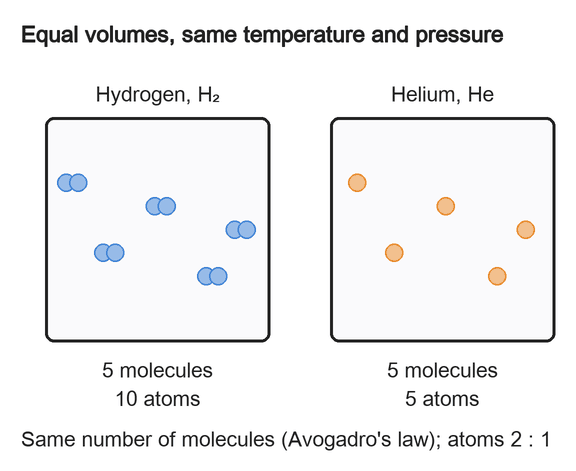
Step 1 — (a) Hydrogen has twice the atoms of helium.
By Avogadro's law, equal volumes of hydrogen and helium at the same temperature and pressure contain the same number of molecules. A hydrogen molecule (H₂) is diatomic, with 2 atoms, while a helium molecule (He) is monoatomic, with 1 atom. So hydrogen has twice as many atoms.
Step 2 — (b) Volume needs temperature and pressure.
The volume of a gas decreases when the pressure increases (Boyle's law) and increases when the temperature rises (Charles's law). So the same amount of gas can have many different volumes, and a volume has meaning only when its pressure and temperature are stated (usually S.T.P., which is 0 °C and 760 mm of Hg).
Step 3 — (c) Inflating a balloon.
Boyle's law says that for a fixed mass of gas at constant temperature, the volume increases when the pressure decreases. While a balloon is blown up, both its volume and the pressure inside increase, which seems to break the law. But more air is being blown in, so the mass of gas is not constant, and Boyle's law does not apply.
Watch out: Boyle's law holds only for a fixed mass of gas at constant temperature.
Therefore, (a) equal volumes hold equal numbers of molecules and H₂ has 2 atoms per molecule against 1 for He; (b) a gas volume changes with pressure and temperature; (c) the mass of air in the balloon is not constant, so Boyle's law is not violated.
