
Question 1582 marksEasy
An organic compound with vapour density 94 contains H = 2.13% and Br = 85.11%. Find its molecular formula.
Confirming your payment
Sign up now and get 250 free tokens.
Mole Concept and Stoichiometry · Question 158 of 159
An organic compound with vapour density 94 contains H = 2.13% and Br = 85.11%. Find its molecular formula.
Solution:
Concept: To find an empirical formula (the simplest whole-number ratio of atoms): divide each element's percentage (or mass) by its atomic mass to get the relative number of gram atoms, divide every value by the smallest one, and, if needed, multiply by a small whole number to clear fractions. The molecular formula is n × (empirical formula), where n = molecular mass ÷ empirical formula mass, and molecular mass = 2 × vapour density.
Step 1 — Find the percentage of carbon.
Carbon is the remainder after hydrogen and bromine.
Step 2 — Find the empirical formula.
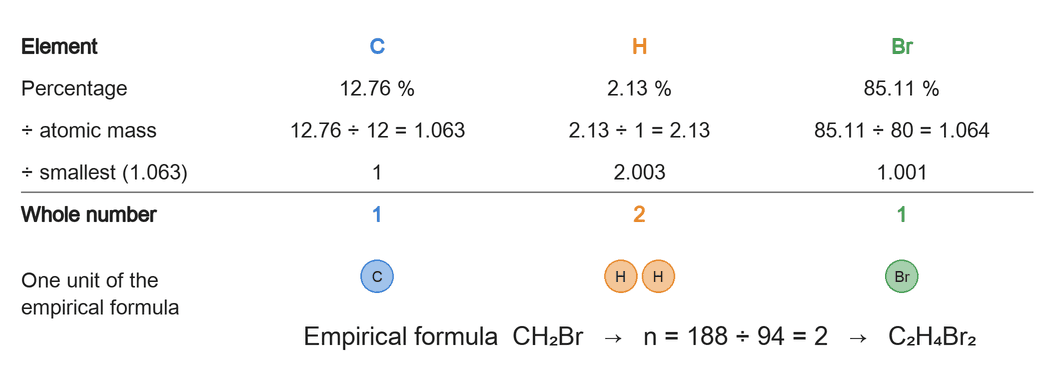
We divide by the atomic masses (C = 12, H = 1, Br = 80), then by the smallest value, 1.063.
| Element | % | Atomic mass | Gram atoms (÷ atomic mass) | ÷ smallest |
|---|---|---|---|---|
| C | 12.76 | 12 | 12.76 ÷ 12 = 1.063 | 1 |
| H | 2.13 | 1 | 2.13 | 2 |
| Br | 85.11 | 80 | 85.11 ÷ 80 = 1.064 | 1 |
So the empirical formula is CH₂Br, with mass 12 + 2 + 80 = 94.
Step 3 — Find n.
The molecular mass is twice the vapour density.
Step 4 — Write the molecular formula.
We double every subscript of CH₂Br, giving C₂H₄Br₂.
Therefore, the molecular formula of the compound is C₂H₄Br₂.