
Question 1594 marksEasy
A compound A consists of 4.8% carbon and 95.2% bromine by mass. Its vapour density is 252. Find its :
(i) empirical formula
(ii) molecular formula
Confirming your payment
Sign up now and get 250 free tokens.
Mole Concept and Stoichiometry · Question 159 of 159
A compound A consists of 4.8% carbon and 95.2% bromine by mass. Its vapour density is 252. Find its :
(i) empirical formula
(ii) molecular formula
Solution:
Concept: To find an empirical formula (the simplest whole-number ratio of atoms): divide each element's percentage (or mass) by its atomic mass to get the relative number of gram atoms, divide every value by the smallest one, and, if needed, multiply by a small whole number to clear fractions. The molecular formula is n × (empirical formula), where n = molecular mass ÷ empirical formula mass, and molecular mass = 2 × vapour density.
Step 1 — (i) Find the simplest ratio.
We divide by the atomic masses (C = 12, Br = 80), then by the smallest value, 0.4.
| Element | % | Atomic mass | Gram atoms (÷ atomic mass) | ÷ smallest |
|---|---|---|---|---|
| C | 4.8 | 12 | 4.8 ÷ 12 = 0.4 | 1 |
| Br | 95.2 | 80 | 95.2 ÷ 80 = 1.19 | 2.98 |
So the empirical formula is CBr₃, with mass 12 + 240 = 252.
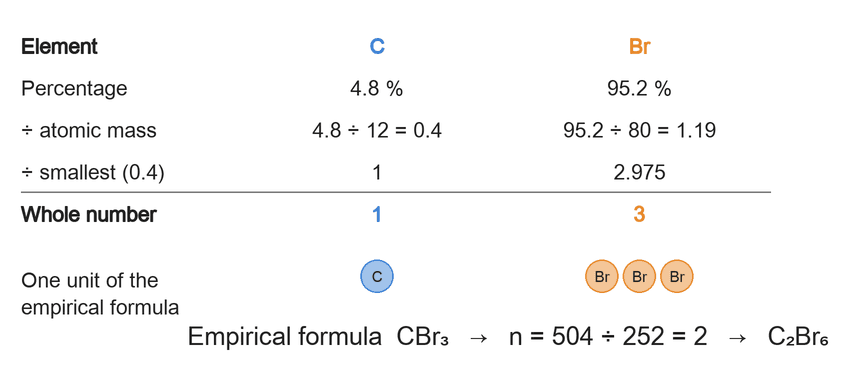
Step 2 — (ii) Find n.
The molecular mass is twice the vapour density.
Step 3 — (ii) Write the molecular formula.
We double every subscript of CBr₃, giving C₂Br₆.
Therefore, (i) the empirical formula is CBr₃; (ii) the molecular formula is C₂Br₆.