Answer: (D) (4)
Concept: In an assertion–reason question we judge the Assertion (A) and the Reason (R) separately as true or false, and then, if both are true, decide whether R correctly explains why A is true.
Step 1 — Judge the Reason.
By Avogadro's law, equal volumes of all gases at the same temperature and pressure contain equal numbers of molecules. So one litre of hydrogen and one litre of oxygen hold the same number of molecules, and R is true.
Step 2 — Judge the Assertion.
An oxygen molecule (O₂, 32) is 32 ÷ 2 = 16 times as heavy as a hydrogen molecule (H₂, 2). With the same number of molecules, one litre of oxygen weighs 16 times as much as one litre of hydrogen. So A is false.
Step 3 — Choose the code.
A false and R true is code (4).
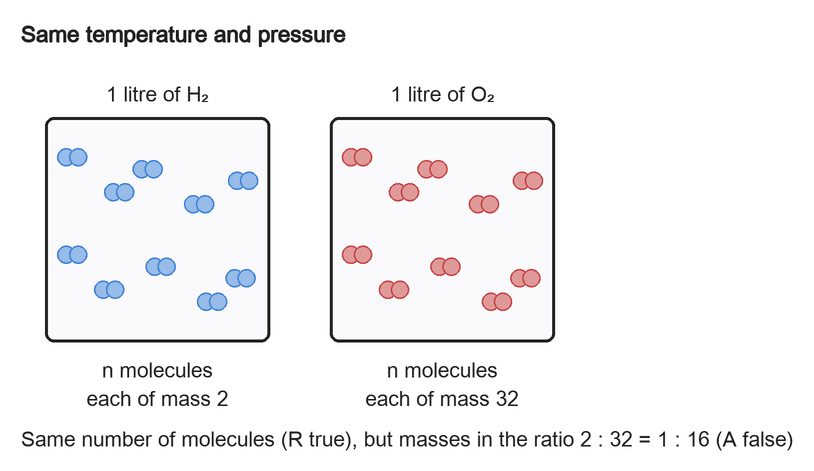
Watch out: Equal volumes mean equal numbers of molecules, not equal masses.
Why the other options are wrong:
- (A) (1): A is false, so this code cannot apply.
- (B) (2): A is false, so this code cannot apply.
- (C) (3): it says A true and R false, which is the reverse of the truth.
Therefore, A is false but R is true, option (D).
