Solution:
Concept: Molar volume: one mole of any gas occupies 22.4 litres (22400 cm³) at S.T.P. (273 K and 760 mm of Hg, or 1 atm). Boyle's law (P1V1=P2V2, constant temperature) and Charles's law (T1V1=T2V2, constant pressure, T in kelvin) give the changes.
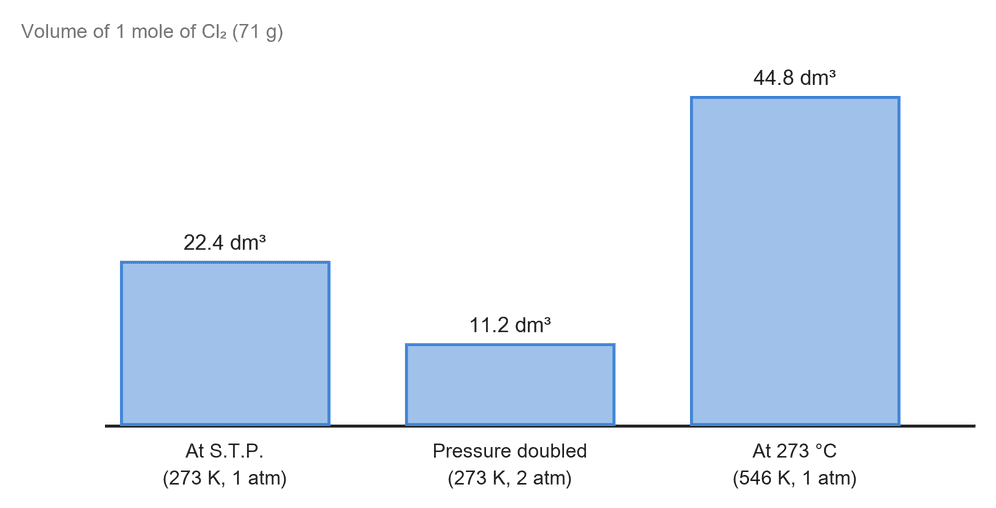
Step 1 — (a) Volume at S.T.P.
One mole of any gas occupies 22.4 dm³ at S.T.P.
Step 2 — (b) Pressure doubled.
At constant temperature, volume is inversely proportional to pressure.
V2=21×22.4 dm3=11.2 dm3
So the volume is halved.
Step 3 — (c) Volume at 273 °C.
273 °C is 273 + 273 = 546 K, twice 273 K. At constant pressure, volume is proportional to the kelvin temperature.
V2=22.4×273546 dm3=44.8 dm3
Step 4 — (d) Mass of 1 mole.
Chlorine gas is diatomic, Cl₂.
mass=2×35.5 g=71 g
Watch out: 273 °C is not double 0 °C in the gas laws; use kelvin (546 K is double 273 K).
Therefore, (a) 22.4 dm³; (b) the volume is halved to 11.2 dm³; (c) 44.8 dm³; (d) 71 g.
