Solution:
Concept: Each part uses one tool: percentage of water of crystallisation (a), the mole ratio of an equation (b, e), and the gas equation T1P1V1=T2P2V2 to change a volume to or from S.T.P. (c, d). At S.T.P., one mole of gas occupies 22.4 L.
Step 1 — (a) Set up the equation for x.
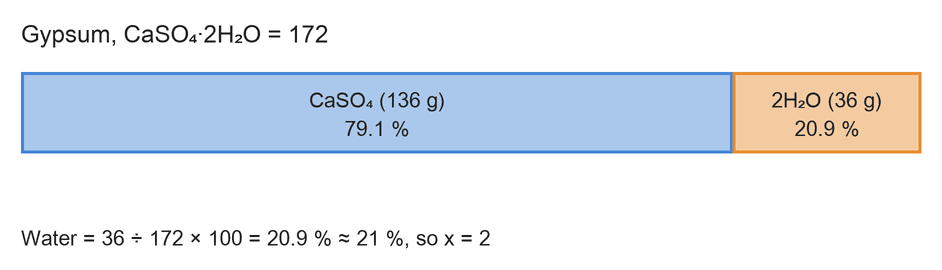
The formula mass of CaSO₄ is 40 + 32 + 64 = 136, and x water molecules weigh 18x. The water is 21% of the crystal.
136+18x18x×100=21
Step 2 — (a) Solve for x.
We multiply out and collect the x terms.
1800x=2856+378x
1422x=2856
x=14222856=2.008≈2
So the hydrate is gypsum, CaSO₄·2H₂O.
Step 3 — (b) Moles of water.
Hydrogen and oxygen combine to form water.
2H2+O2→2H2O
moles of H2O=181.8=0.1
The ratio H₂ : O₂ : H₂O is 2 : 1 : 2, so 0.1 mole of H₂ and 0.05 mole of O₂ are needed.
Step 4 — (b) Volumes at S.T.P.
Each mole occupies 22.4 L.
volume of H2=0.1×22.4 L=2.24 L
volume of O2=0.05×22.4 L=1.12 L
Step 5 — (c) Volume of 2 g of oxygen at S.T.P.
The molar mass of O₂ is 32 g.
V1=322×22.4 L=1.4 L
Step 6 — (c) Change to 27 °C and 740 mm.
We use the gas equation from S.T.P. (760 mm, 273 K) to 740 mm and 27 °C, which is 27 + 273 = 300 K.
V2=1.4×740760×273300 L=1.58 L
Step 7 — (d) Change 44 L of CO₂ to S.T.P.
The gas is at 25 °C, which is 298 K, and 750 mm.
VSTP=44×760750×298273 L=39.78 L
Step 8 — (d) Mass of the CO₂.
We change the volume to moles and multiply by 44 g.
mass=22.439.78×44 g=78.14 g
Step 9 — (e) Moles of AgCl.
Only NaCl gives a precipitate with silver nitrate.
AgNO3+NaCl→AgCl+NaNO3
moles of AgCl=143.51.435=0.01
The ratio NaCl : AgCl is 1 : 1, so the mixture held 0.01 mole of NaCl.
Step 10 — (e) Percentage of NaCl.
The molar mass of NaCl is 23 + 35.5 = 58.5 g.
mass of NaCl=0.01×58.5 g=0.585 g
% NaCl=10.585×100=58.5%

Watch out: In (e) sodium nitrate gives no precipitate, so all the AgCl comes from the sodium chloride.
Therefore, (a) x = 2; (b) 2.24 litres of hydrogen and 1.12 litres of oxygen at S.T.P.; (c) 1.58 litres; (d) 78.14 g of CO₂; (e) the mixture contains 58.5% sodium chloride.
