
Question 122 marksMedium
A mixture of hydrogen and chlorine occupying 36 cm³ was exploded. On shaking it with water, 4 cm³ of hydrogen was left behind. Find the composition of the initial mixture.
Confirming your payment
Sign up now and get 250 free tokens.
Mole Concept and Stoichiometry · Question 12 of 159
A mixture of hydrogen and chlorine occupying 36 cm³ was exploded. On shaking it with water, 4 cm³ of hydrogen was left behind. Find the composition of the initial mixture.
Solution:
Concept: Gay-Lussac's law of combining volumes: when gases react, they do so in volumes that bear a simple whole-number ratio to one another and to the volumes of any gaseous products, all measured at the same temperature and pressure. The ratio is read from the coefficients of the balanced equation. Hydrogen chloride dissolves when shaken with water; hydrogen does not.
Step 1 — Write the balanced equation.
Hydrogen and chlorine react in equal volumes:
Step 2 — Find the volume that reacted.
The 4 cm³ of hydrogen left over did not react, so the rest of the mixture reacted.
Step 3 — Split it in the ratio 1 : 1.
Since H₂ and Cl₂ react in equal volumes, the 32 cm³ was half hydrogen and half chlorine.
Step 4 — Add back the excess hydrogen.
The hydrogen in the original mixture is the hydrogen that reacted plus the 4 cm³ left over.
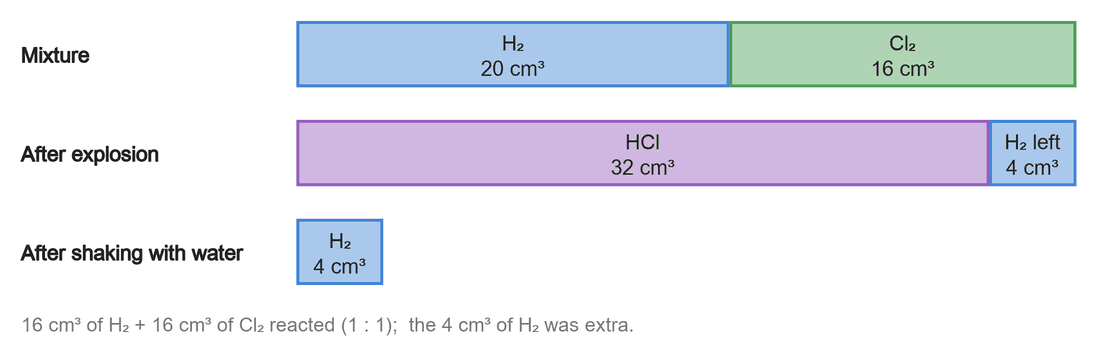
Watch out: The 4 cm³ left over is hydrogen, so it is added to the hydrogen only, not shared between both gases.
Therefore, the initial mixture contained 20 cm³ of hydrogen and 16 cm³ of chlorine.