Solution:
Concept: Gay-Lussac's law of combining volumes: when gases react, they do so in volumes that bear a simple whole-number ratio to one another and to the volumes of any gaseous products, all measured at the same temperature and pressure. The ratio is read from the coefficients of the balanced equation.
Step 1 — Read the volume ratio.
The balanced equation gives the ratio of the gas volumes.
4NH3+5O2→4NO+6H2O
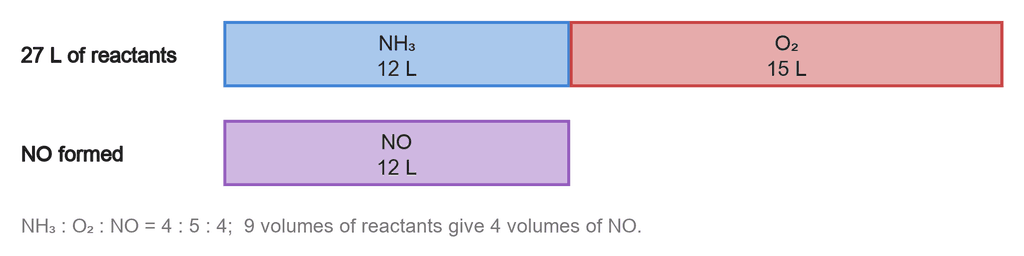
So 4 volumes of ammonia and 5 volumes of oxygen, that is 4 + 5 = 9 volumes of reactants, give 4 volumes of nitrogen monoxide.
Step 2 — Find the volume of NO.
Since every 9 volumes of reactants give 4 volumes of NO, we multiply the 27 L by 4/9.
volume of NO=27×94 L=12 L
(The 27 L was 12 L of ammonia and 15 L of oxygen.)
Watch out: The 27 L is the total of both reactants, so divide by 4 + 5 = 9, not by 4 or 5 alone.
Therefore, 12 litres of nitrogen monoxide are produced.
