
Question 102 marksEasy
If 6 litres of hydrogen and 4 litres of chlorine are mixed and exploded and if water is added to the gases formed, find the volume of the residual gas.
Confirming your payment
Sign up now and get 250 free tokens.
Mole Concept and Stoichiometry · Question 10 of 159
If 6 litres of hydrogen and 4 litres of chlorine are mixed and exploded and if water is added to the gases formed, find the volume of the residual gas.
Solution:
Concept: Gay-Lussac's law of combining volumes: when gases react, they do so in volumes that bear a simple whole-number ratio to one another and to the volumes of any gaseous products, all measured at the same temperature and pressure. The ratio is read from the coefficients of the balanced equation. Hydrogen chloride is very soluble in water, while hydrogen is almost insoluble.
Step 1 — Write the balanced equation.
Hydrogen and chlorine combine to give hydrogen chloride:
So H₂ : Cl₂ : HCl = 1 : 1 : 2 by volume.
Step 2 — Find the limiting gas.
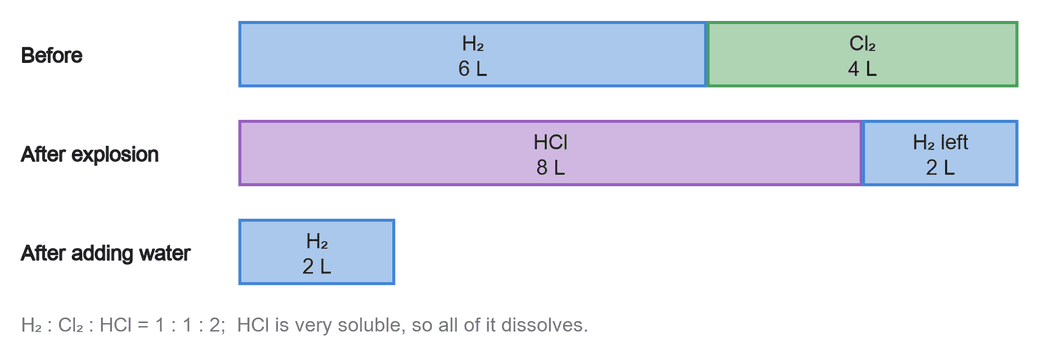
Since H₂ and Cl₂ react 1 : 1, the 4 L of chlorine reacts with only 4 L of hydrogen. So chlorine is used up and hydrogen is in excess.
Step 3 — Find the gases after the explosion.
Each volume of chlorine gives two volumes of HCl, and the unreacted hydrogen is left over.
Step 4 — Add water.
All 8 L of HCl dissolves in the water, but hydrogen does not dissolve, so it remains as the residual gas.
Watch out: The HCl does not remain as a gas after water is added, because it is highly soluble.
Therefore, the residual gas is 2 litres of hydrogen.