
Opening your dashboard
Class 10 Physics Chapter 2: Work, Energy and Power Solutions
146 textbook questions with step-by-step answers, free to read, for ICSE 2026-27.
Get talked through Ch 2, not just shown the answer
Reading a finished solution is not the same as being able to do it. The AI tutor takes one question at a time and works it with you, in your own words, until you can.
- Ask it out loud, in your own words
- It gives you the next step, not the answer
- Stuck on part (ii)? Start there
146 questions with solutions
1–5 marks · Mixed difficulty
The first 141 solutions are on this page. This chapter is a long one, so the rest open on their own page to keep this one quick to load.
- 11 mark
Question 1
In vector form, work done W is written as :
Solve with AIAnswer
(A)
- Correct
(B)
(C)
(D)
Answer: (B)
Concept: Force and displacement are vectors, but work is a scalar (it has size only). Work is the dot (scalar) product of the two vectors, , whose value is , where θ is the angle between them.
Step 1 — Decide what kind of quantity work is.
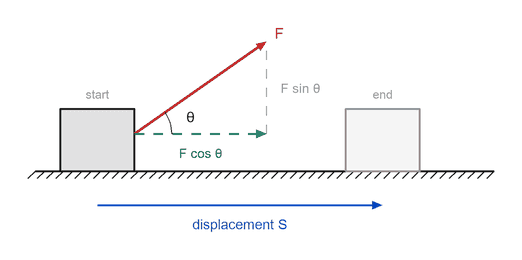
Work has a size (so many joules) but no direction, so W is a scalar and must be written WITHOUT an arrow.
Step 2 — Choose the product that gives a scalar.
The dot product of two vectors is a scalar, while the cross product of two vectors is a vector. So work is the dot product of the force and the displacement.
Step 3 — Write its value.
The dot product equals the product of the magnitudes and the cosine of the angle between the vectors.
Watch out: The book prints the dot as a full stop; means , the dot product.
Why the other options are wrong:
- (A) : it puts an arrow on W, as if work were a vector, but the dot product of two vectors is a scalar.
- (C) : it uses the cross product, which gives a vector of size FS sin θ, and then multiplies by cos θ as well; that is not how work is defined.
- (D) : it puts an arrow on W (work is not a vector) while the right-hand side is a plain number, so the two sides do not even match.
Therefore, in vector form W = F⃗·S⃗ (no arrow on W), option (B).
- 21 mark
Question 2
For work done to be maximum, the angle between the force and displacement should be :
Solve with AIAnswer
- Correct
(A) 0°
(B) 30°
(C) 45°
(D) 90°
Answer: (A) 0°
Concept: Work is done when a force moves a body. If a force F displaces a body through a distance S, and θ is the angle between the force and the displacement, the work done is W = FS cos θ. Work is a scalar, and its S.I. unit is the joule (1 J = 1 N × 1 m).
Step 1 — See how W depends on θ.
For a given force F and displacement S, the work W = FS cos θ is largest when cos θ is largest.
Step 2 — Find the largest value of cos θ.
The greatest value of cos θ is 1, and it occurs at θ = 0°.
Step 3 — Write the maximum work.
At θ = 0° the body moves exactly in the direction of the force, so the work is the full product FS.

Watch out: A larger angle does not mean more work; cos θ falls from 1 at 0° to 0 at 90°.
Why the other options are wrong:
- (B) 30°: cos 30° is about 0·87, so the work is only about 0·87 FS, less than FS.
- (C) 45°: cos 45° is about 0·71, so the work is only about 0·71 FS.
- (D) 90°: cos 90° = 0, so at 90° the work is zero, the least, not the most.
Therefore, the work done is maximum when the angle is 0°, option (A).
- 31 mark
Question 3
When a body moves in a circular path in a horizontal plane, the work done is :
Solve with AIAnswer
(A) Positive
(B) Negative
- Correct
(C) Zero
(D) Maximum
Answer: (C) Zero
Concept: A body moving in a circle is kept on its path by the centripetal force, which always acts along the radius, towards the centre. Work, FS cos θ, is zero when the force is at 90° to the displacement.
Step 1 — Find the direction of the motion.
At every instant the body moves along the tangent to the circle at its position.
Step 2 — Find the angle between force and motion.
A tangent to a circle is always at 90° to the radius, and the centripetal force acts along the radius. So the force is at 90° to the displacement at every point.
Step 3 — Work out the work.
Put θ = 90° into the formula for work; cos 90° = 0.

Watch out: The body does move, but its displacement is always across the force, never along it.
Why the other options are wrong:
- (A) Positive: positive work needs a part of the force along the motion; the centripetal force has none.
- (B) Negative: negative work needs a part of the force opposite to the motion; there is none here either.
- (D) Maximum: maximum work needs the force along the motion (θ = 0°), but here θ = 90°.
Therefore, the work done by the centripetal force on a body moving in a horizontal circle is zero, option (C).
- 41 mark
Question 4
When a ball of mass is thrown upwards to a height , the work done by the force of gravity is :
Solve with AIAnswer
(A)
- Correct
(B)
(C)
(D)
Answer: (B)
Concept: Since W = FS cos θ, the sign of the work depends on θ: W is positive for θ < 90° (the force helps the motion), zero for θ = 90°, and negative for θ > 90° (the force opposes the motion).
Step 1 — Find the force and its direction.
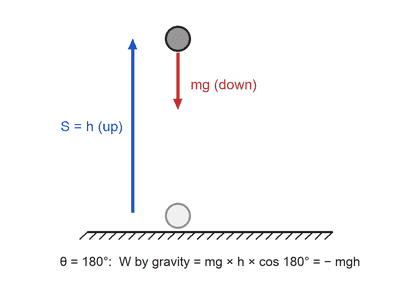
The force of gravity on the ball is its weight mg, acting vertically downward.
Step 2 — Find the displacement and the angle.
The ball moves vertically upward through h, opposite to the weight, so θ = 180° and cos 180° = −1.
Step 3 — Work out the work done by gravity.
Put F = mg, S = h and θ = 180° into the formula for work.
Step 4 — Interpret the sign.
The minus sign means gravity opposes the motion. The thrower does +mgh of work AGAINST gravity, while gravity itself does −mgh.
Watch out: The question asks for the work done BY gravity, not the work done against it.
Why the other options are wrong:
- (A) : mgh is the work done AGAINST gravity (by the thrower), not the work done by gravity.
- (C) : mg is a force (the weight, in newton), not an amount of work.
- (D) : mgh² would have the unit N m², but work has the unit N m (joule).
Therefore, the work done by the force of gravity is −mgh, option (B).
- 51 mark
Question 5
A coolie A takes 1 minute to lift a load to the roof of a bus, whereas coolie B takes 2 minutes to lift the same load to the roof of the same bus. The work done by B is:
Solve with AIAnswer
- Correct
(A) equal to work done by A
(B) greater than work done by A
(C) less than work done by A
(D) none of the above
Answer: (A) equal to work done by A
Concept: To lift a body of mass m through a vertical height h, a force equal to its weight mg must act through h, so the work done against gravity is W = mgh. Only the vertical height counts, not the path or the time.
Step 1 — Compare the loads and heights.
Both coolies lift the SAME load (same weight mg) to the roof of the SAME bus (same height h).
Step 2 — Work out each one's work.
Work against gravity is weight × vertical height, which is the same for both.
Step 3 — See what the time changes.
The time taken changes only the POWER (P = W ÷ t). A takes 1 min and B takes 2 min, so A develops twice the power of B, but the work is the same.

Watch out: Do not confuse work with power: being slower means less power, not less work.
Why the other options are wrong:
- (B) greater than work done by A: B takes longer, but taking longer does not mean doing more work; the work depends only on the load and the height.
- (C) less than work done by A: B is slower, which means B develops less POWER; his work is still mgh, the same as A's.
- (D) none of the above: option (A) is correct, so 'none of the above' cannot be.
Therefore, the work done by B is equal to the work done by A, option (A).
- 61 mark
Question 6
One horse power is equal to :
Solve with AIAnswer
(A) 1000 W
(B) 500 W
(C) 764 W
- Correct
(D) 746 W
Answer: (D) 746 W
Concept: Power is the rate of doing work, P = W ÷ t; its S.I. unit is the watt (1 W = 1 J s⁻¹), and 1 kW = 1000 W, while 1 H.P. = 746 W.
Step 1 — Recall what horse power measures.
Horse power (H.P.) is a practical unit of power, used to rate engines and motors.
Step 2 — Recall its value in watt.
Its value in the S.I. unit of power is fixed.
This is also 0·746 kW.
Watch out: 764 and 746 look alike; the correct value is seven-four-six.
Why the other options are wrong:
- (A) 1000 W: 1000 W is 1 kilowatt, not 1 horse power; 1 kW is about 1·34 H.P.
- (B) 500 W: 500 W is about two-thirds of 1 H.P.; it is not the value of the unit.
- (C) 764 W: 764 W swaps the last two digits of 746, a common slip.
Therefore, one horse power is equal to 746 W, option (D).
- 71 mark
Question 7
1 Joule is equivalent to ........... erg.
Solve with AIAnswer
(A)
- Correct
(B)
(C)
(D) 1
Answer: (B)
Concept: The joule is the S.I. unit of work and the erg is the C.G.S. unit. 1 J = 1 N × 1 m and 1 erg = 1 dyne × 1 cm, with 1 N = 10⁵ dyne and 1 m = 10² cm.
Step 1 — Write the joule in newton and metre.
By definition, 1 joule is the work done when a force of 1 N moves a body through 1 m.
Step 2 — Change both into C.G.S. units.
Replace 1 N by 10⁵ dyne and 1 m by 10² cm, then multiply the powers of ten.
Step 3 — Change dyne cm into erg.
1 dyne cm is 1 erg, so 1 J is 10⁷ erg.
Watch out: Convert BOTH factors; changing only the newton gives 10⁵, which is wrong.
Why the other options are wrong:
- (A) : 10⁵ is the number of dynes in 1 newton; it leaves out the factor 10² for metre to centimetre.
- (C) : 10⁹ would need 1 N = 10⁷ dyne or 1 m = 10⁴ cm; the true factors 10⁵ and 10² multiply to 10⁷.
- (D) 1: 1 would make the joule and the erg equal, but the erg is ten million times smaller.
Therefore, 1 joule is equivalent to 10⁷ erg, option (B).
- 81 mark
Question 8
The energy of electron is 2.5 eV. When expressed in Joule, it is :
Solve with AIAnswer
(A) J
- Correct
(B) J
(C) J
(D) 0
Answer: (B) J
Concept: The electron volt (eV) is a very small unit of energy used for electrons and atoms: 1 eV = 1·6 × 10⁻¹⁹ J.
Step 1 — Set up the conversion.
To change eV into joule, multiply the number of eV by the value of 1 eV in joule.
Step 2 — Multiply the numbers.
2·5 × 1·6 is 4·0, and the power of ten stays the same.
Watch out: Multiply (not divide) by 1·6 × 10⁻¹⁹ when going from eV to joule.
Why the other options are wrong:
- (A) J: 1·6 × 10⁻¹⁹ J is the energy of only 1 eV.
- (C) J: 3·2 × 10⁻¹⁹ J is the energy of 2 eV (2 × 1·6 = 3·2), not 2·5 eV.
- (D) 0: the electron has 2·5 eV of energy, so its energy is not zero.
Therefore, the energy of the electron is 4·0 × 10⁻¹⁹ J, option (B).
- 91 mark
Question 9
A block of mass 20 kg is pulled up a slope as shown in the figure given below with a constant speed by applying a force of 200 N parallel to the slope from the initial position A to the final position B. Work done in moving the block from A to B is :
 Solve with AI
Answer
- Correct
(A) 600 J
(B) 500 J
(C) 60 J
(D) 200 J
Answer: (A) 600 J
Concept: Work is done when a force moves a body. If a force F displaces a body through a distance S, and θ is the angle between the force and the displacement, the work done is W = FS cos θ. Work is a scalar, and its S.I. unit is the joule (1 J = 1 N × 1 m).
Step 1 — Find the angle between force and displacement.
The 200 N force acts along the slope, and the block moves along the slope from A to B. So θ = 0° and cos θ = 1.
Step 2 — Read the displacement from the figure.
The block moves the length of the slope, AB = 3 m.
Step 3 — Work out the work.
Multiply the force by the displacement along it.

Step 4 — See why the height is not used.
The height BC (1·5 m) would be needed only for the work done against gravity. Taking g = 10 m s⁻², that part is
Since the block moves at constant speed, the other 300 J of the force's work is spent against friction.
Watch out: Use the distance moved ALONG the force (3 m), not the vertical height (1·5 m).
Why the other options are wrong:
- (B) 500 J: no correct use of the data gives 500 J: F × AB is 600 J, and even the gain in potential energy is only 300 J.
- (C) 60 J: 60 J multiplies the mass 20 kg by 3 m, using a mass in place of a force in newton.
- (D) 200 J: 200 J is the work over only 1 m of the slope, not the full 3 m.
Therefore, the work done in moving the block from A to B is 600 J, option (A).
- 101 mark
Question 10
Assertion (A) : When the displacement is normal to the direction of force, the work done is zero.
Reason (R) : Work done depends on the angle between force and displacement.
Solve with AIAnswer
- Correct
(A) both A and R are true and R is the correct explanation of A
(B) both A and R are True and R is not the correct explanation of A
(C) assertion is false but reason is true
(D) assertion is true but reason is false
Answer: (A) both A and R are true and R is the correct explanation of A
Concept: In an assertion–reason item, judge the assertion (A) and the reason (R) separately as true or false, and then decide whether R correctly explains A. Here the rule needed is W = FS cos θ.
Step 1 — Judge the assertion.
If the displacement is normal (at 90°) to the force, cos 90° = 0, so W = 0. The assertion is true.
Step 2 — Judge the reason.
Since W = FS cos θ, the work changes with θ: it is largest at 0°, zero at 90° and negative at 180°. The reason is true.
Step 3 — Decide whether R explains A.
The assertion is just the case θ = 90° of the rule stated in the reason. So the reason correctly explains the assertion.
Why the other options are wrong:
- (B) both A and R are True and R is not the correct explanation of A: R does explain A: the zero work follows directly from the dependence of W on the angle (cos 90° = 0).
- (C) assertion is false but reason is true: the assertion is true, not false.
- (D) assertion is true but reason is false: the reason is true, not false.
Therefore, both A and R are true and R is the correct explanation of A, option (A).
- 112 marks
Question 11
A force acts on a body and displaces it by a distance in a direction at an angle with the direction of force. (a) Write the expression for the work done by the force. (b) What should be the angle between the force and displacement so that the work done is (i) zero, (ii) maximum ?
Solve with AIWritten solution
Solution:
Concept: Work is done when a force moves a body. If a force F displaces a body through a distance S, and θ is the angle between the force and the displacement, the work done is W = FS cos θ. Work is a scalar, and its S.I. unit is the joule (1 J = 1 N × 1 m).
(a)
Step 1 — Write the expression for work.
Only the part of the force along the displacement, F cos θ, does work, so the work is that part multiplied by the displacement.
(b)(i)
Step 2 — Find the angle for zero work.
W is zero when cos θ = 0, that is when θ = 90°: the force is perpendicular to the displacement (for example, gravity on a coolie walking on a level road).
(b)(ii)
Step 3 — Find the angle for maximum work.
W is largest when cos θ = 1, that is when θ = 0°: the body moves in the direction of the force, and then W = FS.
Watch out: Zero work comes at 90°, not at 0°; at 0° the work is the greatest.
Therefore, (a) W = FS cos θ; (b) (i) θ = 90° for zero work, (ii) θ = 0° for maximum work.
- 121 mark
Question 12
A body is moved in a direction opposite to the direction of force acting on it. State whether the work is done by the force or work is done against the force.
Solve with AIWritten solution
Solution:
Concept: Since W = FS cos θ, the sign of the work depends on θ: W is positive for θ < 90° (the force helps the motion), zero for θ = 90°, and negative for θ > 90° (the force opposes the motion).
Step 1 — Find the angle.
The body moves opposite to the force, so the angle between the force and the displacement is 180°, and cos 180° = −1.
Step 2 — Find the work done by the force.
Put θ = 180° into the formula for work.
Step 3 — Interpret the minus sign.
Negative work by the force means the force does not move the body; instead some other agent moves the body against the force and does work FS against it. For example, when a ball is lifted, it moves up while gravity acts down, so work is done against gravity.
Watch out: 'work done by a force' is negative here; the positive work is done AGAINST the force by another agent.
Therefore, the work is done against the force (the work done by the force itself is negative).
- 132 marks
Question 13
State whether work is done or not, by writing yes or no, in the following cases :
(a) A man pushes a wall.
(b) A coolie stands with a box on his head for 15 min.
(c) A boy climbs up 20 stairs.
Solve with AIWritten solution
Solution:
Concept: Work is done only when a force displaces a body and the displacement has a part along the force (W = FS cos θ with S ≠ 0 and θ ≠ 90°).
(a)
Step 1 — A man pushes a wall.
The wall does not move, so the displacement is zero and the work, F × 0, is zero. The man gets tired, but he does no work on the wall. Answer: No.
(b)
Step 2 — A coolie stands with a box on his head.
The box stays at the same place, so it is not displaced. Holding a load still needs effort but does no work. Answer: No.
(c)
Step 3 — A boy climbs up 20 stairs.
The boy raises his own body through a vertical height h against gravity, so he does work mgh. Answer: Yes.

Watch out: Feeling tired is not a test of work; check whether the body is displaced.
Therefore, (a) No, (b) No, (c) Yes.
- 141 mark
Question 14
Give an example when work done by the force of gravity acting on a body is zero even though the body gets displaced from its initial position.
Solve with AIWritten solution
Solution:
Concept: Gravity does no work on a body when the body's displacement is perpendicular to the force of gravity (θ = 90°, cos 90° = 0).
Step 1 — Choose a motion at right angles to gravity.
Gravity acts vertically downward, so any horizontal displacement is at 90° to it.
Step 2 — Give the example.
A coolie walks on a level (horizontal) platform with a load on his head. The load moves horizontally while its weight mg acts vertically downward, so θ = 90°.

Step 3 — Give a second example.
A satellite moving in a circular orbit round the earth: gravity acts towards the earth's centre, at 90° to the satellite's motion along the orbit, so gravity does no work on it.
Watch out: The load IS displaced; the work is zero because the displacement is across the force, not along it.
Therefore, the work done by gravity is zero on a load carried by a coolie walking on a level platform (or on a satellite in a circular orbit).
- 152 marks
Question 15
A boy of mass climbs up the stairs of vertical height .
(a) What is the work done by the boy against the force of gravity ?
(b) What would have been the work done if he uses a lift in climbing the same vertical height ?
Solve with AIWritten solution
Solution:
Concept: To lift a body of mass m through a vertical height h, a force equal to its weight mg must act through h, so the work done against gravity is W = mgh. Only the vertical height counts, not the path or the time.
(a)
Step 1 — Work done by the boy on the stairs.
The boy's weight is mg and he rises through a vertical height h, so the work he does against gravity is weight × height.
(b)
Step 2 — Work done in the lift.
The weight (mg) and the vertical height (h) are the same, so the work against gravity is still mgh. Only the path and the agent change: in the lift, the motor of the lift does this work instead of the boy's muscles.

Watch out: Work against gravity does not depend on the path (stairs or lift), only on the vertical height.
Therefore, (a) the work done is mgh, and (b) it is again mgh when he uses a lift.
- 161 mark
Question 16
What physical quantity does the electron volt (eV) measure ? How is it related to the S.I. unit of that quantity ?
Solve with AIWritten solution
Solution:
Concept: Energy is the capacity to do work. Its S.I. unit is the joule; other units are the erg (1 J = 10⁷ erg), the calorie (1 cal = 4.18 J), the electron volt (1 eV = 1.6 × 10⁻¹⁹ J) and the kilowatt hour (1 kWh = 3.6 × 10⁶ J).
Step 1 — Name the quantity.
The electron volt measures energy (or work).
Step 2 — Say what 1 eV means.
1 eV is the energy gained by an electron when it is accelerated through a potential difference of 1 volt. It is a very small unit, used for the energy of electrons and atoms.
Step 3 — Relate it to the joule.
The S.I. unit of energy is the joule, and
Watch out: The eV is a unit of energy, not of potential difference, even though its name contains 'volt'.
Therefore, the electron volt measures energy, and 1 eV = 1·6 × 10⁻¹⁹ J.
- 172 marks
Question 17
Complete the following sentences :
(a) 1 J = .......... calorie.
(b) 1 kWh = .......... J.
Solve with AIWritten solution
Solution:
Concept: Energy is the capacity to do work. Its S.I. unit is the joule; other units are the erg (1 J = 10⁷ erg), the calorie (1 cal = 4.18 J), the electron volt (1 eV = 1.6 × 10⁻¹⁹ J) and the kilowatt hour (1 kWh = 3.6 × 10⁶ J).
(a)
Step 1 — Change 1 J into calorie.
Since 1 calorie = 4·18 J, one joule is 1 ÷ 4·18 of a calorie.
(b)
Step 2 — Change 1 kWh into joule.
1 kWh is the energy used by a 1 kW (1000 W) agent in 1 hour (3600 s), and energy = power × time.
Watch out: 1 kWh is a unit of ENERGY (power × time), not of power.
Therefore, (a) 1 J = 0·24 calorie, and (b) 1 kWh = 3·6 × 10⁶ J.
- 181 mark
Question 18
Name the physical quantity which is measured in calorie. How is it related to the S.I. unit of that quantity ?
Solve with AIWritten solution
Solution:
Concept: Energy is the capacity to do work. Its S.I. unit is the joule; other units are the erg (1 J = 10⁷ erg), the calorie (1 cal = 4.18 J), the electron volt (1 eV = 1.6 × 10⁻¹⁹ J) and the kilowatt hour (1 kWh = 3.6 × 10⁶ J).
Step 1 — Name the quantity.
The calorie measures heat energy.
Step 2 — Say what 1 calorie means.
1 calorie is the heat energy needed to raise the temperature of 1 g of water by 1 °C.
Step 3 — Relate it to the joule.
The S.I. unit of energy is the joule, and
Therefore, the calorie measures heat energy, and 1 calorie = 4·18 J.
- 192 marks
Question 19
(a) Name the physical quantity measured in terms of horse power.
(b) How is horse power related to the S.I. unit of power ?
Solve with AIWritten solution
Solution:
Concept: Power is the rate of doing work, P = W ÷ t; its S.I. unit is the watt (1 W = 1 J s⁻¹), and 1 kW = 1000 W, while 1 H.P. = 746 W.
(a)
Step 1 — Name the quantity.
Horse power measures power, the rate of doing work. It is used to rate engines and motors.
(b)
Step 2 — Relate it to the watt.
The S.I. unit of power is the watt (W), and
This is also 0·746 kW.
Watch out: The value is 746 W, not 764 W.
Therefore, (a) horse power measures power, and (b) 1 H.P. = 746 W.
- 202 marks
Question 20
Name the quantity which is measured in
(a) kWh
(b) kW
(c) Wh
(d) eV.
Solve with AIWritten solution
Solution:
Concept: A unit of power multiplied by a unit of time is a unit of energy. So kW is a unit of power, while kWh and Wh are units of energy.
(a)
Step 1 — kWh.
kilowatt × hour is power × time, so the kWh measures energy. It is the commercial unit of electrical energy (1 kWh = 3·6 × 10⁶ J).
(b)
Step 2 — kW.
The kilowatt measures power (1 kW = 1000 W).
(c)
Step 3 — Wh.
watt × hour is again power × time, so the Wh measures energy (1 Wh = 3600 J).
(d)
Step 4 — eV.
The electron volt measures energy (1 eV = 1·6 × 10⁻¹⁹ J).
Watch out: kW and kWh look alike, but kW is power and kWh is energy.
Therefore, (a) energy, (b) power, (c) energy, (d) energy.
- 211 mark
Question 21
Is it possible that no transfer of energy takes place even when a force is applied to a body ?
Solve with AIWritten solution
Solution:
Concept: Energy is transferred to a body only when work is done on it, and the work, FS cos θ, is zero when S = 0 or when θ = 90°.
Step 1 — Answer the question.
Yes, a force can act on a body without any transfer of energy.
Step 2 — First case: force perpendicular to the motion.
If the force is normal to the displacement (θ = 90°), no work is done. Example: the centripetal force on a body moving in a circle.
Step 3 — Second case: no displacement.
If the body does not move at all (S = 0), no work is done. Example: pushing a rigid wall.
Step 4 — Conclude.
In both cases no work is done, so no energy is transferred.
Therefore, yes: no energy is transferred when the force is perpendicular to the displacement or the body does not move.
- 222 marks
Question 22
Define work. When is work said to be done by a force ?
Solve with AIWritten solution
Solution:
Concept: Work is done when a force moves a body. If a force F displaces a body through a distance S, and θ is the angle between the force and the displacement, the work done is W = FS cos θ. Work is a scalar, and its S.I. unit is the joule (1 J = 1 N × 1 m).
Step 1 — Define work.
Work is said to be done when a force applied on a body displaces it. It is measured by the product of the force and the displacement of the body in the direction of the force.
Step 2 — State when a force does work.
A force does work only when BOTH conditions hold: (1) the force displaces the body (S ≠ 0), and (2) the displacement has a part along the force (θ ≠ 90°).
Step 3 — Give examples.
A horse pulling a cart along a road does work; a man pushing a fixed wall does not.
Watch out: A force that does not move the body, or moves it only at right angles to itself, does no work.
Therefore, work = force × displacement in the direction of the force, and it is done only when the force displaces the body with a part of the displacement along the force.
- 232 marks
Question 23
How is the work done by a force measured when (i) force is in the direction of displacement, (ii) force is at an angle to the direction of displacement ?
Solve with AIWritten solution
Solution:
Concept: Work is done when a force moves a body. If a force F displaces a body through a distance S, and θ is the angle between the force and the displacement, the work done is W = FS cos θ. Work is a scalar, and its S.I. unit is the joule (1 J = 1 N × 1 m).
(i)
Step 1 — Force along the displacement.
Here θ = 0° and cos 0° = 1, so the whole force acts along the motion and work = force × displacement.
(ii)
Step 2 — Force at an angle θ.
Only the component of the force along the displacement, F cos θ, does work. The other component, F sin θ, is at right angles to the motion and does no work.
Step 3 — Say it the other way round.
Equivalently, the work is the force multiplied by the component of the displacement along the force, S cos θ.
Watch out: Use the component of the force ALONG the motion (F cos θ), not F sin θ.
Therefore, (i) W = F × S, and (ii) W = FS cos θ.
- 242 marks
Question 24
A body is acted upon by a force. State two conditions when the work done is zero.
Solve with AIWritten solution
Solution:
Concept: Since W = FS cos θ, the work is zero if either S = 0 or cos θ is zero (θ = 90°).
Step 1 — First condition: no displacement.
If the body does not move (S = 0), the work is zero. Example: a man pushing a fixed wall; the wall does not move.
Step 2 — Second condition: displacement normal to the force.
If the displacement is at 90° to the force, cos 90° = 0 and the work is zero. Example: the weight of a load carried by a coolie walking on a level road.

Therefore, the work done is zero when (1) the body is not displaced, or (2) the displacement is perpendicular to the force.
- 252 marks
Question 25
When a body moves in a circular path, how much work is done by the body ? Give reason.
(Hint : The body is acted upon by the centripetal force)
Solve with AIWritten solution
Solution:
Concept: The centripetal force keeps a body on its circular path and always acts along the radius, towards the centre. Work, FS cos θ, is zero when θ is 90°.
Step 1 — Find the direction of the force.
The centripetal force acts along the radius, towards the centre.
Step 2 — Find the direction of the motion.
At every instant the body moves along the tangent to the circle.
Step 3 — Find the angle and the work.
A tangent is always perpendicular to the radius, so the force is at 90° to the displacement at every point.
Step 4 — Say what it means.
Since no work is done, this force does not change the body's speed or kinetic energy; it only changes the direction of motion.
Watch out: A force can act all the time and still do no work, if it is always at right angles to the motion.
Therefore, the work done by the centripetal force on a body moving in a circular path is zero.
- 262 marks
Question 26
A satellite revolves around the earth in a circular orbit. What is the work done by the force of gravity on the satellite ? Give reason.
Solve with AIWritten solution
Solution:
Concept: The earth's gravity on a satellite provides the centripetal force: it acts along the radius of the orbit, towards the centre of the earth. Work, FS cos θ, is zero when θ is 90°.
Step 1 — Direction of the force.
The earth's gravitational pull on the satellite acts towards the centre of the earth, along the radius of the orbit.
Step 2 — Direction of the displacement.
At every instant the satellite moves along the tangent to its circular orbit.
Step 3 — Work out the work.
A tangent is perpendicular to the radius, so θ = 90° at every point.

Step 4 — Say what it means.
No energy is given to or taken from the satellite by gravity, which is why it keeps moving round the earth with the same speed.
Therefore, the work done by the force of gravity on a satellite in a circular orbit is zero, because the force is always perpendicular to the displacement.
- 272 marks
Question 27
A coolie X carrying a load on his head climbs up a slope and another coolie Y carrying the identical load on his head moves the same distance on a frictionless horizontal platform. Who does more work ? Explain the reason.
Solve with AIWritten solution
Solution:
Concept: To lift a body of mass m through a vertical height h, a force equal to its weight mg must act through h, so the work done against gravity is W = mgh. Only the vertical height counts, not the path or the time. A horizontal displacement is perpendicular to the weight, so it needs no work against gravity.
Step 1 — Coolie X.
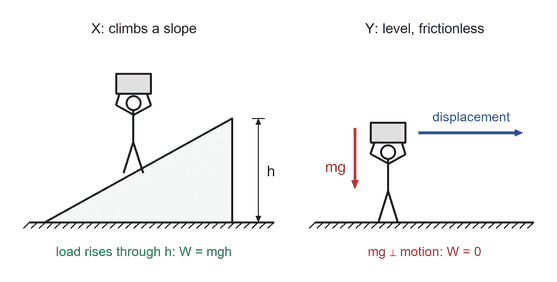
He climbs a slope, so the load is raised through a vertical height h. He does work mgh against gravity.
Step 2 — Coolie Y.
He moves horizontally, so the load's displacement is at 90° to its weight and no work is done against gravity. The platform is frictionless, so no work is done against friction either. So Y does (ideally) zero work on the load.
Step 3 — Compare.
mgh is more than zero, so X does more work.
Watch out: Both coolies move the same distance, but only X raises the load.
Therefore, coolie X does more work, because he raises the load through a height h (work mgh), while Y does no work against gravity.
- 282 marks
Question 28
The work done by a fielder when he takes a catch in a cricket match is negative. Explain.
Solve with AIWritten solution
Solution:
Concept: Since W = FS cos θ, the sign of the work depends on θ: W is positive for θ < 90° (the force helps the motion), zero for θ = 90°, and negative for θ > 90° (the force opposes the motion).
Step 1 — Direction of the fielder's force.
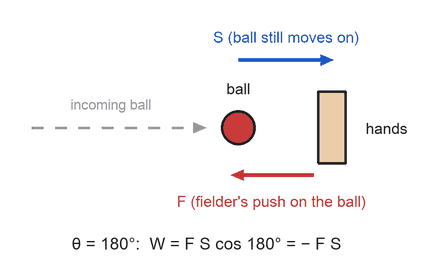
To stop the ball, the fielder pulls his hands back and applies a force on the ball opposite to its motion.
Step 2 — Direction of the ball's displacement.
While it is being stopped, the ball still moves a short distance forward, in its own direction of motion.
Step 3 — Find the work.
The force and the displacement are opposite, so θ = 180°.
Step 4 — Interpret it.
The negative work takes away the ball's kinetic energy and brings it to rest.
Therefore, the work done by the fielder is negative, because his force on the ball is opposite to the ball's displacement (θ = 180°).
- 293 marks
Question 29
What are the S.I. and C.G.S units of work ? How are they related ? Establish the relationship.
Solve with AIWritten solution
Solution:
Concept: The S.I. unit of work is the joule (1 J = 1 N × 1 m) and the C.G.S. unit is the erg (1 erg = 1 dyne × 1 cm), with 1 N = 10⁵ dyne and 1 m = 10² cm.
Step 1 — Name the units.
S.I. unit: joule (J). C.G.S. unit: erg.
Step 2 — Start from the definition of the joule.
1 joule is the work done when a force of 1 N moves a body through 1 m along the force.
Step 3 — Change both factors into C.G.S. units.
Replace 1 N by 10⁵ dyne and 1 m by 10² cm.
Step 4 — Change dyne cm into erg.
1 dyne cm is 1 erg (the work done when a force of 1 dyne moves a body 1 cm along it).
Watch out: Convert both the force and the distance; converting only one gives a wrong power of ten.
Therefore, the S.I. unit is the joule, the C.G.S. unit is the erg, and 1 J = 10⁷ erg.
- 302 marks
Question 30
State and define the S.I. unit of work.
Solve with AIWritten solution
Solution:
Concept: Work is done when a force moves a body. If a force F displaces a body through a distance S, and θ is the angle between the force and the displacement, the work done is W = FS cos θ. Work is a scalar, and its S.I. unit is the joule (1 J = 1 N × 1 m).
Step 1 — Name the unit.
The S.I. unit of work is the joule (J).
Step 2 — Define it.
1 joule of work is done when a force of 1 newton displaces a body through 1 metre in the direction of the force.
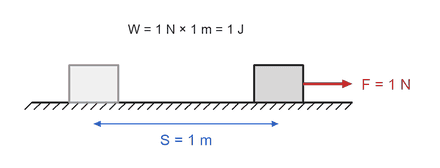
Therefore, the S.I. unit of work is the joule: 1 J is the work done when a 1 N force moves a body 1 m along the force.
- 312 marks
Question 31
Express joule in terms of erg.
Solve with AIWritten solution
Solution:
Concept: 1 J = 1 N × 1 m and 1 erg = 1 dyne × 1 cm, with 1 N = 10⁵ dyne and 1 m = 10² cm.
Step 1 — Write the joule in newton and metre.
By definition, a joule is a newton metre.
Step 2 — Change both into C.G.S. units.
Replace 1 N by 10⁵ dyne and 1 m by 10² cm, then multiply.
Step 3 — Write it in erg.
Since 1 dyne cm = 1 erg, the joule is 10⁷ erg.
Therefore, 1 joule = 10⁷ erg.
- 322 marks
Question 32
Define the term energy and state its S.I. unit.
Solve with AIWritten solution
Solution:
Concept: A body that can do work has energy; the amount of energy is the amount of work it can do.
Step 1 — Define energy.
The energy of a body is its capacity to do work. It is measured by the amount of work the body can do.
Step 2 — State its S.I. unit.
The S.I. unit of energy is the joule (J), the same as that of work. A body has 1 J of energy if it can do 1 J of work.
Step 3 — Give an example.
A stretched bow has energy, because it can do work on the arrow and throw it forward.
Therefore, energy is the capacity to do work, and its S.I. unit is the joule (J).
- 332 marks
Question 33
Define kilowatt hour. How is it related to joule ?
Solve with AIWritten solution
Solution:
Concept: Energy = power × time. A unit of power multiplied by a unit of time is a unit of energy.
Step 1 — Define the kilowatt hour.
1 kWh is the energy consumed (or work done) by an agent of power 1 kilowatt in 1 hour. It is the commercial unit of electrical energy; the 'units' on an electricity bill are kWh.
Step 2 — Relate it to the joule.
Use 1 kW = 1000 W and 1 h = 3600 s.
Watch out: The kWh is a unit of energy, not power.
Therefore, 1 kWh is the energy used by a 1 kW agent in 1 hour, and 1 kWh = 3·6 × 10⁶ J.
- 342 marks
Question 34
Define the term power. State its S.I. unit.
Solve with AIWritten solution
Solution:
Concept: Power tells how FAST work is done, while work tells how MUCH is done.
Step 1 — Define power.
The rate of doing work (or the rate of transfer of energy) is called power.
Step 2 — State its S.I. unit.
The S.I. unit of power is the watt (W), where 1 W = 1 J s⁻¹.
Step 3 — Give an example.
A machine that does 500 J of work in 10 s has a power of 500 ÷ 10, that is 50 W.
Therefore, power is the rate of doing work (P = W ÷ t), and its S.I. unit is the watt (W).
- 353 marks
Question 35
Differentiate between work and power.
Solve with AIWritten solution
Solution:
Concept: Work tells how much is done; power tells how fast it is done (P = W ÷ t).
Step 1 — Compare the two quantities.
The table sets out the differences.
Work Power Work is done when a force displaces a body; it is F × S cos θ. Power is the rate of doing work, W ÷ t. It does not depend on the time taken. It depends on the time in which the work is done. S.I. unit: joule (J). S.I. unit: watt (W). Step 2 — Give an example.
Two coolies lifting the same load to the same height do equal work, but the faster one develops more power.
Therefore, work is the amount of energy transferred (in joule), while power is the rate at which work is done (in watt).
- 363 marks
Question 36
Differentiate between energy and power.
Solve with AIWritten solution
Solution:
Concept: Energy is the store of ability to do work; power is the rate at which that store is used.
Step 1 — Compare the two quantities.
The table sets out the differences.
Energy Power Energy is the capacity to do work. Power is the rate of doing work (rate of using energy). It does not depend on time. It depends on the time taken to use the energy. S.I. unit: joule (J). S.I. unit: watt (W). Step 2 — Give an example.
A 100 W bulb uses 100 J of energy every second.
Therefore, energy is the capacity to do work (in joule), while power is the rate of doing work or using energy (in watt).
- 372 marks
Question 37
State and define the S.I. unit of power.
Solve with AIWritten solution
Solution:
Concept: Power is the rate of doing work, P = W ÷ t; its S.I. unit is the watt (1 W = 1 J s⁻¹), and 1 kW = 1000 W, while 1 H.P. = 746 W.
Step 1 — Name the unit.
The S.I. unit of power is the watt (W).
Step 2 — Define it.
1 watt is the power of an agent that does 1 joule of work in 1 second.
So 1 W = 1 J s⁻¹.
Step 3 — Give the bigger units.
1 kW = 1000 W and 1 MW = 10⁶ W.
Therefore, the S.I. unit of power is the watt: 1 W is the power of an agent doing 1 J of work in 1 s.
- 382 marks
Question 38
Differentiate between watt and watt hour.
Solve with AIWritten solution
Solution:
Concept: The watt is a unit of power; multiplying it by a time (an hour) gives a unit of energy.
Step 1 — Compare the two units.
The table sets out the differences.
Watt (W) Watt hour (Wh) It is the unit of power. It is the unit of energy. 1 W is 1 J s⁻¹. 1 Wh is 1 W × 3600 s, that is 3600 J. Step 2 — Give an example.
A 60 W bulb has a power of 60 W; switched on for 1 hour it uses 60 Wh of energy.
Therefore, the watt is a unit of power (1 W = 1 J s⁻¹), while the watt hour is a unit of energy (1 Wh = 3600 J).
- 394 marks
Question 39
State the condition when the work done by a force is (a) positive, (b) negative. Explain with the help of examples.
Solve with AIWritten solution
Solution:
Concept: Since W = FS cos θ, the sign of the work depends on θ: W is positive for θ < 90° (the force helps the motion), zero for θ = 90°, and negative for θ > 90° (the force opposes the motion).
(a)
Step 1 — Condition for positive work.
Work is positive when the displacement is in the direction of the force, or at an angle less than 90° to it (cos θ > 0). The force helps the motion.
Step 2 — Examples of positive work.
A body falling freely: gravity (down) and the displacement (down) are in the same direction, so gravity does positive work. A horse pulling a cart forward: the pull and the motion are in the same direction.
(b)
Step 3 — Condition for negative work.
Work is negative when the displacement is opposite to the force, or at an angle greater than 90° to it (cos θ < 0). The force opposes the motion.
Step 4 — Examples of negative work.
A ball thrown up: gravity acts down while the ball moves up, so gravity does negative work. Friction on a sliding body acts opposite to its motion, so friction does negative work. A fielder stopping a ball does negative work on it.

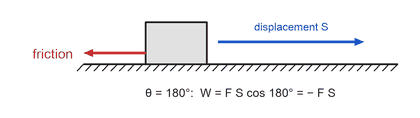
Watch out: The same force (gravity) does positive work on a falling ball and negative work on a rising one.
Therefore, work is positive when θ < 90° (e.g. gravity on a falling body), and negative when θ > 90° (e.g. gravity on a ball thrown up, or friction on a sliding body).
- 404 marks
Question 40
A body of mass falls down through a height . Obtain an expression for the work done by the force of gravity.
Solve with AIWritten solution
Solution:
Concept: Work is done when a force moves a body. If a force F displaces a body through a distance S, and θ is the angle between the force and the displacement, the work done is W = FS cos θ. Work is a scalar, and its S.I. unit is the joule (1 J = 1 N × 1 m).
Step 1 — The force.
The force of gravity on the body is its weight, acting vertically downward.
Step 2 — The displacement.
The body falls through a height h, so its displacement is S = h, also vertically downward.
Step 3 — The angle.
The force and the displacement are in the same direction, so θ = 0° and cos θ = 1.
Step 4 — The work done.
Put these into W = FS cos θ.
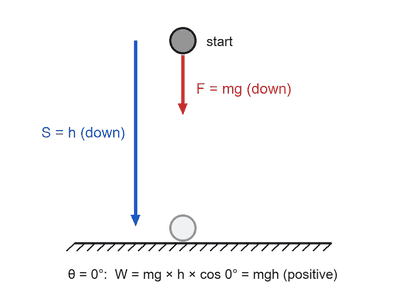
Step 5 — Interpret it.
The work is positive, and it appears as the kinetic energy gained by the falling body.
Therefore, the work done by gravity on a body of mass m falling through a height h is W = mgh (positive).
- 414 marks
Question 41
State two factors on which power spent by a source depends. Explain your answer with examples.
Solve with AIWritten solution
Solution:
Concept: Power is the rate of doing work, P = W ÷ t, so it depends on the work done and on the time taken.
Step 1 — First factor: the amount of work done.
For the same time, more work means more power (P ∝ W). Example: two boys of different weights run up the same staircase in the same time; the heavier boy does more work against gravity, so he develops more power.
Step 2 — Second factor: the time taken.
For the same work, less time means more power (P ∝ 1 ÷ t). Example: two coolies lift identical loads to the same bus roof, one in 1 minute and the other in 2 minutes. Both do the same work, but the one who takes 1 minute develops twice the power.
Therefore, the power spent depends on (1) the amount of work done and (2) the time taken to do it.
- 423 marks
Question 42
A body, when acted upon by a force of 20 kgf, gets displaced by 1 m. Calculate the work done by the force, when the displacement is (i) in the direction of force, (ii) at an angle of 60° with the force, and (iii) normal to the force. ( N kg)
Solve with AIWritten solution
Solution:
Concept: Work is done when a force moves a body. If a force F displaces a body through a distance S, and θ is the angle between the force and the displacement, the work done is W = FS cos θ. Work is a scalar, and its S.I. unit is the joule (1 J = 1 N × 1 m). A force of 1 kgf is the weight of 1 kg, that is 1 kg × g.
Given: F = 20 kgf, S = 1 m, g = 10 N kg⁻¹.
Step 1 — Change the force into newton.
With g = 10 N kg⁻¹, 1 kgf = 10 N.
(i)
Step 2 — Displacement along the force.
Here θ = 0° and cos 0° = 1.
(ii)
Step 3 — Displacement at 60° to the force.
Here θ = 60° and cos 60° = 0·5.
(iii)
Step 4 — Displacement normal to the force.
Here θ = 90° and cos 90° = 0.
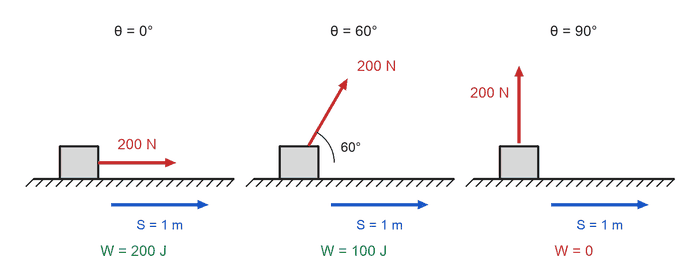
Step 5 — Notice the pattern.
As the angle grows from 0° to 90°, less of the force acts along the motion, so less work is done.
Watch out: Change kgf into newton before multiplying; 20 kgf × 1 m is not 20 J.
Therefore, the work done is (i) 200 J, (ii) 100 J and (iii) zero.
- 433 marks
Question 43
A boy of mass 40 kg climbs up the stairs and reaches the roof at a height 8 m in 5 s. Calculate :
(i) the force of gravity acting on the boy,
(ii) the work done by him against the force of gravity,
(iii) the power spent by the boy.
(Take m s)
Solve with AIWritten solution
Solution:
Concept: To lift a body of mass m through a vertical height h, a force equal to its weight mg must act through h, so the work done against gravity is W = mgh. Only the vertical height counts, not the path or the time. Power is the rate of doing work, P = W ÷ t; its S.I. unit is the watt (1 W = 1 J s⁻¹), and 1 kW = 1000 W, while 1 H.P. = 746 W.
Given: m = 40 kg, h = 8 m, t = 5 s, g = 10 m s⁻².
(i)
Step 1 — Force of gravity on the boy.
The force of gravity is the boy's weight, mass × g.
(ii)
Step 2 — Work done against gravity.
He lifts his weight through the height of the roof.
(iii)
Step 3 — Power spent.
Divide the work by the time.
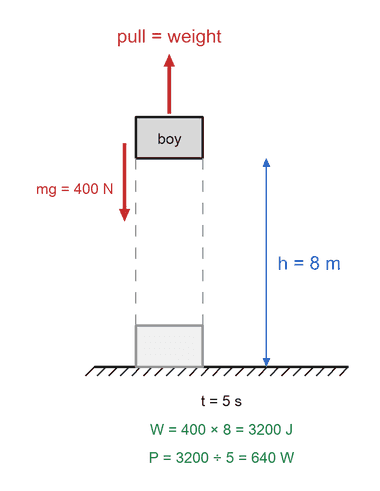
Therefore, (i) the force of gravity is 400 N, (ii) the work done is 3200 J, and (iii) the power spent is 640 W.
- 443 marks
Question 44
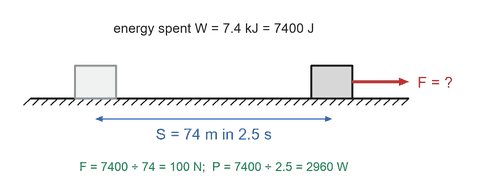
A man spends 7·4 kJ energy in displacing a body by 74 m in the direction in which he applies force, in 2·5 s. Calculate : (i) the force applied, and (ii) the power spent (in H.P.) by the man.
Solve with AIWritten solution
Solution:
Concept: The energy spent equals the work done, and here the force is along the displacement, so W = F × S. Power is the rate of doing work, P = W ÷ t; its S.I. unit is the watt (1 W = 1 J s⁻¹), and 1 kW = 1000 W, while 1 H.P. = 746 W.
Given: energy spent = 7·4 kJ, S = 74 m (along the force), t = 2·5 s.
Step 1 — Change the energy into joule.
7·4 kJ is 7·4 × 1000 J.
(i)
Step 2 — Find the force.
Since W = F × S, the force is the work divided by the displacement.
(ii)
Step 3 — Find the power in watt.
Divide the work by the time.
Step 4 — Change it into horse power.
Divide by 746, since 1 H.P. = 746 W.
Watch out: Change kJ into J first, and divide (not multiply) by 746 to get H.P.
Therefore, (i) the force applied is 100 N, and (ii) the power spent is about 3·97 H.P. (2960 W).
- 453 marks
Question 45
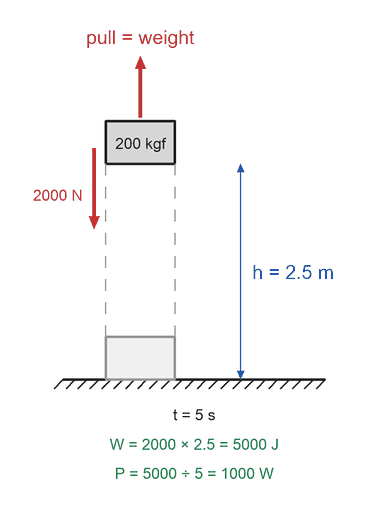
A weight lifter lifted a load of 200 kgf to a height of 2·5 m in 5 s. Calculate : (i) the work done, and (ii) the power developed by him. Take N kg.
Solve with AIWritten solution
Solution:
Concept: To lift a body of mass m through a vertical height h, a force equal to its weight mg must act through h, so the work done against gravity is W = mgh. Only the vertical height counts, not the path or the time. Power is the rate of doing work, P = W ÷ t; its S.I. unit is the watt (1 W = 1 J s⁻¹), and 1 kW = 1000 W, while 1 H.P. = 746 W.
Given: load = 200 kgf, h = 2·5 m, t = 5 s, g = 10 N kg⁻¹.
Step 1 — Change the load into newton.
With g = 10 N kg⁻¹, 1 kgf = 10 N.
(i)
Step 2 — Work done.
He lifts the load through 2·5 m.
(ii)
Step 3 — Power developed.
Divide the work by the time.
Watch out: Convert 200 kgf into 2000 N before working out the work.
Therefore, (i) the work done is 5000 J, and (ii) the power developed is 1000 W (1 kW).
- 463 marks
Question 46
A machine raises a load of 750 N through a height of 16 m in 5 s. Calculate :
(i) the energy spent by the machine,
(ii) the power of the machine if it is 100% efficient.
Solve with AIWritten solution
Solution:
Concept: The energy spent by the machine equals the work it does against gravity (load × height). At 100% efficiency all of its power goes into lifting. Power is the rate of doing work, P = W ÷ t; its S.I. unit is the watt (1 W = 1 J s⁻¹), and 1 kW = 1000 W, while 1 H.P. = 746 W.
Given: load = 750 N, h = 16 m, t = 5 s, efficiency 100%.
(i)
Step 1 — Energy spent.
The machine raises a 750 N load through 16 m.
(ii)
Step 2 — Power of the machine.
Divide the energy by the time.

Therefore, (i) the energy spent is 12 000 J (12 kJ), and (ii) the power of the machine is 2400 W (2·4 kW).
- 473 marks
Question 47
An electric heater of power 3 kW is used for 10 h. How much energy does it consume ? Express your answer in (i) kWh, (ii) joule.
Solve with AIWritten solution
Solution:
Concept: Energy consumed = power × time. Power in kW and time in hours give the energy directly in kWh, and 1 kWh = 3·6 × 10⁶ J.
Given: P = 3 kW, t = 10 h.
(i)
Step 1 — Energy in kWh.
Multiply the power in kW by the time in hours.
(ii)
Step 2 — Energy in joule.
Multiply by 3·6 × 10⁶ J for each kWh.
Watch out: Keep kW with hours (giving kWh); use W with seconds only when you want joule directly.
Therefore, the heater consumes (i) 30 kWh, which is (ii) 1·08 × 10⁸ J.
- 483 marks
Question 48
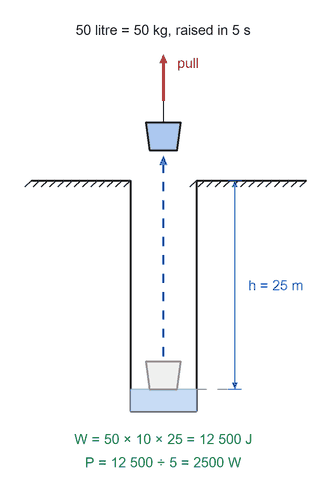
A water pump raises 50 litre of water through a height of 25 m in 5 s. Calculate the power of the pump used (assuming 100% efficiency).
(Take N kg and density of water kg m).
Solve with AIWritten solution
Solution:
Concept: First find the mass of water from its volume (mass = volume × density), then the work against gravity (mgh), then the power (W ÷ t).
Given: V = 50 litre, h = 25 m, t = 5 s, g = 10 N kg⁻¹, density of water = 1000 kg m⁻³.
Step 1 — Mass of water.
1 litre = 10⁻³ m³, so 50 litre = 0·05 m³; multiply by the density.
Step 2 — Work done.
The pump raises 50 kg of water through 25 m.
Step 3 — Power.
Divide the work by the time.
Watch out: Convert litres into m³ (or use 1 litre of water = 1 kg) before using the density in kg m⁻³.
Therefore, the power of the pump is 2500 W (2·5 kW).
- 494 marks
Question 49
A pump is used to lift 600 kg of water from a depth of 75 m in 10 s. Calculate :
(a) the work done by the pump,
(b) the power at which the pump works, and
(c) the power rating of the pump if its efficiency is 40%. (Take m s)
[Hint : Efficiency ]
Solve with AIWritten solution
Solution:
Concept: The work done in lifting the water is the useful work. Efficiency = useful power (output) ÷ power input. A machine that is less than 100% efficient must take in MORE power than it gives out usefully; the rest is wasted, mostly as heat.
Given: m = 600 kg, depth h = 75 m, t = 10 s, efficiency = 40%, g = 10 m s⁻².
(a)
Step 1 — Work done by the pump.
The pump lifts 600 kg of water through 75 m.
(b)
Step 2 — Power at which the pump works.
Divide the useful work by the time.
(c)
Step 3 — Power rating.
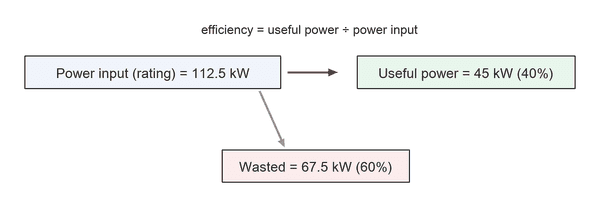
The power rating is the power input. Since efficiency = useful power ÷ power input, the power input is the useful power divided by the efficiency (40% = 0·40).
Step 4 — Check the waste.
Of the 112·5 kW taken in, only 45 kW lifts the water; the remaining 67·5 kW is wasted, mostly as heat.
Watch out: The rating must be LARGER than the useful power; dividing by 0·40, not multiplying, gives it.
Therefore, (a) the work done is 4·5 × 10⁵ J, (b) the pump works at 45 kW, and (c) its power rating is 112·5 kW.
- 503 marks
Question 50
An ox can apply a maximum force of 1000 N. It is taking part in a cart race and is able to pull the cart at a constant speed of 30 m s while making its best effort. Calculate the power developed by the ox.
Solve with AIWritten solution
Solution:
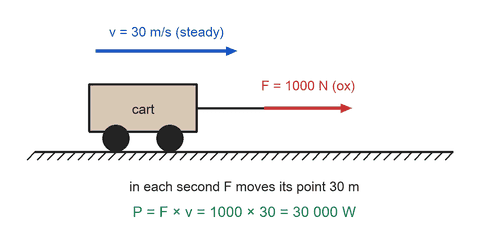
Concept: When a force F moves its point of application at a steady speed v in its own direction, the work done each second is F × v, so the power is P = F × v.
Given: F = 1000 N, v = 30 m s⁻¹ (constant).
Step 1 — Get the formula.
In time t the cart moves a distance S = v × t, so the work per second is
Step 2 — Substitute.
Put F = 1000 N and v = 30 m s⁻¹.
Watch out: Use P = F × v only when the force and the velocity are in the same direction and the speed is steady.
Note: 30 m s⁻¹ is the book's value; it is 108 km h⁻¹, far faster than a real ox, but the method is what the question tests.
Therefore, the power developed by the ox is 30 000 W (30 kW).
- 513 marks
Question 51
The power of a motor is 40 kW. At what speed can the motor raise a load of 20,000 N ?
Solve with AIWritten solution
Solution:
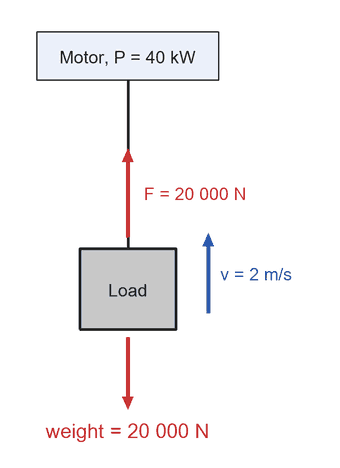
Concept: To raise a load at a steady speed, the motor pulls with a force equal to the load's weight. When a force F moves its point of application at a steady speed v in its own direction, the work done each second is F × v, so the power is P = F × v.
Given: P = 40 kW, load F = 20 000 N.
Step 1 — Change the power into watt.
40 kW is 40 × 1000 W.
Step 2 — Rearrange P = F × v.
Divide both sides by F to get the speed.
Step 3 — Substitute.
Put P = 40 000 W and F = 20 000 N.
Watch out: Change kW into W first, so that the speed comes out in m s⁻¹.
Therefore, the motor can raise the load at 2 m s⁻¹.
- 523 marks
Question 52
Rajan exerts a force of 150 N in pulling a cart at a constant speed of 10 m s. Calculate the power exerted.
Solve with AIWritten solution
Solution:
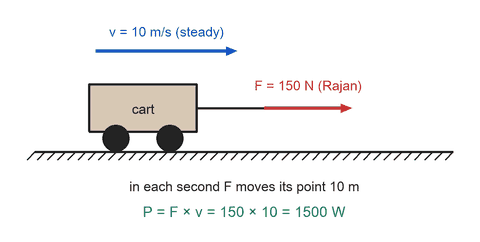
Concept: When a force F moves its point of application at a steady speed v in its own direction, the work done each second is F × v, so the power is P = F × v.
Given: F = 150 N, v = 10 m s⁻¹ (constant).
Step 1 — Choose the formula.
Rajan's force moves at a steady 10 m s⁻¹ along its own direction, so P = F × v.
Step 2 — Substitute.
Put F = 150 N and v = 10 m s⁻¹.
Step 3 — Interpret it.
He does 1500 J of work every second.
Therefore, the power exerted by Rajan is 1500 W (1·5 kW).
- 533 marks
Question 53
A boy weighing 350 N climbs up 30 steps, each 20 cm high in 1 minute. Calculate :
(i) the work done, and (ii) the power spent.
Solve with AIWritten solution
Solution:
Concept: To lift a body of mass m through a vertical height h, a force equal to its weight mg must act through h, so the work done against gravity is W = mgh. Only the vertical height counts, not the path or the time. Power is the rate of doing work, P = W ÷ t; its S.I. unit is the watt (1 W = 1 J s⁻¹), and 1 kW = 1000 W, while 1 H.P. = 746 W.
Given: weight = 350 N, 30 steps of 20 cm each, t = 1 min.
Step 1 — Height climbed.
There are 30 steps, each 20 cm high; change cm into m.
(i)
Step 2 — Work done.
Multiply his weight by the height.
(ii)
Step 3 — Power spent.
1 minute is 60 s; divide the work by the time.
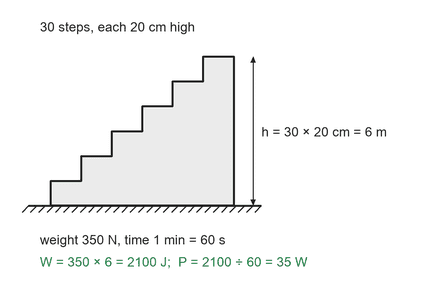
Watch out: Change 600 cm into 6 m and 1 minute into 60 s before calculating.
Therefore, (i) the work done is 2100 J, and (ii) the power spent is 35 W.
- 543 marks
Question 54
It takes 20 s for a person A of mass 50 kg to climb up the stairs, while another person B of same mass does the same in 15 s. Compare the (i) work done, and (ii) power developed by the persons A and B.
Solve with AIWritten solution
Solution:
Concept: To lift a body of mass m through a vertical height h, a force equal to its weight mg must act through h, so the work done against gravity is W = mgh. Only the vertical height counts, not the path or the time. For equal work, power is inversely proportional to the time (P = W ÷ t).
Given: m = 50 kg each, same stairs; t_A = 20 s, t_B = 15 s.
(i)
Step 1 — Compare the work.
A and B have the same mass and climb the same stairs (same h), so each does work mgh.
(ii)
Step 2 — Compare the power.
The work W is the same, so the ratio of powers is the inverse ratio of the times.
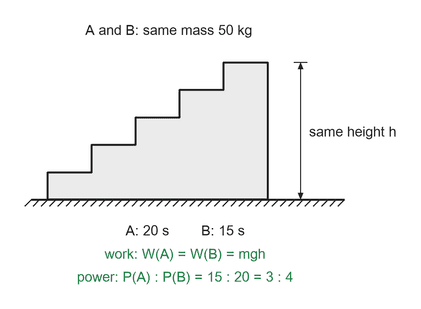
Watch out: The faster person (B, 15 s) has the LARGER power, so the times go in the ratio upside down.
Therefore, (i) the work done by A and B is in the ratio 1 : 1, and (ii) their powers are in the ratio 3 : 4.
- 554 marks
Question 55
A boy weighing 40 kgf climbs up a stair of 30 steps each 20 cm high in 4 minutes and a girl weighing 30 kgf does the same in 3 minutes. Compare :
(i) the work done by them, and
(ii) the power developed by them.
Solve with AIWritten solution
Solution:
Concept: To lift a body of mass m through a vertical height h, a force equal to its weight mg must act through h, so the work done against gravity is W = mgh. Only the vertical height counts, not the path or the time. Power is the rate of doing work, P = W ÷ t; its S.I. unit is the watt (1 W = 1 J s⁻¹), and 1 kW = 1000 W, while 1 H.P. = 746 W.
Given: boy 40 kgf in 4 min, girl 30 kgf in 3 min; 30 steps of 20 cm.
Step 1 — Height climbed.
Both climb 30 steps of 20 cm, that is 30 × 0·2 m.
(i)
Step 2 — Compare the work.
The height is the same for both, so the work is in the ratio of their weights.
(ii)
Step 3 — Find each power.
Take g = 10 N kg⁻¹, so 40 kgf = 400 N and 30 kgf = 300 N; the times are 4 min = 240 s and 3 min = 180 s.
Step 4 — Compare the powers.
The two powers are equal.
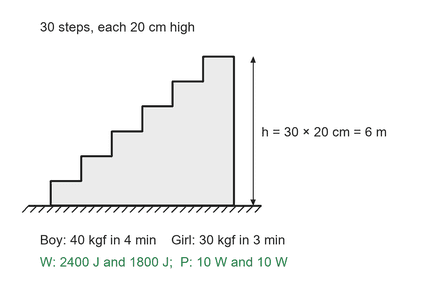
Watch out: The ratio does not depend on the value of g; any value cancels.
Therefore, (i) the work done by the boy and the girl is in the ratio 4 : 3, and (ii) their powers are in the ratio 1 : 1.
- 564 marks
Question 56
A man raises a box of mass 50 kg to a height of 2 m in 20 s, while another man raises the same box to the same height in 50 s.
(a) Compare : (i) the work done, and (ii) the power developed by them.
(b) Calculate : (i) the work done, and (ii) the power developed by each man. Take N kg.
Solve with AIWritten solution
Solution:
Concept: To lift a body of mass m through a vertical height h, a force equal to its weight mg must act through h, so the work done against gravity is W = mgh. Only the vertical height counts, not the path or the time. For equal work, power is inversely proportional to the time.
Given: m = 50 kg, h = 2 m, t₁ = 20 s, t₂ = 50 s, g = 10 N kg⁻¹.
(a)(i)
Step 1 — Compare the work.
Both men raise the same box through the same height, so they do the same work.
(a)(ii)
Step 2 — Compare the power.
For the same work, the power ratio is the inverse ratio of the times.
(b)(i)
Step 3 — Work done by each.
Use W = mgh, with m = 50 kg, g = 10 N kg⁻¹ and h = 2 m.
(b)(ii)
Step 4 — Power of each.
Divide the work by each man's time.
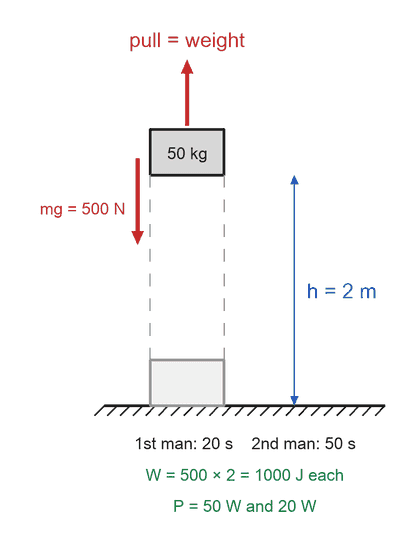
Check: The answers in (b) agree with (a): 50 W : 20 W is 5 : 2.
Therefore, (a) the work is in the ratio 1 : 1 and the power 5 : 2; (b) each man does 1000 J of work, and their powers are 50 W and 20 W.
- 574 marks
Question 57
A boy takes 3 minutes to lift a 20 litre water bucket from a 20 m deep well, while his father does it in 2 minutes. (a) Compare : (i) the work, and (ii) power developed by them. (b) How much work each does ? Take density of water kg m and N kg.
Solve with AIWritten solution
Solution:
Concept: To lift a body of mass m through a vertical height h, a force equal to its weight mg must act through h, so the work done against gravity is W = mgh. Only the vertical height counts, not the path or the time. For equal work, power is inversely proportional to the time.
Given: V = 20 litre, depth h = 20 m, boy 3 min, father 2 min, density of water = 10³ kg m⁻³, g = 9·8 N kg⁻¹.
(a)(i)
Step 1 — Compare the work.
Both lift the same bucket of water through the same depth, so the work is the same.
(a)(ii)
Step 2 — Compare the power.
For equal work, the power ratio is the inverse ratio of the times.
(b)
Step 3 — Mass of water.
20 litre = 0·02 m³; multiply by the density (the bucket's own mass is ignored, as in the book).
Step 4 — Work done by each.
Use W = mgh, with g = 9·8 N kg⁻¹ and h = 20 m.
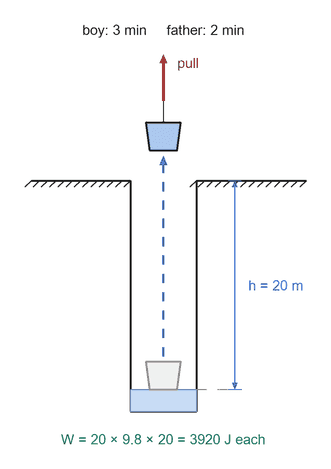
Watch out: This question gives g = 9·8 N kg⁻¹, not 10.
Therefore, (a) the work is in the ratio 1 : 1 and the power (boy : father) 2 : 3; (b) each does 3920 J of work.
- 581 mark
Question 58
The energy possessed by a body due to the force of attraction of earth on it is called its :
Solve with AIAnswer
(A) Rotational kinetic energy
(B) Kinetic energy
- Correct
(C) Gravitational potential energy
(D) Elastic potential energy
Answer: (C) Gravitational potential energy
Concept: Potential energy is the energy of a body due to its position or configuration (state). A body of mass m at a height h above the ground (where U is taken as zero) has gravitational potential energy U = mgh; a body whose shape or size has been changed (a compressed spring) has elastic potential energy.
Step 1 — See where the energy comes from.
The earth pulls every body downward. To raise a body of mass m through a height h, work mgh must be done against this pull.
Step 2 — See where the work is stored.
That work is stored in the body because of its position (its height). If the body is let go, the earth's pull makes it fall and it can do work again.
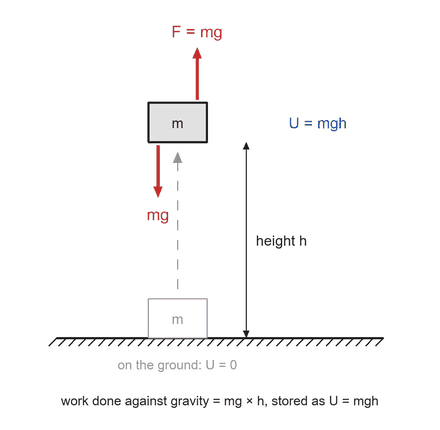
Step 3 — Name the energy.
Energy due to the earth's attraction on a body at a height is gravitational potential energy.
Why the other options are wrong:
- (A) Rotational kinetic energy: rotational kinetic energy is the energy of a body spinning about an axis, not of its position.
- (B) Kinetic energy: kinetic energy is the energy of motion; a body at rest at a height has none.
- (D) Elastic potential energy: elastic potential energy is due to a change in shape or size (a stretched spring), not to the earth's attraction.
Therefore, the energy due to the earth's attraction is gravitational potential energy, option (C).
- 591 mark
Question 59
The energy possessed by a body in the deformed state due to change in its size or shape is called :
Solve with AIAnswer
(A) Rotational kinetic energy
(B) Kinetic energy
(C) Gravitational potential energy
- Correct
(D) Elastic potential energy
Answer: (D) Elastic potential energy
Concept: Potential energy is the energy of a body due to its position or configuration (state). A body of mass m at a height h above the ground (where U is taken as zero) has gravitational potential energy U = mgh; a body whose shape or size has been changed (a compressed spring) has elastic potential energy.
Step 1 — See what is done to the body.
When the shape or size of an elastic body is changed (it is compressed, stretched, bent or twisted), work is done on it.
Step 2 — See where that work goes.
The work is stored in the deformed body, and the body gives it back when it regains its shape. Examples: a compressed or stretched spring, a bent bow, a wound watch spring.
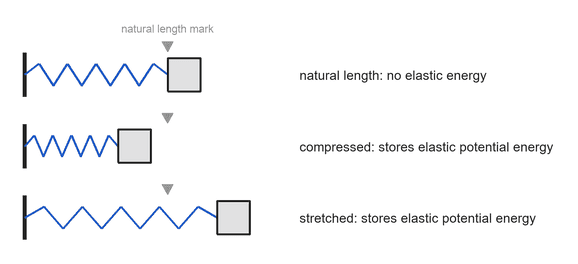
Step 3 — Name the energy.
The energy depends on the configuration (state) of the body, not on its motion or height, so it is elastic potential energy.
Why the other options are wrong:
- (A) Rotational kinetic energy: rotational kinetic energy belongs to a spinning body, not a deformed one.
- (B) Kinetic energy: kinetic energy belongs to a moving body; a compressed spring held at rest has none.
- (C) Gravitational potential energy: gravitational potential energy is due to height in the earth's field, not to a change in shape or size.
Therefore, the energy of a body in a deformed state is elastic potential energy, option (D).
- 601 mark
Question 60
According to work energy theorem, the increase in the kinetic energy of a moving body is equal to ................ by a force acting in the direction of the moving body.
Solve with AIAnswer
(A) displacement
(B) velocity
(C) acceleration
- Correct
(D) work done
Answer: (D) work done
Concept: Work–energy theorem: the work done by a force on a body equals the change in its kinetic energy, W = ½mv² − ½mu², where u and v are the initial and final speeds.
Step 1 — Set up the situation.
A force F acts along the motion of a body of mass m over a displacement S, and its speed rises from u to v.
Step 2 — Apply the theorem.
The work done by the force equals the gain in kinetic energy.
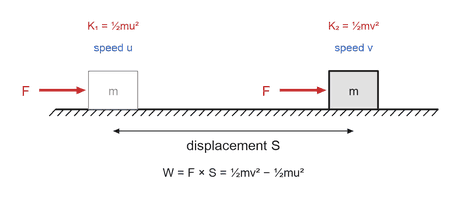
Step 3 — Fill the blank.
So the increase in kinetic energy is equal to the WORK DONE by the force.
Watch out: An increase in energy can only equal another energy-type quantity (in joule).
Why the other options are wrong:
- (A) displacement: displacement is a distance (unit m), not an energy (unit J).
- (B) velocity: velocity has the unit m s⁻¹, so it cannot equal an increase in energy.
- (C) acceleration: acceleration has the unit m s⁻², so it cannot equal an increase in energy either.
Therefore, the increase in kinetic energy equals the work done by the force, option (D).
- 611 mark
Question 61
A wire clamped at both the ends is struck in the middle. It will possess :
Solve with AIAnswer
(A) rotational kinetic energy
(B) translational kinetic energy
- Correct
(C) vibrational kinetic energy
(D) none of these
Answer: (C) vibrational kinetic energy
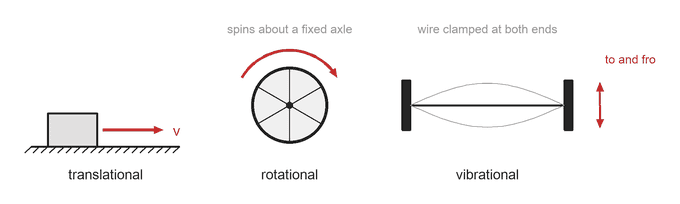
Concept: Kinetic energy has three forms: translational (the body moves from place to place), rotational (it spins about an axis) and vibrational (it moves to and fro about a mean position).
Step 1 — See what the clamps allow.
The wire is clamped at both ends, so as a whole it cannot move from one place to another, and it does not spin.
Step 2 — See how it moves when struck.
Struck in the middle, the wire moves to and fro about its rest position; that is, it vibrates.
Step 3 — Name the energy.
The energy of to-and-fro motion is vibrational kinetic energy.
Why the other options are wrong:
- (A) rotational kinetic energy: rotational kinetic energy needs the wire to spin about an axis, which it does not.
- (B) translational kinetic energy: translational kinetic energy needs the wire to move from one place to another; its ends are clamped.
- (D) none of these: the vibrating wire is moving, so it does have kinetic energy; 'none of these' is wrong.
Therefore, the struck wire possesses vibrational kinetic energy, option (C).
- 621 mark
Question 62
The wheel of a moving vehicle possesses :
Solve with AIAnswer
(A) rotational kinetic energy
(B) translational kinetic energy
(C) vibrational kinetic energy
- Correct
(D) both rotational and translational kinetic energy
Answer: (D) both rotational and translational kinetic energy
Concept: Kinetic energy has three forms: translational (the body moves from place to place), rotational (it spins about an axis) and vibrational (it moves to and fro about a mean position). A body can have more than one form at the same time.
Step 1 — Look at the spinning.
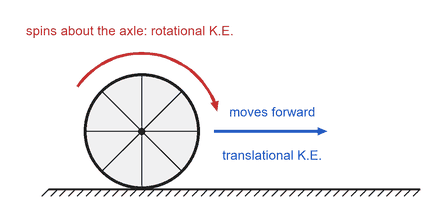
The wheel spins about its axle, so it has rotational kinetic energy.
Step 2 — Look at the forward motion.
At the same time the axle, and with it the whole wheel, moves forward along the road with the vehicle, so the wheel also has translational kinetic energy.
Why the other options are wrong:
- (A) rotational kinetic energy: rotational kinetic energy alone leaves out the forward motion of the wheel.
- (B) translational kinetic energy: translational kinetic energy alone leaves out the spinning of the wheel.
- (C) vibrational kinetic energy: the wheel does not move to and fro about a mean position, so it has no vibrational kinetic energy.
Therefore, the wheel of a moving vehicle has both rotational and translational kinetic energy, option (D).
- 631 mark
Question 63
The velocity of a moving cart is reduced to rd of the initial velocity. Its kinetic energy is reduced by :
Solve with AIAnswer
(A)
(B)
(C)
- Correct
(D)
Answer: (D)
Concept: Kinetic energy is the energy of a body due to its motion. A body of mass m moving with speed v has K = ½mv². For a fixed mass, K is proportional to v² (double the speed, four times the energy).
Step 1 — Write the initial kinetic energy.
Let the initial velocity be v.
Step 2 — Write the new kinetic energy.
The new velocity is v ÷ 3; square it, keeping the same mass.

Step 3 — Read off the change.
The kinetic energy becomes one-ninth of its initial value.
Watch out: K depends on v², so a factor of 1/3 in the speed becomes (1/3)² = 1/9 in the energy.
Note on wording: strictly, 'reduced to 1/9' is a reduction BY 8/9. The book's key, 1/9, reads the stem as 'reduced to'; that is the only option that fits, so the key is kept.
Why the other options are wrong:
- (A) : ½ does not come from squaring 1/3; K would be halved only if v were cut to about 0·71 of its value.
- (B) : 1/3 treats K as proportional to v, forgetting the square.
- (C) : 1/6 multiplies the ½ of ½mv² by 1/3 instead of squaring 1/3.
Therefore, the kinetic energy is reduced to 1/9 of its initial value, option (D).
- 641 mark
Question 64
A body of mass 10 kg is moving with a velocity of 20 m/s. The mass of the body is doubled and velocity is halved. Its initial kinetic energy is :
Solve with AIAnswer
(A) 200 J
(B) 4000 J
- Correct
(C) 2000 J
(D) 1000 J
Answer: (C) 2000 J
Concept: Kinetic energy is the energy of a body due to its motion. A body of mass m moving with speed v has K = ½mv². For a fixed mass, K is proportional to v² (double the speed, four times the energy). The question asks only for the INITIAL kinetic energy, so use the starting mass and velocity; the doubling and halving describe the later state.
Step 1 — Note the initial values.
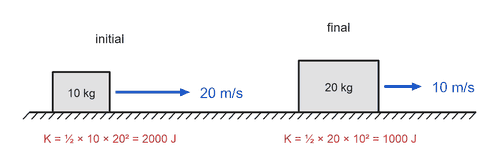
The initial mass is m = 10 kg and the initial velocity is v = 20 m s⁻¹.
Step 2 — Work out the kinetic energy.
Put these into K = ½mv².
Watch out: Read the stem carefully: it asks for the INITIAL kinetic energy, before the change.
Why the other options are wrong:
- (A) 200 J: 200 J is m × v (10 × 20), which leaves out both the ½ and the square.
- (B) 4000 J: 4000 J is m × v² (10 × 400), which leaves out the ½.
- (D) 1000 J: 1000 J is the FINAL kinetic energy, after the mass is doubled to 20 kg and the velocity halved to 10 m s⁻¹.
Therefore, the initial kinetic energy is 2000 J, option (C).
- 651 mark
Question 65
The kinetic energy K and momentum are related as :
Solve with AIAnswer
(A)
(B)
- Correct
(C)
(D)
Answer: (C)
Concept: Kinetic energy is K = ½mv² and momentum is p = mv. Removing v between the two gives the relation.
Step 1 — Express v in terms of p.
From p = mv, divide both sides by m.
Step 2 — Put this into the kinetic energy.
Replace v in K = ½mv² and simplify.
Step 3 — Write it the other way round.
Rearranging, the momentum is
Why the other options are wrong:
- (A) : it leaves out the mass m; the correct form is p = √(2mK).
- (B) : it has g (acceleration due to gravity) in place of m; g has nothing to do with this relation.
- (D) : K depends on the SQUARE of p, not on a square root of p.
Therefore, K and p are related as K = p² ÷ 2m, option (C).
- 661 mark
Question 66
On doubling the velocity of a moving body, the quantity which gets doubled is :
Solve with AIAnswer
(A) acceleration
- Correct
(B) momentum
(C) kinetic energy
(D) weight
Answer: (B) momentum
Concept: Momentum p = mv is proportional to v, while kinetic energy K = ½mv² is proportional to v².
Step 1 — Double v in the momentum.
When v becomes 2v, the momentum becomes m(2v), that is 2mv: it doubles.
Step 2 — Double v in the kinetic energy.
The kinetic energy becomes ½m(2v)², that is four times ½mv²: it does not just double.

Watch out: Kinetic energy goes up four times, not two times, when v is doubled.
Why the other options are wrong:
- (A) acceleration: acceleration depends on how fast the velocity CHANGES, not on its value, so doubling v does not double it.
- (C) kinetic energy: kinetic energy becomes four times (2² = 4), not two times.
- (D) weight: weight (mg) depends only on mass and g, not on velocity.
Therefore, on doubling the velocity, the momentum gets doubled, option (B).
- 671 mark
Question 67
In a photoelectric cell, the change in energy is from :
Solve with AIAnswer
(A) electrical to mechanical
- Correct
(B) light energy to electrical energy
(C) electrical energy to light energy
(D) chemical energy to light energy
Answer: (B) light energy to electrical energy
Concept: Energy can neither be created nor destroyed; it only changes from one form to another. To name an energy change, ask which form goes IN and which form comes OUT.
Step 1 — Find the input.
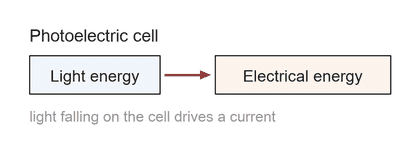
A photoelectric cell gives an electric current when light falls on it, so light is the input.
Step 2 — Find the output.
The output is an electric current, so the cell changes light energy into electrical energy. A solar cell works the same way.
Why the other options are wrong:
- (A) electrical to mechanical: electrical to mechanical is what an electric motor does.
- (C) electrical energy to light energy: electrical energy to light energy is the reverse change, as in an electric bulb.
- (D) chemical energy to light energy: chemical energy to light energy happens in a burning candle or a glowing firefly, not in a photocell.
Therefore, in a photoelectric cell light energy changes to electrical energy, option (B).
- 681 mark
Question 68
In a petrol vehicle while in motion, the change in energy is from :
Solve with AIAnswer
(A) kinetic energy to potential energy
- Correct
(B) chemical energy to kinetic energy
(C) potential energy to kinetic energy
(D) chemical energy to potential energy
Answer: (B) chemical energy to kinetic energy
Concept: Energy can neither be created nor destroyed; it only changes from one form to another. To name an energy change, ask which form goes IN and which form comes OUT. Fuels store chemical energy.
Step 1 — Find the input.
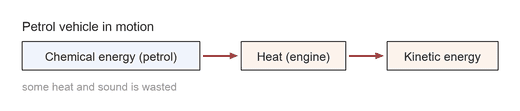
Petrol burns inside the engine, releasing its chemical energy as heat.
Step 2 — Find the output.
The engine changes this into the motion of the vehicle, that is, kinetic energy. Part of the energy is wasted as heat and sound.
Why the other options are wrong:
- (A) kinetic energy to potential energy: kinetic to potential energy happens when a moving body rises, such as a ball thrown up; it does not say where the vehicle's energy comes from.
- (C) potential energy to kinetic energy: potential to kinetic energy happens in a falling body; a vehicle on a level road is not falling.
- (D) chemical energy to potential energy: chemical to potential energy would need the vehicle to gain height; on a level road it gains speed, not height.
Therefore, in a moving petrol vehicle chemical energy changes to kinetic energy, option (B).
- 691 mark
Question 69
In nuclear fission :
Solve with AIAnswer
(A) chemical energy changes to electrical energy
(B) mechanical energy changes to chemical energy
- Correct
(C) nuclear energy changes to electrical energy
(D) electrical energy changes to nuclear energy
Answer: (C) nuclear energy changes to electrical energy
Concept: In nuclear fission a heavy nucleus such as uranium-235 splits into two lighter nuclei and releases a huge amount of nuclear energy. In a nuclear power plant this energy is used to produce electricity.
Step 1 — Follow the energy in the reactor.
The nuclear energy released by fission appears as heat in the reactor.
Step 2 — Follow it to the generator.
The heat turns water into steam, the steam turns a turbine (kinetic energy), and the turbine drives a generator, which gives electrical energy.

Step 3 — State the overall change.
So, overall, nuclear energy changes into electrical energy.
Why the other options are wrong:
- (A) chemical energy changes to electrical energy: chemical to electrical energy happens in an electric cell, not in fission.
- (B) mechanical energy changes to chemical energy: fission is a change inside the nucleus; it does not turn mechanical energy into chemical energy.
- (D) electrical energy changes to nuclear energy: electrical to nuclear energy is the reverse; fission releases nuclear energy, it does not store it.
Therefore, in nuclear fission (in a power plant) nuclear energy changes to electrical energy, option (C).
- 701 mark
Question 70
In an electrical cell while in use, the change in energy is from :
Solve with AIAnswer
(A) electrical to mechanical
(B) electrical to chemical
(C) chemical to mechanical
- Correct
(D) chemical to electrical
Answer: (D) chemical to electrical
Concept: A cell stores energy in the form of chemicals. While it is in use (discharging), chemical reactions inside it drive a current through the circuit.
Step 1 — Find the input.
The input is the chemical energy of the substances in the cell.
Step 2 — Find the output.
The output is an electric current in the circuit, that is, electrical energy.
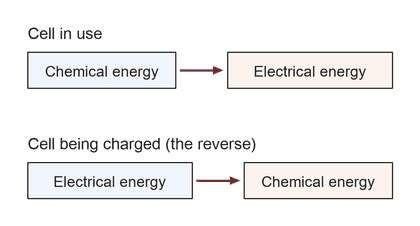
Why the other options are wrong:
- (A) electrical to mechanical: electrical to mechanical is what an electric motor does.
- (B) electrical to chemical: electrical to chemical happens while a cell (battery) is being CHARGED, not while it is in use.
- (C) chemical to mechanical: a cell gives no motion by itself; it gives a current, so its output is electrical, not mechanical.
Therefore, in an electric cell in use chemical energy changes to electrical energy, option (D).
- 711 mark
Question 71
Assertion (A) : If momentum of a body increases by 50%, its kinetic energy will increase by 125%.
Reason (R) : Kinetic energy is proportional to the square of velocity.
Solve with AIAnswer
- Correct
(A) both A and R are true and R is the correct explanation of A
(B) both A and R are True and R is not the correct explanation of A
(C) assertion is false but reason is true
(D) assertion is true but reason is false
Answer: (A) both A and R are true and R is the correct explanation of A
Concept: In an assertion–reason item, judge the assertion (A) and the reason (R) separately as true or false, and then decide whether R correctly explains A. For a fixed mass, momentum p = mv is proportional to v, and kinetic energy K = ½mv² is proportional to v².
Step 1 — Find the new velocity.
A 50% rise in momentum means p becomes 1·5 p; the mass is unchanged, so v also becomes 1·5 v.
Step 2 — Find the new kinetic energy.
K depends on v², so it becomes (1·5)² times its old value.
Step 3 — Judge the assertion.
K becomes 2·25 K, an increase of 1·25 K, that is 125%. The assertion is true.
Step 4 — Judge the reason.
Since K = ½mv², K is proportional to v². The reason is true.
Step 5 — Decide whether R explains A.
The 125% comes from squaring the factor 1·5, which is exactly what the reason states. So R correctly explains A.
Watch out: An increase TO 2·25 times is an increase BY 125%, not by 225%.
Why the other options are wrong:
- (B) both A and R are True and R is not the correct explanation of A: R does explain A: squaring the factor 1·5 is what gives the 125%.
- (C) assertion is false but reason is true: the assertion is true (2·25 − 1 = 1·25, that is 125%).
- (D) assertion is true but reason is false: the reason is true, since K = ½mv².
Therefore, both A and R are true and R is the correct explanation of A, option (A).
- 721 mark
Question 72
What are the two forms of mechanical energy ?
Solve with AIWritten solution
Solution:
Concept: Mechanical energy is the energy a body has because of its position (or configuration) and its motion.
Step 1 — First form.
Potential energy (U): energy due to the position or configuration of the body. Example: a stone held at a height.
Step 2 — Second form.
Kinetic energy (K): energy due to the motion of the body. Example: a moving cricket ball.

Therefore, the two forms of mechanical energy are potential energy and kinetic energy.
- 731 mark
Question 73
Name the form of energy which a wound up watch spring possesses.
Solve with AIWritten solution
Solution:
Concept: Energy stored because the shape of a body has been changed is elastic potential energy.
Step 1 — See what winding does.
Winding the spring coils it tightly, which changes its shape. The work done in winding is stored in it.
Step 2 — See how the energy is used.
As the spring slowly unwinds, the stored energy turns the gears and moves the hands of the watch.
Therefore, a wound up watch spring possesses elastic potential energy.
- 742 marks
Question 74
Name the type of energy (kinetic energy or potential energy ) possessed in the following cases :
(a) A moving cricket ball
(b) A compressed spring
(c) A moving bus
(d) A stretched wire
(e) An arrow shot out of a bow
(f) A piece of stone placed on the roof.
Solve with AIWritten solution
Solution:
Concept: A moving body has kinetic energy K. A body at a height, or one whose shape or size is changed, has potential energy U.
Step 1 — Bodies in motion.
(a) A moving cricket ball, (c) a moving bus and (e) an arrow shot out of a bow are all moving, so each has K.
Step 2 — Bodies with changed shape or size.
(b) A compressed spring and (d) a stretched wire have their length changed, so each has U (elastic potential energy).
Step 3 — Body at a height.
(f) A stone placed on the roof is above the ground, so it has U (gravitational potential energy).
Therefore, (a) K, (b) U, (c) K, (d) U, (e) K, (f) U.
- 752 marks
Question 75
(a) A body of mass is moving with a velocity . Write the expression for its kinetic energy.
(b) Show that the quantity has the unit of mass, where K is the kinetic energy of the body.
Solve with AIWritten solution
Solution:
Concept: Kinetic energy is the energy of a body due to its motion. A body of mass m moving with speed v has K = ½mv². For a fixed mass, K is proportional to v² (double the speed, four times the energy).
(a)
Step 1 — Expression for kinetic energy.
For a body of mass m moving with velocity v,
(b)
Step 2 — Rearrange the expression.
Multiply both sides by 2 and divide by v².
The quantity is the mass itself, so it has the unit of mass.
Step 3 — Check with units.
The unit of K is the joule (1 J = 1 kg m² s⁻²) and the unit of v is m s⁻¹.
Therefore, (a) K = ½mv², and (b) 2K ÷ v² equals the mass m, so it has the unit kg.
- 761 mark
Question 76
Two bodies A and B of masses and M (M >> ) have same kinetic energy. Which body will have more momentum ?
Solve with AIWritten solution
Solution:
Concept: Momentum is p = mv, and kinetic energy is K = ½mv²; replacing v by p ÷ m in K gives K = p² ÷ 2m, or p = √(2mK).
Step 1 — Use the relation.
For the SAME kinetic energy K, p = √(2mK) is proportional to the square root of the mass.
Step 2 — Compare the bodies.
M is much larger than m, so √(2MK) is much larger than √(2mK). For example, if M = 9m, B has √9, that is 3 times, the momentum of A.
Watch out: The heavier body moves more slowly, but its momentum is still larger.
Therefore, body B (the heavier body, of mass M) has more momentum.
- 772 marks
Question 77
Complete the following sentences :
(a) The kinetic energy of a body is the energy by virtue of its ............ .
(b) The potential energy of a body is the energy by virtue of its ............ .
(c) The conversion of part of energy into an undesirable form is called ............ .
Solve with AIWritten solution
Solution:
Concept: Kinetic energy comes from motion, potential energy from position or configuration, and the energy lost in an unwanted form is called degraded energy.
Step 1 — Kinetic energy.
(a) The kinetic energy of a body is the energy by virtue of its motion.
Step 2 — Potential energy.
(b) The potential energy of a body is the energy by virtue of its position (or configuration).
Step 3 — Unwanted conversion.
(c) The conversion of part of energy into an undesirable form is called degradation of energy. For example, in a filament bulb most of the electrical energy becomes unwanted heat instead of light.
Therefore, (a) motion, (b) position or configuration, (c) degradation of energy.
- 784 marks
Question 78
Energy can exist in several forms and may change from one form to another. For each of the following, state the energy changes that occur in :
(a) the unwinding of a watch spring,
(b) a loaded truck when started and set in motion,
(c) a car going uphill,
(d) photosynthesis in green leaves,
(e) charging of a battery,
(f) respiration,
(g) burning of a match stick,
(h) explosion of crackers.
Solve with AIWritten solution
Solution:
Concept: Energy can neither be created nor destroyed; it only changes from one form to another. To name an energy change, ask which form goes IN and which form comes OUT.
Step 1 — Changes from stored mechanical energy.
(a) Unwinding of a watch spring: elastic potential energy → kinetic energy of the moving gears and hands.
Step 2 — Changes from the chemical energy of fuels.
(b) A loaded truck started and set in motion: chemical energy of the fuel → (heat in the engine) → kinetic energy of the truck. (c) A car going uphill: chemical energy of the fuel → kinetic energy and gravitational potential energy (it moves and also gains height).
Step 3 — Changes in living things.
(d) Photosynthesis in green leaves: light energy → chemical energy, stored in the food (glucose) the leaves make. (f) Respiration: chemical energy of food → heat energy (body warmth) and the energy the body uses to do work.
Step 4 — Electrical change.
(e) Charging of a battery: electrical energy → chemical energy, stored in the battery.
Step 5 — Burning.
(g) Burning of a match stick: chemical energy → heat and light energy. (h) Explosion of crackers: chemical energy → heat, light and sound energy (and kinetic energy of the flying pieces).
Watch out: Charging a battery (electrical → chemical) is the reverse of using a cell (chemical → electrical).
Therefore, the changes are: (a) elastic P.E. → K.E.; (b) chemical → K.E.; (c) chemical → K.E. + P.E.; (d) light → chemical; (e) electrical → chemical; (f) chemical → heat; (g) chemical → heat + light; (h) chemical → heat + light + sound.
- 795 marks
Question 79
State the energy changes in the following cases while in use :
(a) loudspeaker
(b) a steam engine
(c) microphone
(d) washing machine
(e) a glowing electric bulb
(f) burning coal
(g) a solar cell
(h) bio-gas burner
(i) an electric cell in a circuit
(j) a petrol engine of a running car
(k) an electric iron
(l) a ceiling fan
(m) an electromagnet.
Solve with AIWritten solution
Solution:
Concept: For each device, the input energy is what it uses and the output energy is what it is made to give.
Step 1 — Devices that use electrical energy.
(a) Loudspeaker: electrical → sound. (d) Washing machine: electrical → mechanical (kinetic) energy of the drum, through its motor. (e) A glowing electric bulb: electrical → light and heat. (k) An electric iron: electrical → heat. (l) A ceiling fan: electrical → mechanical (kinetic) energy of the blades. (m) An electromagnet: electrical → magnetic energy.
Step 2 — Devices that give electrical energy.
(c) Microphone: sound → electrical. (g) A solar cell: light → electrical. (i) An electric cell in a circuit: chemical → electrical.
Step 3 — Engines and burners.
(b) A steam engine: heat → mechanical (kinetic). (f) Burning coal: chemical → heat and light. (h) Bio-gas burner: chemical → heat (and light). (j) A petrol engine of a running car: chemical → heat → mechanical (kinetic).
Watch out: The loudspeaker and the microphone do opposite changes.
Therefore, (a) electrical → sound, (b) heat → mechanical, (c) sound → electrical, (d) electrical → mechanical, (e) electrical → light + heat, (f) chemical → heat + light, (g) light → electrical, (h) chemical → heat, (i) chemical → electrical, (j) chemical → heat → mechanical, (k) electrical → heat, (l) electrical → mechanical, (m) electrical → magnetic.
- 801 mark
Question 80
Name the process used for producing electricity from nuclear energy.
Solve with AIWritten solution
Solution:
Concept: Electricity is obtained from nuclear energy in a nuclear power plant, where heavy nuclei are split.
Step 1 — Name the process.
The process is nuclear fission.
Step 2 — Describe it.
In a nuclear reactor, heavy nuclei such as uranium-235 are split by neutrons in a controlled chain reaction. The nuclear energy released appears as heat.
Step 3 — Follow the energy to electricity.
The heat makes steam, which turns the turbines, and the generators coupled to them produce electricity: nuclear energy → heat → kinetic energy of the turbine → electrical energy.
Therefore, electricity is produced from nuclear energy by nuclear fission (in a controlled chain reaction).
- 812 marks
Question 81
Is it practically possible to convert a form of energy completely into another useful form ? Explain your answer.
Solve with AIWritten solution
Solution:
Concept: In every energy change a part of the energy goes into forms that are not wanted (mostly heat, sometimes sound). This wasted part is called degraded energy; the total energy is still conserved.
Step 1 — Answer the question.
No, it is not practically possible.
Step 2 — Give the reason.
In every conversion, some energy changes into heat (because of friction or electrical resistance) and sometimes sound. This part is not available for the useful purpose; it is degraded. The total energy is conserved, but the useful energy obtained is always less than the energy supplied.
Step 3 — Give an example.
In a filament bulb only about 5% of the electrical energy becomes visible light; about 95% becomes heat.
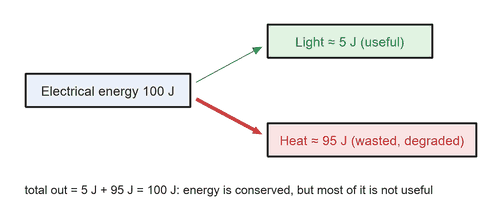
Therefore, no form of energy can be converted completely into another useful form; a part is always degraded, mostly into heat.
- 823 marks
Question 82
Define the term potential energy of a body. Name its two forms and give one example of each.
Solve with AIWritten solution
Solution:
Concept: Potential energy is stored energy. It depends on where the body is (its position) or what state it is in (its configuration), not on its motion.
Step 1 — Define potential energy.
The energy possessed by a body by virtue of its position or configuration is called its potential energy. It is measured by the work done in bringing the body to that position or state.
Step 2 — First form.
Gravitational potential energy, due to the body's height above the ground. Example: water stored in a dam at a height; when it flows down, it can turn a turbine.
Step 3 — Second form.
Elastic potential energy, due to a change in the body's shape or size. Example: a compressed spring, or the bent bow of an archer.
Therefore, potential energy is the energy due to position or configuration; its two forms are gravitational (water in a dam) and elastic (a compressed spring).
- 832 marks
Question 83
Name the form of energy which a body may possess even when it is not in motion. Give an example to support your answer.
Solve with AIWritten solution
Solution:
Concept: Kinetic energy needs motion, but potential energy depends only on position or configuration, so a body at rest can still have it.
Step 1 — Name the form.
Potential energy.
Step 2 — Give an example at a height.
A stone lying on a roof is at rest, so its kinetic energy is zero. But it is at a height, so it has gravitational potential energy; if it falls, this energy can do work, such as driving a nail into the ground.
Step 3 — Give an example with changed shape.
A compressed spring held at rest has elastic potential energy, which it can use to push a ball away when released.
Therefore, a body at rest may possess potential energy, for example a stone lying on a roof.
- 843 marks
Question 84
Write an expression for the potential energy of a body of mass placed at a height above the earth's surface. State the assumptions made, if any.
Solve with AIWritten solution
Solution:
Concept: Gravitational potential energy equals the work done against the earth's pull in raising the body from the ground (the reference level) to the height h.
Step 1 — Find the work done in lifting.
To lift the body slowly, a force equal to its weight mg acts through h.
Step 2 — Write the expression.
This work is stored as potential energy.
Here m is the mass of the body, g the acceleration due to gravity and h the height above the earth's surface.
Step 3 — State the assumptions.
(1) The potential energy at the earth's surface is taken as zero (the surface is the reference level). (2) The height h is small compared with the radius of the earth, so g stays constant over the height h.
Therefore, U = mgh, assuming U = 0 at the earth's surface and g constant over the height h (h much smaller than the earth's radius).
- 852 marks
Question 85
What do you understand by the kinetic energy of a body ?
Solve with AIWritten solution
Solution:
Concept: A moving body can do work (a moving hammer drives a nail), so it must have energy because of its motion.
Step 1 — Define kinetic energy.
The energy possessed by a body by virtue of its motion is called its kinetic energy.
Step 2 — Say how it is measured.
It is measured by the work the moving body can do before it comes to rest; equally, by the work done to bring it from rest to its present speed. For a body of mass m moving with speed v,
Step 3 — Give examples.
A moving hammer, a flying bullet and flowing wind all have kinetic energy. A body at rest has no kinetic energy.
Therefore, kinetic energy is the energy of a body due to its motion, K = ½mv².
- 862 marks
Question 86
State the work-energy theorem.
Solve with AIWritten solution
Solution:
Concept: The work done by a force goes into changing the speed of the body, and so into changing its kinetic energy.
Step 1 — State the theorem.
The work done by a force acting on a body is equal to the change in its kinetic energy.
Step 2 — Write it as a formula.
If the force changes the velocity of a body of mass m from u to v,
Step 3 — Explain the sign.
If the force acts along the motion, W is positive and the kinetic energy increases. If it opposes the motion (like friction or brakes), W is negative and the kinetic energy decreases.
Therefore, the work–energy theorem: the work done by a force on a body equals the change in its kinetic energy.
- 873 marks
Question 87
A body of mass is moving with a uniform velocity . A force is applied on the body due to which its velocity increases from to . How much work is being done by the force ?
Solve with AIWritten solution
Solution:
Concept: Work–energy theorem: the work done by a force on a body equals the change in its kinetic energy, W = ½mv² − ½mu², where u and v are the initial and final speeds. For a constant force it follows from F = ma and v² − u² = 2aS.
Given: mass m; velocity rises from u to v (the force acts along the motion).
Step 1 — Write the two kinetic energies.
The initial kinetic energy is ½mu² and the final kinetic energy is ½mv².
Step 2 — Find S from the equation of motion.
Let the force F give an acceleration a over a distance S. From v² − u² = 2aS,
Step 3 — Work out the work.
Work = force × displacement, with F = ma.
Step 4 — Interpret it.
This is the final kinetic energy minus the initial one: the increase in kinetic energy.
Therefore, the work done by the force is ½m(v² − u²), the increase in the kinetic energy of the body.
- 882 marks
Question 88
A light mass and a heavy mass have equal momentum. Which will have more kinetic energy ?
[Hint : kinetic energy where is the momentum]
Solve with AIWritten solution
Solution:
Concept: Use the relation between kinetic energy and momentum, K = p² ÷ 2m.
Step 1 — Compare for the same momentum.
For the same p, the numerator p² is the same for both bodies, so K is inversely proportional to the mass: the smaller m gives the larger K.
Step 2 — Check with numbers.
With p = 12 kg m s⁻¹, a 2 kg body and a 6 kg body have
Step 3 — See why.
The lighter body has the same momentum only because it moves faster, and K grows with the SQUARE of the speed.
Therefore, the lighter mass has more kinetic energy.
- 893 marks
Question 89
Name the three forms of kinetic energy and give one example of each.
Solve with AIWritten solution
Solution:
Concept: Kinetic energy has three forms: translational (the body moves from place to place), rotational (it spins about an axis) and vibrational (it moves to and fro about a mean position).
Step 1 — Translational kinetic energy.
It is the energy of a body moving from one place to another along a path. Example: a car moving on a straight road.
Step 2 — Rotational kinetic energy.
It is the energy of a body spinning about an axis. Example: a spinning top, or the blades of a rotating ceiling fan.
Step 3 — Vibrational kinetic energy.
It is the energy of a body moving to and fro about its mean position. Example: a vibrating guitar string, or the prongs of a struck tuning fork.
Therefore, the three forms are translational (a moving car), rotational (a spinning top) and vibrational (a vibrating string).
- 902 marks
Question 90
State two differences between potential energy and kinetic energy.
Solve with AIWritten solution
Solution:
Concept: Potential energy depends on position or configuration; kinetic energy depends on motion.
Step 1 — Set out the differences.
The table compares the two.
Potential energy Kinetic energy 1. It is due to the position or configuration of the body. 1. It is due to the motion of the body. 2. For a body at height h it is mgh. 2. For a body moving with speed v it is ½mv². Step 2 — Add a further difference.
A body at rest can have potential energy (a stone on a roof), but a body at rest has no kinetic energy.
Therefore, potential energy is due to position or configuration (mgh), while kinetic energy is due to motion (½mv²).
- 912 marks
Question 91
Name six different forms of energy.
Solve with AIWritten solution
Solution:
Concept: Energy exists in many forms, and one form can change into another.
Step 1 — List six forms.
(1) Mechanical energy (potential and kinetic), for example of a moving car; (2) heat energy, for example from burning fuel; (3) light energy, for example from the sun; (4) sound energy, for example from a ringing bell; (5) electrical energy, for example in a current through a wire; (6) chemical energy, for example stored in food and fuels.
Step 2 — Mention others.
Other forms include magnetic energy and nuclear energy.
Therefore, six forms of energy are mechanical, heat, light, sound, electrical and chemical energy.
- 922 marks
Question 92
What is degraded energy ?
Solve with AIWritten solution
Solution:
Concept: In every energy change a part of the energy goes into forms that are not wanted (mostly heat, sometimes sound). This wasted part is called degraded energy; the total energy is still conserved.
Step 1 — Explain what happens in an energy change.
When energy changes from one form to another, a part of it always changes into a form that cannot be used for the purpose intended, mostly heat and sometimes sound.
Step 2 — Name it.
This unusable, wasted energy is called degraded energy.
Step 3 — Give an example.
A filament bulb is meant to give light, but most of the electrical energy becomes heat; that heat is degraded energy.
Therefore, degraded energy is the part of the energy that changes into an unwanted, unusable form (mostly heat) during an energy change.
- 933 marks
Question 93
What do you mean by degradation of energy ? Explain it by taking one example from your daily life.
Solve with AIWritten solution
Solution:
Concept: In every energy change a part of the energy goes into forms that are not wanted (mostly heat, sometimes sound). This wasted part is called degraded energy; the total energy is still conserved.
Step 1 — Define degradation of energy.
The conversion of a part of the energy into useless (undesirable) forms during any energy change is called degradation of energy. The total energy is conserved, but the useful part keeps decreasing.
Step 2 — Example: what the bulb is for.
A filament bulb is meant to change electrical energy into light.
Step 3 — Example: what really happens.
Only a small part (about 5%) of the electrical energy becomes visible light. The rest (about 95%) becomes heat, which is not wanted.
Step 4 — Example: the result.
This heat is wasted, so it is degraded energy; that is why a glowing bulb becomes hot. Similarly, in a car engine much of the fuel's chemical energy is lost as heat to the surroundings.
Therefore, degradation of energy is the loss of part of the energy into useless forms; in a filament bulb most of the electrical energy is degraded into heat.
- 945 marks
Question 94
What is meant by gravitational potential energy ? Derive an expression for it for a body placed at a height above the ground.
Solve with AIWritten solution
Solution:
Concept: Gravitational potential energy is the work done against gravity in raising a body to its height, stored in the body.
Step 1 — Define gravitational potential energy.
The energy possessed by a body because of its position (height) relative to the earth is called gravitational potential energy. It is measured by the work done against the force of gravity in raising the body from the ground (where U is taken as zero) to that height.
Step 2 — Find the force needed.
Let a body of mass m be raised slowly, at constant velocity, from the ground to a height h. Without acceleration, the upward force must equal the weight.
Step 3 — Find the displacement.
The body moves up through h, in the direction of F.
Step 4 — Work out the work done against gravity.
Multiply the force by the displacement.
Step 5 — Store it as potential energy.
This work is stored in the body as its gravitational potential energy.
Step 6 — State the assumptions.
U = 0 at the ground, and g is constant over the height h (h is small compared with the radius of the earth).
Therefore, the gravitational potential energy of a body of mass m at a height h above the ground is U = mgh.
- 954 marks
Question 95
When an arrow is shot from a bow, it has kinetic energy in it. Explain briefly from where does it get its kinetic energy.
Solve with AIWritten solution
Solution:
Concept: The arrow's kinetic energy comes from the elastic potential energy stored in the bent bow, which in turn comes from the work done by the archer.
Step 1 — Pulling the string.
To shoot the arrow, the archer pulls the string back. This bends (deforms) the bow, and the work done by the archer is stored in the bent bow as elastic potential energy.
Step 2 — Releasing the string.
When the string is released, the bow springs back to its original shape and pushes the arrow forward.
Step 3 — The energy transfer.
The stored elastic potential energy of the bow changes into the kinetic energy of the arrow, so the arrow flies off with a high speed.
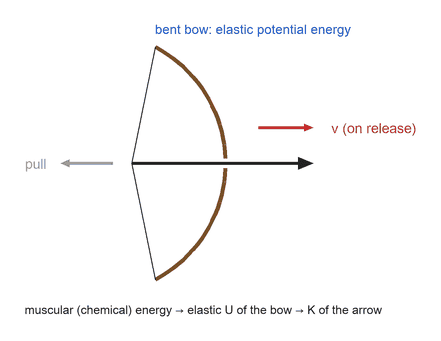
Step 4 — The chain of changes.
Muscular (chemical) energy of the archer → elastic potential energy of the bow → kinetic energy of the arrow.
Therefore, the arrow gets its kinetic energy from the elastic potential energy stored in the bent bow.
- 964 marks
Question 96
A ball is placed on a compressed spring. What form of energy does the spring possess ? On releasing the spring, the ball flies away. Give a reason.
Solve with AIWritten solution
Solution:
Concept: A compressed spring stores elastic potential energy; on release it does work on whatever it pushes, giving it kinetic energy.
Step 1 — Name the energy of the spring.
The compressed spring possesses elastic potential energy, stored because its shape and size (length) have been changed.
Step 2 — See what the spring does on release.
On release, the spring regains its natural length and pushes the ball, doing work on the ball.
Step 3 — Follow the energy.
By this work, the elastic potential energy of the spring is converted into the kinetic energy of the ball, so the ball moves off with a speed.
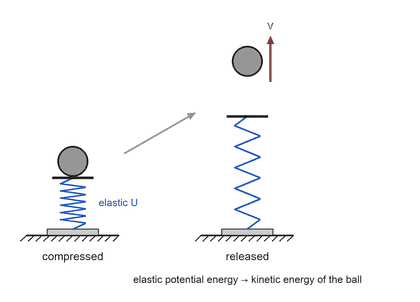
Step 4 — If the spring is vertical.
The ball then rises, and its kinetic energy changes into gravitational potential energy as it goes up.
Therefore, the compressed spring has elastic potential energy, and the ball flies away because this energy changes into the ball's kinetic energy.
- 974 marks
Question 97
A pebble is thrown up. It goes to a height and then comes back on the ground. State the different changes in form of energy during its motion.
Solve with AIWritten solution
Solution:
Concept: Conservation of mechanical energy: when friction and air resistance are negligible, potential energy and kinetic energy change into each other, but their sum U + K stays constant.
Step 1 — At the moment of throwing.
The muscular energy of the hand gives the pebble kinetic energy. At the ground its potential energy is zero.
Step 2 — While going up.
Its speed decreases and its height increases, so kinetic energy changes into potential energy.
Step 3 — At the highest point.
It is momentarily at rest, so its kinetic energy is zero and its potential energy is maximum.
Step 4 — While coming down.
Its speed increases and its height decreases, so potential energy changes back into kinetic energy.
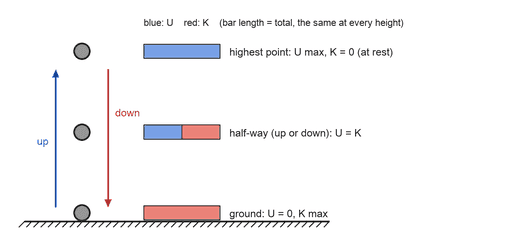
Step 5 — On hitting the ground.
Its kinetic energy is maximum just before impact. On striking the ground and stopping, this kinetic energy changes into heat and sound energy (and a little work in denting the ground).
Watch out: With air resistance neglected, K + U is the same at every point of the flight.
Therefore, the changes are: muscular → K (throw); K → U (going up); U → K (coming down); K → heat and sound (on hitting the ground).
- 984 marks
Question 98
In what way does the temperature of water at the bottom of a waterfall differ from the temperature at the top ? Explain the reason.
Solve with AIWritten solution
Solution:
Concept: Falling water loses potential energy and gains kinetic energy; when it is stopped at the bottom, that kinetic energy becomes heat.
Step 1 — At the top.
The water has gravitational potential energy, mgh.
Step 2 — While falling.
This potential energy changes into kinetic energy.
Step 3 — At the bottom.
When the falling water strikes the bottom and is brought to rest, its kinetic energy is converted into heat energy, which raises its temperature slightly.
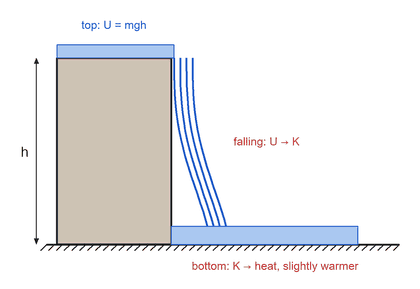
Step 4 — Estimate the rise.
If all of mgh becomes heat in the water, mgh = mcΔθ, so the rise in temperature is gh ÷ c. For water (c = 4200 J kg⁻¹ K⁻¹) and g = 9·8 m s⁻², a fall of 420 m gives
Watch out: The rise is small (about 1 °C for every 420 m of fall), so it is hard to feel.
Therefore, the water at the bottom of a waterfall is slightly warmer than at the top, because its kinetic energy turns into heat when it is stopped.
- 993 marks
Question 99
Two bodies of equal masses are placed at heights and . Find the ratio of their gravitational potential energies.
Solve with AIWritten solution
Solution:
Concept: Gravitational potential energy U = mgh. For equal masses (and the same g), U is proportional to the height h.
Given: equal masses m; heights h₁ = h, h₂ = 2h.
Step 1 — Write the two potential energies.
The masses are equal, and the heights are h and 2h.
Step 2 — Take the ratio.
Divide U₁ by U₂; m, g and h cancel.
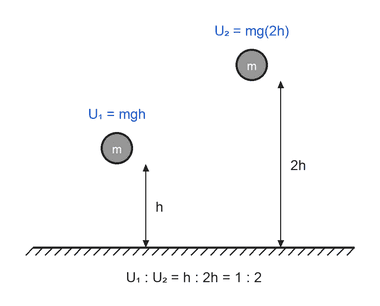
Therefore, the ratio of their gravitational potential energies is 1 : 2.
- 1003 marks
Question 100
Find the gravitational potential energy of 1 kg mass kept at a height of 5 m above the ground. Calculate its kinetic energy when it falls and hits the ground. Take m s.
Solve with AIWritten solution
Solution:
Concept: At 5 m the mass is at rest, so its energy is all potential energy. Conservation of mechanical energy: when friction and air resistance are negligible, potential energy and kinetic energy change into each other, but their sum U + K stays constant.
Given: m = 1 kg, h = 5 m, g = 10 m s⁻².
Step 1 — Potential energy at 5 m.
Use U = mgh.
Step 2 — Kinetic energy on hitting the ground.
At the ground U = 0, and (with air resistance neglected) all 50 J of potential energy has become kinetic energy.

Therefore, the potential energy at 5 m is 50 J, and the kinetic energy on hitting the ground is 50 J.
- 1013 marks
Question 101
A box of mass 300 kg has gravitational potential energy stored in it equal to 29400 J. Find the height of the box above the ground.
(Take N kg).
Solve with AIWritten solution
Solution:
Concept: Rearrange U = mgh to find the height: divide U by the weight mg.
Given: m = 300 kg, U = 29 400 J, g = 9·8 N kg⁻¹.
Step 1 — Find the weight.
mg is 300 × 9·8.
Step 2 — Find the height.
Divide the potential energy by the weight.
Check: Multiply back: 300 × 9·8 × 10 gives 29 400 J.
Therefore, the box is 10 m above the ground.
- 1023 marks
Question 102
A body of mass 10 kg falls from a height of 20 m to 8 m. Calculate : (i) the loss in potential energy of the body, and (ii) the total energy possessed by the body at any instant ? (Take m s).
Solve with AIWritten solution
Solution:
Concept: The loss in potential energy depends only on the fall in height. Conservation of mechanical energy: when friction and air resistance are negligible, potential energy and kinetic energy change into each other, but their sum U + K stays constant.
Given: m = 10 kg, from 20 m to 8 m, g = 10 m s⁻².
(i)
Step 1 — Fall in height.
The body falls from 20 m to 8 m.
Step 2 — Loss in potential energy.
Use mg × (fall in height).
(ii)
Step 3 — Total energy.
At the start the body is at rest at 20 m, so all its energy is potential, and this total stays the same at every instant.
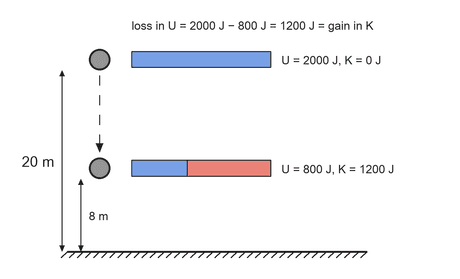
Check: At 8 m, U is 800 J and K is 1200 J (the P.E. lost); together they make 2000 J.
Therefore, (i) the loss in potential energy is 1200 J, and (ii) the total energy at any instant is 2000 J.
- 1033 marks
Question 103
Calculate the height through which a body of mass 0·5 kg is lifted if the energy spent in doing so is 1·0 J. Take m s.
Solve with AIWritten solution
Solution:
Concept: The energy spent in lifting a body is stored as its potential energy, mgh; so h = E ÷ (mg).
Given: m = 0·5 kg, energy spent = 1·0 J, g = 10 m s⁻².
Step 1 — Find the weight.
mg is 0·5 × 10.
Step 2 — Find the height.
Divide the energy spent by the weight.
Therefore, the body is lifted through 0·2 m (20 cm).
- 1043 marks
Question 104
A boy weighing 50 kgf climbs up from the first floor at a height of 3 m above the ground to the third floor at a height of 9 m above the ground. What will be the increase in his gravitational potential energy ?
(Take N kg).
Solve with AIWritten solution
Solution:
Concept: The increase in potential energy = weight × rise in height. Only the difference between the two heights matters.
Given: weight = 50 kgf; from 3 m to 9 m; g = 10 N kg⁻¹.
Step 1 — Weight in newton.
With g = 10 N kg⁻¹, 50 kgf is 50 × 10 N.
Step 2 — Rise in height.
He climbs from 3 m to 9 m.
Step 3 — Increase in potential energy.
Multiply the weight by the rise.
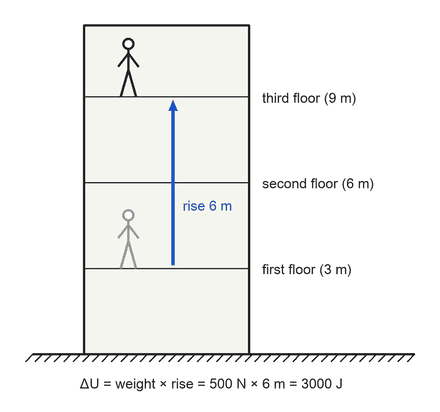
Watch out: Use the rise (6 m), not the final height (9 m).
Therefore, his gravitational potential energy increases by 3000 J.
- 1053 marks
Question 105
A vessel containing 50 kg of water is placed at a height of 15 m above the ground. Assuming the gravitational potential energy at ground to be zero, what will be the gravitational potential energy of water in the vessel ? ( m s)
Solve with AIWritten solution
Solution:
Concept: With the ground as the zero level, the potential energy of the water is U = mgh, where h is its height above the ground.
Given: m = 50 kg, h = 15 m, g = 10 m s⁻².
Step 1 — Substitute in U = mgh.
Put m = 50 kg, g = 10 m s⁻² and h = 15 m.
Therefore, the gravitational potential energy of the water is 7500 J.
- 1063 marks
Question 106
A man of mass 50 kg climbs up a ladder of height 15 m. Calculate : (i) the work done by the man, and (ii) the increase in his potential energy.
( m s).
Solve with AIWritten solution
Solution:
Concept: In climbing, the man does work against his own weight; this work is stored as his gravitational potential energy, so the two answers are equal.
Given: m = 50 kg, h = 15 m, g = 9·8 m s⁻².
(i)
Step 1 — Work done by the man.
Work = weight × height.
(ii)
Step 2 — Increase in potential energy.
The work done against gravity is stored as potential energy.
Watch out: This question gives g = 9·8 m s⁻².
Therefore, (i) the work done is 7350 J, and (ii) the increase in his potential energy is 7350 J.
- 1074 marks
Question 107
A block A, weighing 100 N, is pulled up a slope of length 5 m by means of a constant force (= 100 N) as illustrated in Fig. 2.15.
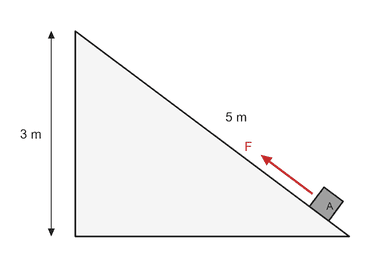
(a) What is the work done by the force in moving the block A, 5 m along the slope ?
(b) What is the increase in potential energy of the block A ?
(c) Account for the difference in the work done by the force and the increase in potential energy of the block.
Solve with AIWritten solution
Solution:
Concept: Work done by F uses the distance moved along the slope (the direction of F). The gain in potential energy uses only the vertical height risen. The difference is the work done against friction.
Given: weight = 100 N, F = 100 N along the slope, length of slope = 5 m, height = 3 m.
(a)
Step 1 — Work done by F.
F and the displacement are both along the slope.
(b)
Step 2 — Increase in potential energy.
The block (weight 100 N) rises through the vertical height of the slope, 3 m (Fig. 2.15).
(c)
Step 3 — Account for the difference.
The difference is used in doing work against the force of friction between the block and the slope, and it appears as heat.
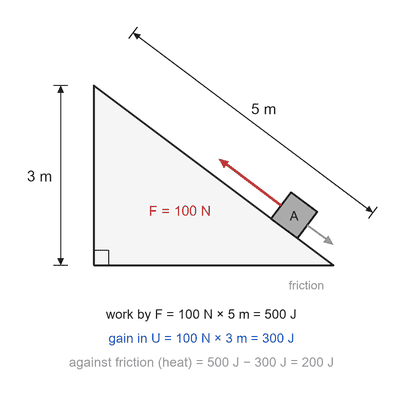
Step 4 — Compare with a smooth slope.
On a frictionless slope a force of only 100 × 3/5, that is 60 N, would be enough, doing exactly 300 J over 5 m.
Watch out: Use 5 m for the work of F, but 3 m (the vertical rise) for the potential energy.
Therefore, (a) the work done by F is 500 J, (b) the increase in potential energy is 300 J, and (c) the remaining 200 J is spent against friction (as heat).
- 1083 marks
Question 108
Find the kinetic energy of a body of mass 5 kg moving with a uniform velocity of 10 m s.
Solve with AIWritten solution
Solution:
Concept: Kinetic energy is the energy of a body due to its motion. A body of mass m moving with speed v has K = ½mv². For a fixed mass, K is proportional to v² (double the speed, four times the energy).
Given: m = 5 kg, v = 10 m s⁻¹.
Step 1 — Substitute in K = ½mv².
Put m = 5 kg and v = 10 m s⁻¹.
Watch out: Square the velocity before multiplying.
Therefore, the kinetic energy of the body is 250 J.
- 1093 marks
Question 109
If the speed of a car is halved, how does its kinetic energy change ?
Solve with AIWritten solution
Solution:
Concept: Kinetic energy is the energy of a body due to its motion. A body of mass m moving with speed v has K = ½mv². For a fixed mass, K is proportional to v² (double the speed, four times the energy).
Step 1 — Write the new kinetic energy.
The new speed is v ÷ 2 and the mass is unchanged.

Step 2 — Interpret it.
The kinetic energy becomes one-fourth of what it was; it decreases by three-fourths.
Watch out: Halving the speed does not halve the kinetic energy; (½)² = ¼.
Therefore, the kinetic energy becomes one-fourth of its initial value.
- 1103 marks
Question 110
Two bodies of equal masses are moving with uniform velocities and . Find the ratio of their kinetic energies.
Solve with AIWritten solution
Solution:
Concept: Kinetic energy is the energy of a body due to its motion. A body of mass m moving with speed v has K = ½mv². For a fixed mass, K is proportional to v² (double the speed, four times the energy).
Given: equal masses m; velocities v and 2v.
Step 1 — Take the ratio of the kinetic energies.
The masses are equal, so ½m cancels and only the squares of the velocities remain.
Therefore, the ratio of their kinetic energies is 1 : 4.
- 1113 marks
Question 111
Two bodies have masses in the ratio 5 : 1 and kinetic energies in the ratio 125 : 9. Calculate the ratio of their velocities.
Solve with AIWritten solution
Solution:
Concept: Write the ratio of kinetic energies using K = ½mv²; the ½ cancels, leaving the masses and the squares of the velocities.
Given: m₁ : m₂ = 5 : 1; K₁ : K₂ = 125 : 9.
Step 1 — Write the ratio.
Divide K₁ by K₂.
Step 2 — Substitute the given ratios.
Put K₁ : K₂ = 125 : 9 and m₁ : m₂ = 5 : 1.
Step 3 — Solve for the ratio of squares.
Divide both sides by 5.
Step 4 — Take the square root.
Both velocities are positive, so take the positive root.
Watch out: Take the square root at the end; 25 : 9 is the ratio of the SQUARES of the velocities.
Therefore, the ratio of their velocities is 5 : 3.
- 1123 marks
Question 112
A car is running at a speed of 15 km h while another similar car is moving at a speed of 45 km h. Find the ratio of their kinetic energies.
Solve with AIWritten solution
Solution:
Concept: 'Similar cars' have equal masses, so K ∝ v². Since only a ratio is asked, the speeds need not be changed into m s⁻¹.
Given: v₁ = 15 km h⁻¹, v₂ = 45 km h⁻¹, equal masses.
Step 1 — Take the ratio.
For equal masses the ratio of kinetic energies is the ratio of the squares of the speeds.
Step 2 — Interpret it.
The car moving three times as fast has nine times the kinetic energy.
Therefore, the ratio of their kinetic energies is 1 : 9.
- 1133 marks
Question 113
A ball of mass 0·5 kg slows down from a speed of 10 m s to that of 6 m s. Calculate the change in the kinetic energy of the ball.
Solve with AIWritten solution
Solution:
Concept: Change in kinetic energy = final K.E. − initial K.E. A negative answer means the kinetic energy has decreased.
Given: m = 0·5 kg, u = 10 m s⁻¹, v = 6 m s⁻¹.
Step 1 — Initial kinetic energy.
At 10 m s⁻¹,
Step 2 — Final kinetic energy.
At 6 m s⁻¹,
Step 3 — Change in kinetic energy.
Subtract the initial value from the final value.
Watch out: Do not subtract the speeds first: ½ × 0·5 × (10 − 6)² gives a wrong 4 J.
Therefore, the kinetic energy of the ball decreases by 16 J.
- 1143 marks
Question 114
A cannon ball of mass 500 g is fired with a speed of 15 m s. Find : (i) its kinetic energy, and (ii) its momentum.
Solve with AIWritten solution
Solution:
Concept: Use S.I. units: change the mass from grams to kilograms first. Then K = ½mv² and p = mv.
Given: m = 500 g, v = 15 m s⁻¹.
Step 1 — Change the mass into kg.
500 g is 0·5 kg.
(i)
Step 2 — Kinetic energy.
Use K = ½mv².
(ii)
Step 3 — Momentum.
Use p = mv.
Watch out: Using 500 (grams) instead of 0·5 kg makes both answers a thousand times too large.
Therefore, (i) the kinetic energy is 56·25 J, and (ii) the momentum is 7·5 kg m s⁻¹.
- 1153 marks
Question 115
A body of mass 10 kg is moving with a velocity of 20 m s. If the mass of the body is doubled and its velocity is halved, find : (i) the initial kinetic energy, and (ii) the final kinetic energy.
Solve with AIWritten solution
Solution:
Concept: Kinetic energy is the energy of a body due to its motion. A body of mass m moving with speed v has K = ½mv². For a fixed mass, K is proportional to v² (double the speed, four times the energy). Doubling m doubles K, but halving v makes K one-fourth, so overall K becomes half.
Given: m = 10 kg, v = 20 m s⁻¹; then mass doubled, velocity halved.
(i)
Step 1 — Initial kinetic energy.
Use m = 10 kg and v = 20 m s⁻¹.
(ii)
Step 2 — Final kinetic energy.
Now m = 20 kg and v = 10 m s⁻¹.
Therefore, (i) the initial kinetic energy is 2000 J, and (ii) the final kinetic energy is 1000 J (half of it).
- 1164 marks
Question 116
A truck weighing 1000 kg changes its speed from 36 km h to 72 km h in 2 minutes. Calculate : (i) the work done by the engine, and (ii) its power. ( m s).
Solve with AIWritten solution
Solution:
Concept: Work–energy theorem: the work done by a force on a body equals the change in its kinetic energy, W = ½mv² − ½mu², where u and v are the initial and final speeds. Power = work done ÷ time taken.
Given: m = 1000 kg, u = 36 km h⁻¹, v = 72 km h⁻¹, t = 2 min.
Step 1 — Change the speeds into m s⁻¹.
Multiply km h⁻¹ by 5/18.
The time is 2 × 60 s, that is 120 s.
(i)
Step 2 — Work done by the engine.
It equals the increase in kinetic energy.

(ii)
Step 3 — Power.
Divide the work by the time.
Watch out: Change km h⁻¹ into m s⁻¹ and minutes into seconds first; the value of g is not needed here.
Note: 'weighing 1000 kg' gives the truck's mass, so g = 10 m s⁻² is not used.
Therefore, (i) the work done by the engine is 1·5 × 10⁵ J, and (ii) its power is 1250 W (1·25 kW).
- 1173 marks
Question 117
A body of mass 60 kg has momentum of 3000 kg m s. Calculate : (i) the kinetic energy, and (ii) the speed of the body.
Solve with AIWritten solution
Solution:
Concept: Momentum is p = mv, and kinetic energy is K = ½mv²; replacing v by p ÷ m in K gives K = p² ÷ 2m, or p = √(2mK).
Given: m = 60 kg, p = 3000 kg m s⁻¹.
(i)
Step 1 — Kinetic energy.
Use K = p² ÷ 2m.
(ii)
Step 2 — Speed.
Use v = p ÷ m.
Check: ½ × 60 × 50² gives 75 000 J, the same kinetic energy.
Therefore, (i) the kinetic energy is 7·5 × 10⁴ J, and (ii) the speed is 50 m s⁻¹.
- 1183 marks
Question 118
How much work is needed to be done on a ball of mass 50 g to give it a momentum of 5 kg m s ?
Solve with AIWritten solution
Solution:
Concept: Starting from rest, the work done on the ball equals the kinetic energy it gets (work–energy theorem). Momentum is p = mv, and kinetic energy is K = ½mv²; replacing v by p ÷ m in K gives K = p² ÷ 2m, or p = √(2mK).
Given: m = 50 g, p = 5 kg m s⁻¹ (ball initially at rest).
Step 1 — Change the mass into kg.
50 g is 0·05 kg.
Step 2 — Work needed.
The work equals the kinetic energy gained, K = p² ÷ 2m.
Check: The ball's speed is 5 ÷ 0·05, that is 100 m s⁻¹, and ½ × 0·05 × 100² is again 250 J.
Watch out: Change 50 g into 0·05 kg; using 50 gives a wrong 0·25 J.
Therefore, 250 J of work must be done on the ball.
- 1194 marks
Question 119
How much energy is gained by a box of mass 20 kg when a man
(a) carrying the box waits for 5 minutes for a bus?
(b) runs carrying the box with a speed of 3 m s to catch the bus ?
(c) raises the box by 0·5 m in order to place it inside the bus ? ( m s)
Solve with AIWritten solution
Solution:
Concept: The box gains energy only when work is done on it: kinetic energy if its speed increases, potential energy if it is raised. Just holding it still does no work on it.
Given: m = 20 kg, speed 3 m s⁻¹, rise 0·5 m, g = 10 m s⁻².
(a)
Step 1 — Waiting for 5 minutes.
The box is neither moved nor raised, so its displacement is zero and no work is done on it. Energy gained: zero.
(b)
Step 2 — Running with the box at 3 m s⁻¹.
The box gains kinetic energy.
(c)
Step 3 — Raising the box by 0·5 m.
The box gains potential energy.

Therefore, the box gains (a) no energy, (b) 90 J (kinetic), and (c) 100 J (potential).
- 1203 marks
Question 120
A bullet of mass 50 g is moving with a velocity of 500 m s. It penetrates 10 cm into a still target and comes to rest. Calculate : (a) the kinetic energy possessed by the bullet, and (b) the average retarding force offered by the target.
Solve with AIWritten solution
Solution:
Concept: The target stops the bullet, so its retarding force does work equal to the bullet's whole kinetic energy (work–energy theorem): F × S = K.
Given: m = 50 g, v = 500 m s⁻¹, penetration S = 10 cm.
Step 1 — Change to S.I. units.
50 g is 0·05 kg and 10 cm is 0·1 m.
(a)
Step 2 — Kinetic energy of the bullet.
Use K = ½mv².
(b)
Step 3 — Average retarding force.
Since F × S = K, divide K by the distance of penetration.

Step 4 — Interpret it.
The force is very large because all the energy is removed over only 10 cm.
Watch out: Change 10 cm into 0·1 m; dividing by 10 gives a force a hundred times too small.
Therefore, (a) the kinetic energy of the bullet is 6250 J, and (b) the average retarding force is 62 500 N.
- 1213 marks
Question 121
A spring is kept compressed by a small trolley of mass 0·5 kg lying on a smooth horizontal surface as shown in the adjacent Fig. 2.16. When the trolley is released, it is found to move at a speed m s. What potential energy did the spring possess when compressed ?
 Solve with AI
Written solution
Solution:
Concept: The surface is smooth (no friction), so on release all the elastic potential energy of the compressed spring changes into the kinetic energy of the trolley.
Given: m = 0·5 kg, v = 2 m s⁻¹ (Fig. 2.16), smooth surface.
Step 1 — Equate the energies.
The spring's potential energy equals the trolley's kinetic energy when it leaves the spring.
Step 2 — Substitute.
Put m = 0·5 kg and v = 2 m s⁻¹.
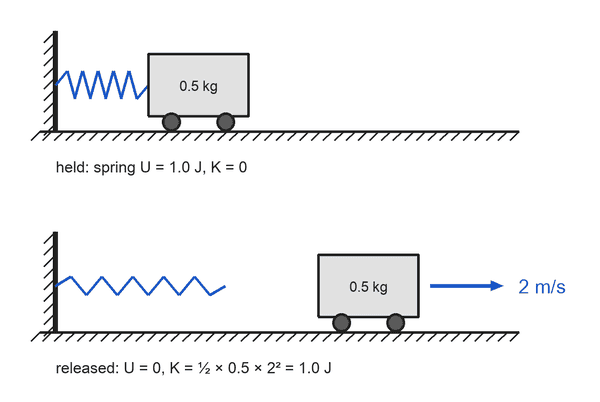
Therefore, the compressed spring possessed 1·0 J of potential energy.
- 1221 mark
Question 122
According to the principle of conservation of mechanical energy :
Solve with AIAnswer
(A) Potential energy of a system is always greater than its kinetic energy
(B) Kinetic energy of a system is always greater than its potential energy
(C) Mechanical energy is always converted into heat energy
- Correct
(D) Total mechanical energy of a system remains constant if no external force is worked on it.
Answer: (D) Total mechanical energy of a system remains constant if no external force is worked on it.
Concept: Mechanical energy is potential energy U plus kinetic energy K. Conservation of mechanical energy: when friction and air resistance are negligible, potential energy and kinetic energy change into each other, but their sum U + K stays constant.
Step 1 — State the principle.
When no outside force such as friction or air resistance does work on the system, U and K may change into each other, but their sum stays constant.
Step 2 — Check it with an example.
For a freely falling body, U falls and K rises by the same amount, so U + K stays mgh throughout the fall.
Why the other options are wrong:
- (A) Potential energy of a system is always greater than its kinetic energy: U is not always larger: just before a falling body hits the ground, U is zero and K is maximum.
- (B) Kinetic energy of a system is always greater than its potential energy: K is not always larger: at the top of the fall, K is zero and U is maximum.
- (C) Mechanical energy is always converted into heat energy: mechanical energy changes into heat only when friction acts, and that is exactly when it is NOT conserved.
Therefore, the principle says the total mechanical energy of a system stays constant if no external force does work on it, option (D).
- 1231 mark
Question 123
A skater is gliding on a smooth ice surface. What happens to his mechanical energy as he skates ?
Solve with AIAnswer
(A) It increases
(B) It decreases
(C) It becomes zero
- Correct
(D) It remains constant
Answer: (D) It remains constant
Concept: Mechanical energy changes only when an outside force (such as friction) does work on a body or energy is supplied to it.
Step 1 — Look at friction.
Smooth ice means (almost) no friction, so no work is done against friction and no mechanical energy is changed into heat.
Step 2 — Look at energy input.
Nothing pushes the skater either, so no energy is added. His total mechanical energy, K + U, therefore stays constant.
Why the other options are wrong:
- (A) It increases: it would need some force or source to supply extra energy; there is none.
- (B) It decreases: it would need friction to take energy away; smooth ice has almost none.
- (C) It becomes zero: he keeps moving, so he still has kinetic energy; his mechanical energy is not zero.
Therefore, the skater's mechanical energy remains constant, option (D).
- 1241 mark
Question 124
A spring is compressed, storing potential energy. When the spring is released, it propels an object forward. What change would you notice in the total mechanical energy of the system ?
Solve with AIAnswer
(A) It increases
(B) It decreases
(C) It becomes zero
- Correct
(D) It remains constant
Answer: (D) It remains constant
Concept: A compressed spring stores elastic potential energy. When it is released, this energy changes into the kinetic energy of the object; it is not lost. Conservation of mechanical energy: when friction and air resistance are negligible, potential energy and kinetic energy change into each other, but their sum U + K stays constant.
Step 1 — Follow the spring's energy.
As the spring stretches back, its potential energy decreases.
Step 2 — Follow the object's energy.
At the same time the object speeds up, so its kinetic energy increases by exactly the same amount.
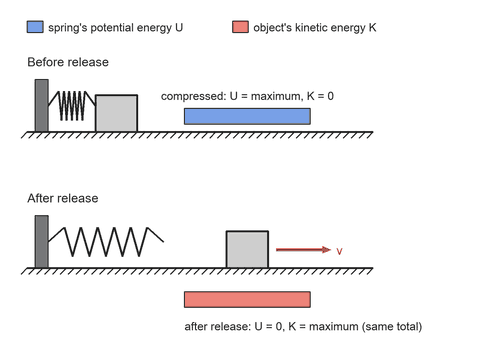
Step 3 — Add them.
One form falls as the other rises, so the total mechanical energy stays constant (friction neglected).
Why the other options are wrong:
- (A) It increases: the spring cannot give out more energy than it stored.
- (B) It decreases: energy would have to be removed, for example by friction, which is neglected here.
- (C) It becomes zero: the energy has only changed form; the object is moving, so it has kinetic energy.
Therefore, the total mechanical energy of the system remains constant, option (D).
- 1251 mark
Question 125
A ball of mass is thrown vertically up with an initial velocity so as to reach height . The correct statement is:
Solve with AIAnswer
(A) Potential energy of the ball at the ground is mgh.
(B) Kinetic energy of the ball at the ground is zero.
(C) Kinetic energy of the ball at the highest point is mgh.
- Correct
(D) Potential energy of the ball at the highest point is mgh.
Answer: (D) Potential energy of the ball at the highest point is mgh.
Concept: Potential energy depends on height (U = mgh, zero at the ground); kinetic energy depends on speed (K = ½mv²). Conservation of mechanical energy: when friction and air resistance are negligible, potential energy and kinetic energy change into each other, but their sum U + K stays constant.
Step 1 — At the ground.
The ball is thrown with its full speed, so K is maximum and U = 0.
Step 2 — At the highest point.
At height h the ball stops for a moment, so K = 0 and all of its energy is potential energy.
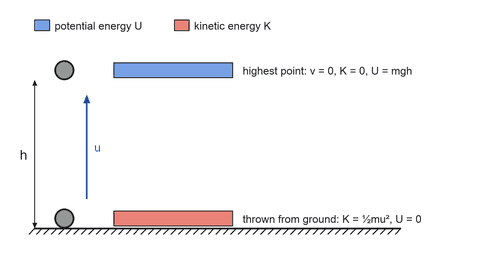
Why the other options are wrong:
- (A) Potential energy of the ball at the ground is mgh: at the ground h = 0, so the potential energy is 0, not mgh.
- (B) Kinetic energy of the ball at the ground is zero: at the ground the ball moves fastest, so its kinetic energy is maximum (equal to mgh), not zero.
- (C) Kinetic energy of the ball at the highest point is mgh: at the highest point the ball is momentarily at rest, so its kinetic energy is zero, not mgh.
Therefore, the correct statement is that the potential energy at the highest point is mgh, option (D).
- 1261 mark
Question 126
A body is released from a height. During its motion in striking the ground, the quantity which does not change is :
Solve with AIAnswer
(A) momentum
(B) kinetic energy
(C) potential energy
- Correct
(D) mechanical energy
Answer: (D) mechanical energy
Concept: As a body falls, its potential energy changes into kinetic energy; the P.E. lost is exactly equal to the K.E. gained (air resistance neglected).
Step 1 — Potential energy.
The height decreases, so U = mgh decreases.
Step 2 — Kinetic energy.
The speed increases, so K = ½mv² increases by the same amount.
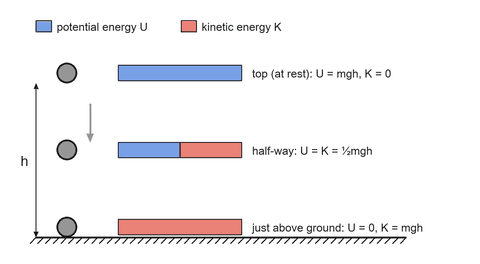
Step 3 — Their sum.
So the mechanical energy U + K does not change.
Why the other options are wrong:
- (A) momentum: momentum = mv, and v keeps increasing, so the momentum increases.
- (B) kinetic energy: kinetic energy increases as the speed increases.
- (C) potential energy: potential energy decreases as the height decreases.
Therefore, the quantity that does not change is the mechanical energy, option (D).
- 1271 mark
Question 127
A pendulum is oscillating on either side of its rest position. The correct statement is :
Solve with AIAnswer
(A) It has only kinetic energy at its each position.
(B) It has the maximum kinetic energy at its extreme position.
(C) It has the maximum potential energy at its mean position.
- Correct
(D) The sum of its kinetic energy and potential energy remains constant throughout the motion.
Answer: (D) The sum of its kinetic energy and potential energy remains constant throughout the motion.
Concept: In a swinging pendulum (air friction neglected), potential energy (due to height) and kinetic energy (due to speed) keep changing into each other. At an extreme position the bob is momentarily at rest at its highest point; at the mean position it is lowest and fastest. Their sum stays constant.
Step 1 — At an extreme position.
The bob is momentarily at rest at its highest point: K = 0 and U is maximum.
Step 2 — At the mean position.
The bob is at its lowest point and moving fastest: U = 0 (taking this level as zero) and K is maximum.
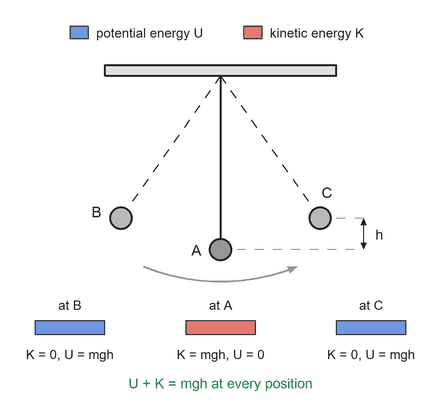
Step 3 — In between.
It has some of each, and the total is always the same.
Why the other options are wrong:
- (A) It has only kinetic energy at its each position: at the extreme positions it has ONLY potential energy, so it does not have only kinetic energy everywhere.
- (B) It has the maximum kinetic energy at its extreme position: at the extreme position the bob is at rest, so its kinetic energy is zero; K is maximum at the mean position.
- (C) It has the maximum potential energy at its mean position: at the mean position the bob is lowest, so its potential energy is minimum; U is maximum at the extremes.
Therefore, the sum of the pendulum's kinetic and potential energy remains constant, option (D).
- 1281 mark
Question 128
A simple pendulum while oscillating rises to a maximum vertical height of 7 cm from its rest position when it reaches its extreme position on one side. The mass of the bob of simple pendulum is 400 g and m/s. The total energy of the simple pendulum at any instant while oscillating is :
Solve with AIAnswer
- Correct
(A) 0.28 J
(B) 2.8 J
(C) 28 J
(D) 28000 J
Answer: (A) 0.28 J
Concept: At the extreme position the bob is momentarily at rest, so all its energy is potential energy. Conservation of mechanical energy: when friction and air resistance are negligible, potential energy and kinetic energy change into each other, but their sum U + K stays constant. So this is the total energy at every instant.
Step 1 — Change to S.I. units.
400 g is 0·4 kg and 7 cm is 0·07 m.
Step 2 — Work out the total energy.
Use E = mgh at the extreme position.
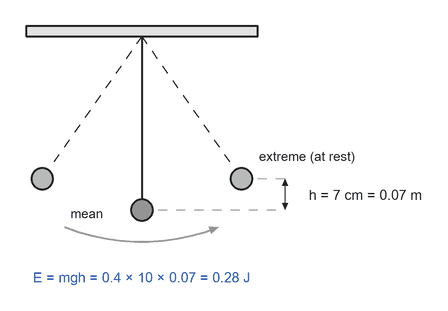
Watch out: Convert grams to kilograms and centimetres to metres before multiplying.
Why the other options are wrong:
- (B) 2.8 J: 2·8 J comes from taking 7 cm as 0·7 m.
- (C) 28 J: 28 J comes from taking 7 cm as 7 m.
- (D) 28000 J: 28 000 J uses 400 (grams) and 7 (centimetres) without converting them (400 × 10 × 7).
Therefore, the total energy of the pendulum at any instant is 0·28 J, option (A).
- 1291 mark
Question 129
Assertion (A) : When a hammer is made to fall on a nail fixed upright on a wooden piece, the nail begins to penetrate the wood.
Reason (R) : As the hammer starts falling, its kinetic energy begins to change into potential energy.
Solve with AIAnswer
(A) both A and R are true and R is the correct explanation of A
(B) both A and R are True and R is not the correct explanation of A
(C) assertion is false but reason is true
- Correct
(D) assertion is true but reason is false
Answer: (D) assertion is true but reason is false
Concept: In an assertion–reason item, judge the assertion (A) and the reason (R) separately as true or false, and then decide whether R correctly explains A. A body at a height has potential energy; as it falls, this changes into kinetic energy, and a moving body can do work.
Step 1 — Judge the assertion.
The falling hammer has kinetic energy. When it strikes the nail, it does work on the nail and drives it into the wood. The assertion is true.
Step 2 — Judge the reason.
As the hammer FALLS, its height decreases and its speed increases, so its potential energy changes into kinetic energy. The reason states the change the wrong way round, so it is false.

Why the other options are wrong:
- (A) both A and R are true and R is the correct explanation of A: it says the reason is true, but the reason is false.
- (B) both A and R are True and R is not the correct explanation of A: it also says the reason is true, but the reason is false.
- (C) assertion is false but reason is true: it says the assertion is false, but a falling hammer does drive the nail in.
Therefore, the assertion is true but the reason is false, option (D).
- 1301 mark
Question 130
A body is thrown vertically upwards. Its velocity keeps on decreasing. What happens to its kinetic energy as its velocity becomes zero ?
Solve with AIWritten solution
Solution:
Concept: Kinetic energy depends on speed (K = ½mv²); potential energy depends on height (U = mgh). Conservation of mechanical energy: when friction and air resistance are negligible, potential energy and kinetic energy change into each other, but their sum U + K stays constant.
Step 1 — See what happens as it rises.
As the body rises it slows down, so its kinetic energy changes into potential energy.
Step 2 — At zero velocity.
When the velocity becomes zero at the highest point, K = ½m × 0², so the kinetic energy is zero; all of it has become gravitational potential energy (air resistance neglected).
Therefore, the kinetic energy becomes zero when the velocity becomes zero, because it has all changed into potential energy.
- 1312 marks
Question 131
A body falls freely under gravity from rest. Name the kind of energy it will possess
(a) at the point from where it falls,
(b) while falling,
(c) on reaching the ground.
Solve with AIWritten solution
Solution:
Concept: A body has potential energy because of its height and kinetic energy because of its speed. As it falls, P.E. changes into K.E.
(a)
Step 1 — At the point from where it falls.
It is at rest (K = 0) at a height h, so it has only potential energy (mgh).
(b)
Step 2 — While falling.
It still has some height and it has gained speed, so it has both potential and kinetic energy.
(c)
Step 3 — On reaching the ground.
Its height is zero (U = 0) and its speed is maximum just before it hits, so it has only kinetic energy.
Therefore, (a) potential energy, (b) both potential and kinetic energy, (c) kinetic energy.
- 1322 marks
Question 132
State the principle of conservation of energy.
Solve with AIWritten solution
Solution:
Concept: Energy may seem to be lost in many processes, but it only changes form.
Step 1 — State the principle.
Energy can neither be created nor be destroyed. It can only be transformed from one form to another, and the total energy of an isolated system remains constant.
Step 2 — Explain with an example.
When a moving car brakes to a stop, its kinetic energy is not destroyed; it becomes heat in the brakes and some sound.
Therefore, energy can neither be created nor destroyed; it only changes from one form to another, and the total energy stays constant.
- 1333 marks
Question 133
What do you understand by the conservation of mechanical energy ? State the condition under which mechanical energy is conserved.
Solve with AIWritten solution
Solution:
Concept: Conservation of mechanical energy: when friction and air resistance are negligible, potential energy and kinetic energy change into each other, but their sum U + K stays constant.
Step 1 — Explain the conservation.
In a system, potential energy may change into kinetic energy and kinetic energy into potential energy, but the sum of the two, the total mechanical energy, stays constant at every instant.
Step 2 — Give an example.
For a body falling freely from a height h: at the top U = mgh and K = 0; at the bottom U = 0 and K = mgh; and at every point in between U + K is mgh.
Step 3 — State the condition.
Mechanical energy is conserved only when no friction, air resistance or other external force does work on the system, so that no mechanical energy changes into heat or other forms.
Therefore, conservation of mechanical energy means K + U stays constant; it holds only when friction, air resistance and other external forces do no work.
- 1342 marks
Question 134
Name two examples in which the mechanical energy of a system remains constant.
Solve with AIWritten solution
Solution:
Concept: Mechanical energy stays constant when only U and K change into each other, and no friction or air resistance takes energy away as heat.
Step 1 — First example: a simple pendulum.
With air resistance negligible, the bob has only P.E. at the extremes and only K.E. at the mean position, and K + U is the same everywhere.
Step 2 — Second example: a freely falling body.
With air resistance neglected, the P.E. it loses equals the K.E. it gains, so K + U stays mgh throughout.
Step 3 — Other examples.
A body thrown vertically upwards; a ball rolling on a frictionless curved track.
Therefore, two examples are (1) an oscillating simple pendulum and (2) a freely falling body (air resistance neglected).
- 1353 marks
Question 135
A pendulum with bob of mass is oscillating on either side from its resting position A between the extremes B and C at a vertical height above A.
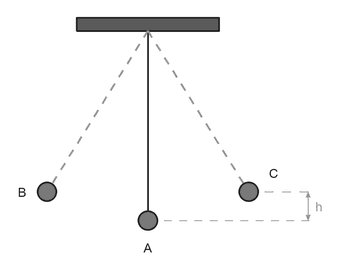
What is the kinetic energy and potential energy when the pendulum is at positions (i) A, (ii) B, and (iii) C ?
Solve with AIWritten solution
Solution:
Concept: Take the potential energy at the resting (mean) position A as zero. At the extremes the bob is momentarily at rest at height h, so all its energy is potential energy, mgh. Mechanical energy is conserved, so the total is mgh at every position.
(i)
Step 1 — At A.
A is the mean position: the bob is lowest (U = 0) and moving fastest, so all its energy is kinetic: K = mgh, U = 0.
(ii)
Step 2 — At B.
B is an extreme position: the bob is at rest at height h, so K = 0, U = mgh.
(iii)
Step 3 — At C.
C is the other extreme, also at rest at height h, so K = 0, U = mgh.
Check: At every position K + U is mgh, which shows that mechanical energy is conserved.
Therefore, at A: K = mgh, U = 0; at B: K = 0, U = mgh; at C: K = 0, U = mgh.
- 1363 marks
Question 136
Name the type of energy possessed by the bob of a simple pendulum when it is at (a) the extreme position, (b) the mean position, and (c) between the mean and extreme positions.
Solve with AIWritten solution
Solution:
Concept: In a swinging pendulum (air friction neglected), potential energy (due to height) and kinetic energy (due to speed) keep changing into each other. At an extreme position the bob is momentarily at rest at its highest point; at the mean position it is lowest and fastest. Their sum stays constant.
(a)
Step 1 — At the extreme position.
The bob is momentarily at rest (K = 0) at its highest point, so it has only potential energy.
(b)
Step 2 — At the mean position.
It is at its lowest point (U = 0) and moving fastest, so it has only kinetic energy.
(c)
Step 3 — Between the two.
It has some height and some speed, so it has both kinetic and potential energy.
Therefore, (a) potential energy, (b) kinetic energy, (c) both kinetic and potential energy.
- 1375 marks
Question 137
Show that the sum of kinetic energy and potential energy (i.e., total mechanical energy) is always conserved in the case of a freely falling body under gravity (with air resistance neglected) from a height by finding it when (i) the body is at the top, (ii) the body has fallen a distance , (iii) the body has reached the ground.
Solve with AIWritten solution
Solution:
Concept: Find U (mgh) and K (½mv²) at three points of the fall and show that their sum is the same, mgh, at each. The speed comes from the equation of motion v² = u² + 2gs, with u = 0.
Step 1 — Set up the fall.
Let a body of mass m fall freely from rest from point A at height h. B is the point after it has fallen a distance x, and C is on the ground.
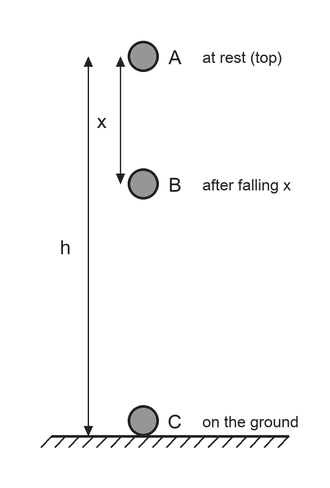
(i)
Step 2 — At the top, A.
The body is at rest, so K = 0, and its height is h, so U = mgh.
(ii)
Step 3 — Potential energy at B.
Its height is now h − x.
Step 4 — Kinetic energy at B.
It has fallen x from rest, so v² = 2gx.
Step 5 — Total at B.
Add the two.
(iii)
Step 6 — On the ground, C.
The height is 0, so U = 0. It has fallen through h, so v² = 2gh.
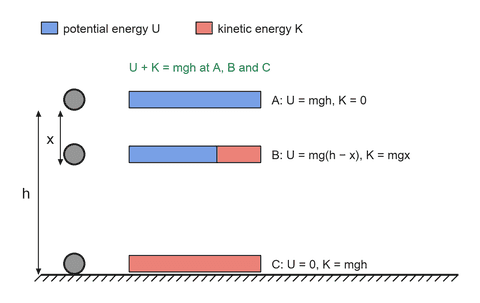
Step 7 — Conclude.
E_A, E_B and E_C are all mgh: the loss in potential energy is exactly equal to the gain in kinetic energy.
Therefore, the total mechanical energy of the freely falling body is mgh at the top, after falling x and at the ground: mechanical energy is conserved.
- 1385 marks
Question 138
A pendulum is oscillating on either side of its rest position. Explain the energy changes that take place in the oscillating pendulum. How does mechanical energy remain constant in it ? Draw the necessary diagram.
Solve with AIWritten solution
Solution:
Concept: In a swinging pendulum (air friction neglected), potential energy (due to height) and kinetic energy (due to speed) keep changing into each other. At an extreme position the bob is momentarily at rest at its highest point; at the mean position it is lowest and fastest. Their sum stays constant.
Step 1 — Set up the pendulum.
Let the bob of mass m swing between the extreme positions B and C, which are at a height h above the mean (rest) position A. Take P.E. at A as zero.
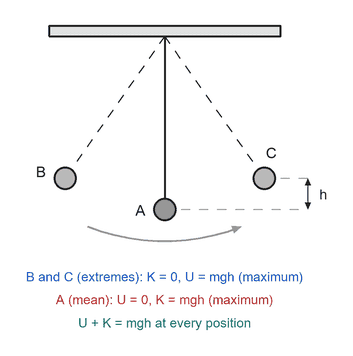
Step 2 — At the extreme position B.
The bob is momentarily at rest at its highest point: K.E. = 0 and P.E. = mgh (maximum).
Step 3 — From B to A.
The bob moves down and speeds up, so its P.E. changes into K.E.
Step 4 — At the mean position A.
It is at its lowest point with maximum speed: P.E. = 0 and K.E. = mgh (maximum).
Step 5 — From A to C.
It rises and slows down, so its K.E. changes back into P.E.
Step 6 — At the other extreme C.
It is at rest again, with K.E. = 0 and P.E. = mgh. The cycle then repeats from C back through A to B.
Step 7 — Why the total stays constant.
At every point, whatever P.E. is lost is gained as K.E. and vice versa.
Step 8 — In practice.
Air friction slowly changes some of the mechanical energy into heat, so the swings gradually die out.
Therefore, in an oscillating pendulum P.E. and K.E. keep changing into each other (P.E. maximum at B and C, K.E. maximum at A), while their sum K + U stays constant at mgh.
- 1393 marks
Question 139
A ball of mass 0·20 kg is thrown vertically upwards with an initial velocity of 20 m s. Calculate the maximum potential energy it gains as it goes up.
Solve with AIWritten solution
Solution:
Concept: As the ball rises it slows down and its kinetic energy changes into potential energy. At the highest point it is at rest, so ALL the initial K.E. has become P.E. (air resistance neglected).
Given: m = 0·20 kg, initial velocity u = 20 m s⁻¹.
Step 1 — Equate the energies.
Maximum P.E. gained = initial kinetic energy.
Step 2 — Substitute.
Put m = 0·20 kg and u = 20 m s⁻¹.
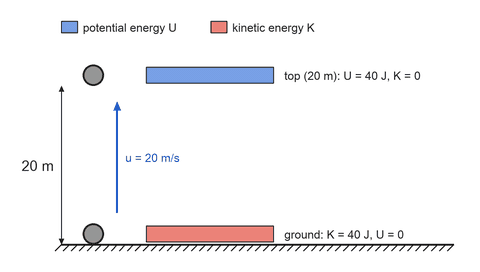
Step 3 — Say what it means.
Taking g = 10 m s⁻², the ball rises until mgh is 40 J.
Therefore, the maximum potential energy the ball gains is 40 J.
- 1404 marks
Question 140
A stone of mass 500 g is thrown vertically upwards with a velocity of 15 m s. Calculate : (a) the potential energy at the greatest height, (b) the kinetic energy on reaching the ground, and (c) the total energy at its half way point.
Solve with AIWritten solution
Solution:
Concept: Conservation of mechanical energy: when friction and air resistance are negligible, potential energy and kinetic energy change into each other, but their sum U + K stays constant. So the stone's total energy at every point equals the kinetic energy it was thrown with.
Given: m = 500 g, u = 15 m s⁻¹ (air resistance neglected).
Step 1 — Initial (total) energy.
500 g is 0·5 kg; use K = ½mu².
This total stays 56·25 J throughout the motion.
(a)
Step 2 — Potential energy at the greatest height.
The stone is at rest there (K = 0), so all the energy is potential: U = 56·25 J.
(b)
Step 3 — Kinetic energy on reaching the ground.
On the way down, all the P.E. changes back into K.E.; at the ground U = 0, so K = 56·25 J.
(c)
Step 4 — Total energy at the half-way point.
At half the greatest height it has half the P.E. and half the K.E. (28·125 J each), but the total is unchanged: 56·25 J.
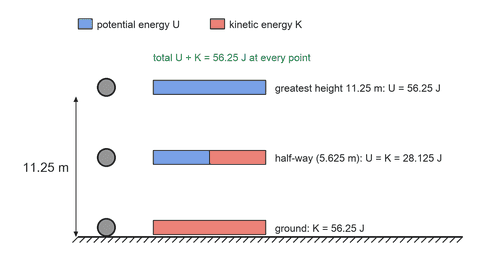
Therefore, (a) the potential energy at the greatest height is 56·25 J, (b) the kinetic energy on reaching the ground is 56·25 J, and (c) the total energy at the half-way point is 56·25 J.
- 1414 marks
Question 141
A metal ball of mass 2 kg is allowed to fall freely from rest from a height of 5 m above the ground.
(a) Taking m s, calculate :
(i) the potential energy possessed by the ball when it is initially at rest.
(ii) the kinetic energy of the ball just before it hits the ground ?
(b) What happens to the mechanical energy after the ball hits the ground and comes to rest ?
Solve with AIWritten solution
Solution:
Concept: At rest at a height, the ball has only potential energy. As it falls, this P.E. changes into K.E., so just before it hits the ground its K.E. equals the P.E. it started with (air resistance neglected).
Given: m = 2 kg, h = 5 m, g = 10 m s⁻².
(a)(i)
Step 1 — Potential energy at rest.
Use U = mgh.
(a)(ii)
Step 2 — Kinetic energy just before hitting the ground.
All 100 J of P.E. has become K.E.
Check: V² = 2gh gives 100 m² s⁻², so K = ½ × 2 × 100, which is 100 J.
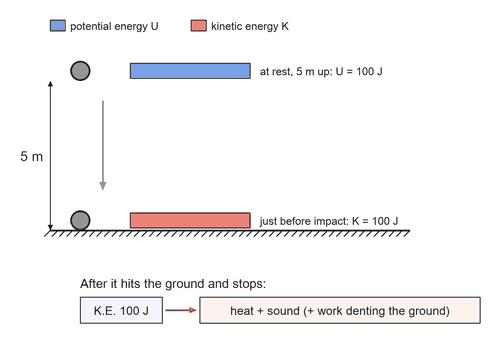
(b)
Step 3 — After the ball hits the ground and stops.
Its mechanical energy changes mainly into heat (the ball and the ground warm up slightly) and sound, with a little used in denting the ground. The energy is not destroyed; it only changes form.
Therefore, (a)(i) U = 100 J, (a)(ii) K = 100 J, and (b) on stopping, the mechanical energy changes into heat and sound energy.
- 1423 marks
Question 142
A person swings on a rope from a cliff that is 20 m high. How fast is the person moving at the lowest point of the swing ? (take m s)
- 1434 marks
Question 143
The diagram given alongside shows a ski jump. A skier weighing 60 kgf stands at A at the top of ski jump. He moves from A and takes off for his jump at B.
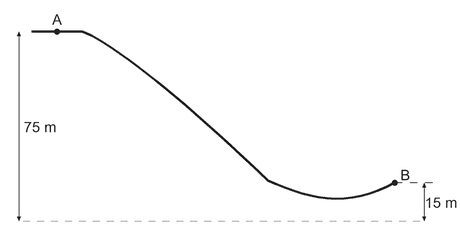
(a) Calculate the change in the gravitational potential energy of the skier between A and B.
(b) If 75% of the energy in part (a) becomes kinetic energy at B, calculate the speed at which the skier arrives at B.
(Take m s)
- 1444 marks
Question 144
A hydroelectric power station takes its water from a lake whose water level is at a height of 50 m above the turbine. Assuming an overall efficiency of 40%, calculate the mass of water which must flow through the turbine each second to produce power output of 1 MW. (Take m s).
- 1453 marks
Question 145
The bob of a simple pendulum is imparted a velocity of 5 m s when it is at its mean position. To what maximum vertical height will it rise on reaching at its extreme position if 60% of its energy is lost in overcoming the friction of air ?
(Take m s).
- 1463 marks
Question 146
The figure alongside shows a simple pendulum of mass 200 g. It is displaced from the mean position A to the extreme position B. The potential energy at position A is zero. At position B the bob is raised by 5 m.
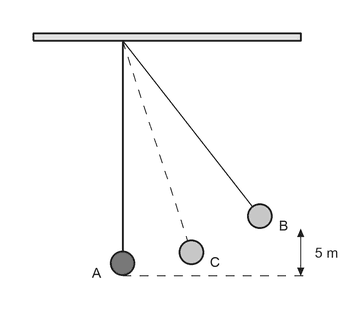
(a) What is the potential energy of the pendulum at position B ?
(b) What is the total mechanical energy at point C?
(c) What is the speed of the bob at position A when released from position B ? (Take m s)
What Class 10 Physics Ch 2 covers
The sections of the chapter, in the order the book takes them. Every question above comes from one of these.
- 01Work
- 02Power
- 03Energy
- 04Mechanical Energy and Its Different Forms
- 05Potential Energy
- 06Kinetic Energy
More ways to study this chapter
The same chapter asked three other ways. Practise it, revise it, and see what the board has set on Ch 2 before.
- Competency-Based Questions (CBQ)Case study questions: a situation, and the part of the chapter that answers it.40questionsOpen
- Previous Year QuestionsQuestions that have actually appeared in board papers, each tagged with its year.34questionsOpen
- Practice QuestionsExtra questions per chapter, for when one attempt at a method is not enough.46questionsOpen
Ch 2 in past ICSE papers
The same chapter as the board has actually asked it. These are worded differently from the textbook exercise, which is the point of reading them.
- 12 marks
Board paper question 1
A boy weighing 40 kgf climbs up a stair of 30 steps each 20 cm high in 4 minutes and a girl weighing 30 kgf does the same in 3 minutes. Compare :-
(i) The work done by them.
(ii) The power developed by them.
Solve with AIWritten solution
Solution:
Concept: In climbing stairs, a person does work against their own weight: W = weight × height climbed.
Power is the rate of doing work, P = W ÷ t; its S.I. unit is the watt, one joule per second. When a force F moves its point of application at a steady speed v along its own direction, the work done per second is F times the distance moved per second, so P = F v.
Given: Boy 40 kgf in 4 min, girl 30 kgf in 3 min; 30 steps, each 20 cm high.
Step 1 — Find the height climbed.
Both children climb the same 30 steps, each 20 cm high, so each rises through the same height h. Since 100 cm = 1 m, 20 cm = 0.2 m:
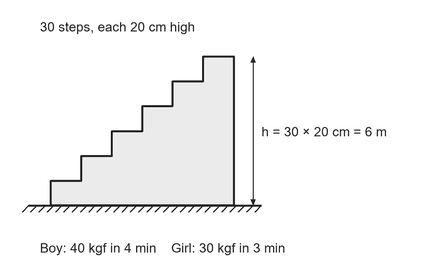
Step 2 — Change the weights into newton.
Taking g = 10 m s⁻², a weight of 1 kgf is 10 N:
Step 3 — Part (i): work done by each.
In climbing, each child does work against their own weight through the height h, so W = weight × h:
Step 4 — Part (i): compare the work.
Dividing the two values gives the ratio:
So the work done by the boy and the girl is in the ratio 4 : 3.
Step 5 — Change the times into seconds.
Power needs the time in seconds, and 1 min = 60 s:
Step 6 — Part (ii): power of each.
Power is the work done divided by the time taken:
Step 7 — Part (ii): compare the power.
Both powers are 10 W, so the ratio is 1 : 1. The boy does more work, but he also takes longer, so both do work at the same rate.
Watch out: The time does not enter the work at all; it is used only for the power. Change kgf to N, cm to m and minutes to seconds first.
Note: with g = 9.8 m s⁻² the values become 2352 J, 1764 J and 9.8 W each; the ratios 4 : 3 and 1 : 1 do not change.
Therefore, (i) work done by the boy : work done by the girl = 4 : 3; (ii) power of the boy : power of the girl = 1 : 1.
- 22 marks
Board paper question 2
If the power of a motor be 100 kW, at what speed can it raise a load of 50,000 N?
Solve with AIWritten solution
Solution:
Concept: Power is the rate of doing work, P = W ÷ t; its S.I. unit is the watt, one joule per second. When a force F moves its point of application at a steady speed v along its own direction, the work done per second is F times the distance moved per second, so P = F v.
Given: P = 100 kW; load = 50,000 N, raised at a steady speed.
Step 1 — Change the power into watt.
Since 1 kW = 1000 W:
Step 2 — Find the force needed.
To raise the load at a steady speed, the motor must pull up with a force equal to the load, so F = 50,000 N.
Step 3 — Rearrange P = F v.
We want the speed, so we divide both sides of P = F v by F:
Step 4 — Substitute the values.
Now we put in P = 100,000 W and F = 50,000 N:
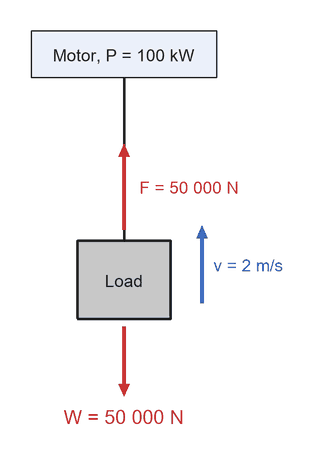
Check: In each second the load rises 2 m, so the motor does 50,000 N × 2 m of work every second:
This is the 100 kW power of the motor.
Watch out: Change kW into W before dividing; 100 ÷ 50,000 would give a speed 1000 times too small.
Therefore, the motor can raise the load at a speed of 2 m s⁻¹.
- 32 marks
Board paper question 3
(i) State and define the S.I. unit of power.
(ii) How is the unit horse power related to the S.I. unit of power ?
Solve with AIWritten solution
Solution:
Concept: Power is the rate of doing work: P = W ÷ t.
Step 1 — Part (i): name the unit.
Power is work done per unit time, so its unit is the unit of work (joule) divided by the unit of time (second). This unit is called the watt (W).
Step 2 — Part (i): define the watt.
The power of an agent is 1 watt if it does 1 joule of work in 1 second (or uses 1 J of energy every second):
Step 3 — Part (ii): relate the horse power.
The horse power (H.P.) is a bigger, older unit of power:
So 1 H.P. is 0.746 kW, a little less than one kilowatt.
Watch out: The watt is a unit of power; the joule and the kilowatt hour are units of work (energy).
Therefore, (i) the S.I. unit of power is the watt: 1 W = 1 J s⁻¹, the power of an agent doing 1 J of work in 1 s; (ii) 1 H.P. = 746 W.
- 42 marks
Board paper question 4
State the energy changes in the following cases while in use:
(i) An electric iron.
(ii) A ceiling fan.
Solve with AIWritten solution
Solution:
Concept: Every device or process takes in energy in one form and gives it out in another. To name the change, first name the form of energy that is supplied, then the useful form that comes out.
Step 1 — Part (i): the electric iron.
An electric iron takes in electrical energy from the mains. The current flows through its heating element (a nichrome coil), which becomes hot, and this heat passes to the clothes. So the useful output is heat energy.
Step 2 — Part (ii): the ceiling fan.
A ceiling fan also takes in electrical energy. Its electric motor turns the blades, so the useful output is mechanical (kinetic) energy of the rotating blades and of the air they push. A small part is wasted as heat and sound.
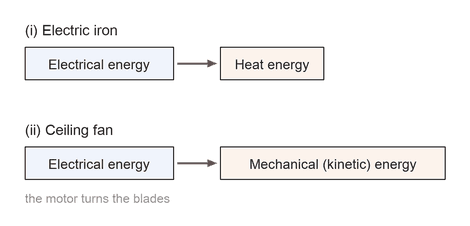
Watch out: Name forms of energy (electrical, heat, mechanical), not parts of the device.
Therefore, (i) electric iron: electrical energy → heat energy; (ii) ceiling fan: electrical energy → mechanical (kinetic) energy.
- 52 marks
Board paper question 5
(i) Why is the motion of a body moving with a constant speed around a circular path said to be accelerated?
(ii) Name the unit of physical quantity obtained by the formula . Where K: kinetic energy, V: Linear Velocity.
Solve with AIWritten solution
Solution:
Concept: Velocity has both size and direction, and acceleration is the rate of change of velocity, so a change of direction alone is an acceleration. A body of mass m moving with speed v has kinetic energy K = ½ m v².
Step 1 — Part (i): look at the direction of motion.
On a circular path the body moves, at each instant, along the tangent to the circle at that point. As it goes round, this tangent keeps turning, so the direction of motion changes at every point.
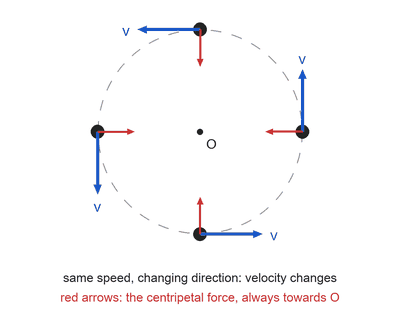
Step 2 — Part (i): see why this is acceleration.
Velocity has both a size (the speed) and a direction. Even though the speed stays constant, the direction keeps changing, so the velocity keeps changing. A change of velocity per unit time is acceleration, so the motion is accelerated; this acceleration points towards the centre (centripetal acceleration).
Step 3 — Part (ii): write the kinetic energy.
A body of mass m moving with velocity V has kinetic energy:
Step 4 — Part (ii): rearrange for 2K/V².
Multiplying both sides by 2 and then dividing by V² leaves the mass alone:
Step 5 — Part (ii): name the unit.
So 2K/V² is the mass of the body, whose S.I. unit is the kilogram (kg). The units agree, since 1 J = 1 kg m² s⁻²:
Watch out: Constant speed is not constant velocity: a body going round a circle at a steady speed is still accelerated.
Therefore, (i) its direction of motion, and so its velocity, changes at every instant, which is an acceleration (towards the centre); (ii) 2K/V² is the mass, whose unit is the kilogram (kg).
- 63 marks
Board paper question 6
(i) Derive a relationship between S.I. and C.G.S. unit of work.
(ii) A force acts on a body and displaces it by a distance S in a direction at an angle θ with the direction of force. What should be the value of θ to get the maximum positive work?
Solve with AIWritten solution
Solution:
Concept: Work is done when a force moves a body. If the force F makes an angle θ with the displacement S, only the part F cos θ acts along the displacement, so W = F S cos θ. Its S.I. unit is the joule: 1 joule is the work done when a force of 1 N moves a body through 1 m in its own direction. The C.G.S. unit of work is the erg (1 dyne × 1 cm).
Step 1 — Part (i): write the two units.
The S.I. unit of work is the joule and the C.G.S. unit is the erg:
Step 2 — Part (i): change newton and metre into C.G.S. units.
Since 1 kg = 1000 g and 1 m = 100 cm, a newton (1 kg m s⁻²) is:
and 1 m = 10² cm.
Step 3 — Part (i): substitute.
We put both into 1 J = 1 N × 1 m:
Step 4 — Part (ii): write the work at an angle.
When the force F makes an angle θ with the displacement S, only its part F cos θ acts along the displacement, so:
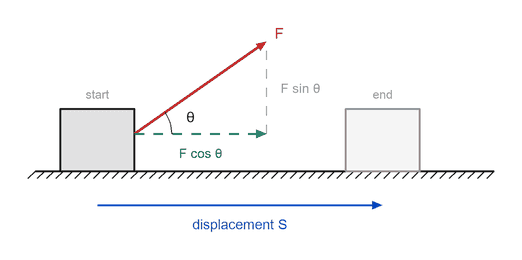
Step 5 — Part (ii): make the work greatest.
For a given F and S, W is greatest when cos θ is greatest. The largest value of cos θ is 1, at θ = 0°:
So the body must move in the direction of the force.
Watch out: Θ = 90° gives zero work and θ = 180° gives negative work; the maximum positive work is at θ = 0°.
Therefore, (i) 1 J = 10⁷ erg; (ii) θ = 0°, that is, the body moves in the direction of the force, and then W = F S.
All 34 board paper questions for this chapter, solved the same way.
Class 10 Physics Ch 2 questions students ask
How many questions are there in Class 10 Physics Ch 2?
146 questions. Every one is solved step by step on this page.
Are these Class 10 Physics solutions free?
Yes. Every question and its full working is free to read, with no account needed.
Can I download the Class 10 Physics Ch 2 solutions as a PDF?
There is no PDF to download. Every solution is on this page instead, which means it is searchable, always the current syllabus, and readable on a phone. Use your browser's print option if you want it on paper.