Solution:
Concept: Conservation of mechanical energy: when friction and air resistance are negligible, potential energy and kinetic energy change into each other, but their sum U + K stays constant. So the stone's total energy at every point equals the kinetic energy it was thrown with.
Given: m = 500 g, u = 15 m s⁻¹ (air resistance neglected).
Step 1 — Initial (total) energy.
500 g is 0·5 kg; use K = ½mu².
K=21×0.5×152=0.25×225=56.25 J
This total stays 56·25 J throughout the motion.
(a)
Step 2 — Potential energy at the greatest height.
The stone is at rest there (K = 0), so all the energy is potential: U = 56·25 J.
(b)
Step 3 — Kinetic energy on reaching the ground.
On the way down, all the P.E. changes back into K.E.; at the ground U = 0, so K = 56·25 J.
(c)
Step 4 — Total energy at the half-way point.
At half the greatest height it has half the P.E. and half the K.E. (28·125 J each), but the total is unchanged: 56·25 J.
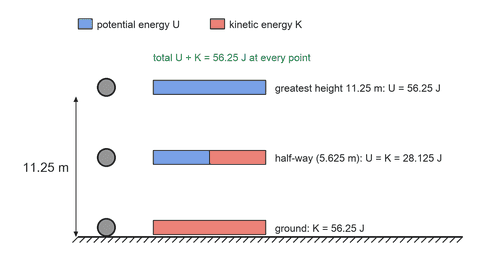
Therefore, (a) the potential energy at the greatest height is 56·25 J, (b) the kinetic energy on reaching the ground is 56·25 J, and (c) the total energy at the half-way point is 56·25 J.
