Solution:
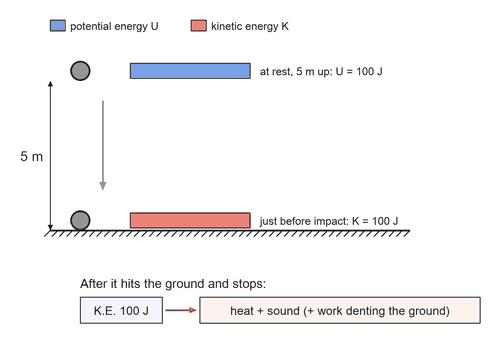
Concept: At rest at a height, the ball has only potential energy. As it falls, this P.E. changes into K.E., so just before it hits the ground its K.E. equals the P.E. it started with (air resistance neglected).
Given: m = 2 kg, h = 5 m, g = 10 m s⁻².
(a)(i)
Step 1 — Potential energy at rest.
Use U = mgh.
U=2×10×5=100 J
(a)(ii)
Step 2 — Kinetic energy just before hitting the ground.
All 100 J of P.E. has become K.E.
K=100 J
Check: V² = 2gh gives 100 m² s⁻², so K = ½ × 2 × 100, which is 100 J.
(b)
Step 3 — After the ball hits the ground and stops.
Its mechanical energy changes mainly into heat (the ball and the ground warm up slightly) and sound, with a little used in denting the ground. The energy is not destroyed; it only changes form.
Therefore, (a)(i) U = 100 J, (a)(ii) K = 100 J, and (b) on stopping, the mechanical energy changes into heat and sound energy.
