
Question 1393 marksEasy
A ball of mass 0·20 kg is thrown vertically upwards with an initial velocity of 20 m s. Calculate the maximum potential energy it gains as it goes up.
Confirming your payment
Sign up now and get 250 free tokens.
Work, Energy and Power · Question 139 of 146
A ball of mass 0·20 kg is thrown vertically upwards with an initial velocity of 20 m s. Calculate the maximum potential energy it gains as it goes up.
Solution:
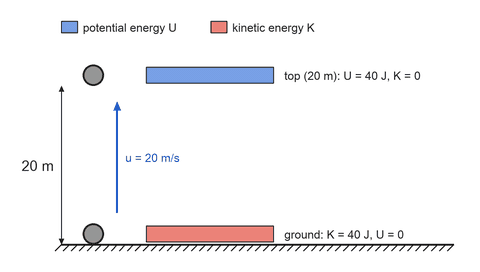
Concept: As the ball rises it slows down and its kinetic energy changes into potential energy. At the highest point it is at rest, so ALL the initial K.E. has become P.E. (air resistance neglected).
Given: m = 0·20 kg, initial velocity u = 20 m s⁻¹.
Step 1 — Equate the energies.
Maximum P.E. gained = initial kinetic energy.
Step 2 — Substitute.
Put m = 0·20 kg and u = 20 m s⁻¹.
Step 3 — Say what it means.
Taking g = 10 m s⁻², the ball rises until mgh is 40 J.
Therefore, the maximum potential energy the ball gains is 40 J.