
Question 1385 marksMedium
A pendulum is oscillating on either side of its rest position. Explain the energy changes that take place in the oscillating pendulum. How does mechanical energy remain constant in it ? Draw the necessary diagram.
Confirming your payment
Sign up now and get 250 free tokens.
Work, Energy and Power · Question 138 of 146
A pendulum is oscillating on either side of its rest position. Explain the energy changes that take place in the oscillating pendulum. How does mechanical energy remain constant in it ? Draw the necessary diagram.
Solution:
Concept: In a swinging pendulum (air friction neglected), potential energy (due to height) and kinetic energy (due to speed) keep changing into each other. At an extreme position the bob is momentarily at rest at its highest point; at the mean position it is lowest and fastest. Their sum stays constant.
Step 1 — Set up the pendulum.
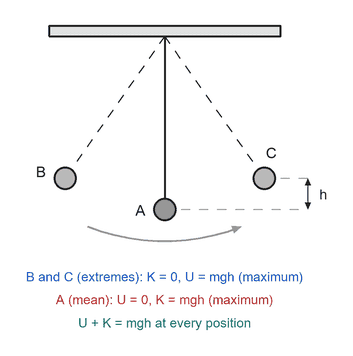
Let the bob of mass m swing between the extreme positions B and C, which are at a height h above the mean (rest) position A. Take P.E. at A as zero.
Step 2 — At the extreme position B.
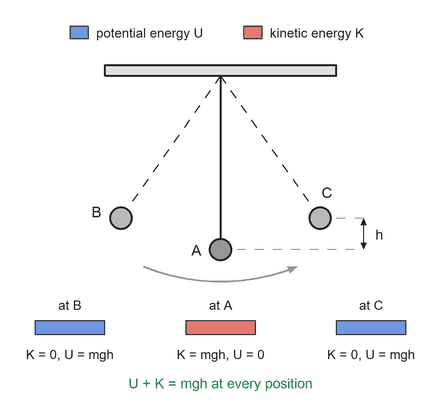
The bob is momentarily at rest at its highest point: K.E. = 0 and P.E. = mgh (maximum).
Step 3 — From B to A.
The bob moves down and speeds up, so its P.E. changes into K.E.
Step 4 — At the mean position A.
It is at its lowest point with maximum speed: P.E. = 0 and K.E. = mgh (maximum).
Step 5 — From A to C.
It rises and slows down, so its K.E. changes back into P.E.
Step 6 — At the other extreme C.
It is at rest again, with K.E. = 0 and P.E. = mgh. The cycle then repeats from C back through A to B.
Step 7 — Why the total stays constant.
At every point, whatever P.E. is lost is gained as K.E. and vice versa.
Step 8 — In practice.
Air friction slowly changes some of the mechanical energy into heat, so the swings gradually die out.
Therefore, in an oscillating pendulum P.E. and K.E. keep changing into each other (P.E. maximum at B and C, K.E. maximum at A), while their sum K + U stays constant at mgh.