Solution:
Concept: Find U (mgh) and K (½mv²) at three points of the fall and show that their sum is the same, mgh, at each. The speed comes from the equation of motion v² = u² + 2gs, with u = 0.
Step 1 — Set up the fall.
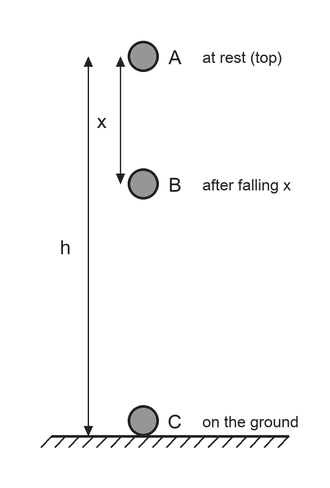
Let a body of mass m fall freely from rest from point A at height h. B is the point after it has fallen a distance x, and C is on the ground.
(i)
Step 2 — At the top, A.
The body is at rest, so K = 0, and its height is h, so U = mgh.
EA=0+mgh=mgh
(ii)
Step 3 — Potential energy at B.
Its height is now h − x.
UB=mg(h−x)
Step 4 — Kinetic energy at B.
It has fallen x from rest, so v² = 2gx.
KB=21m(2gx)=mgx
Step 5 — Total at B.
Add the two.
EB=mgx+mg(h−x)=mgh
(iii)
Step 6 — On the ground, C.
The height is 0, so U = 0. It has fallen through h, so v² = 2gh.
KC=21m(2gh)=mgh
EC=mgh+0=mgh
Step 7 — Conclude.
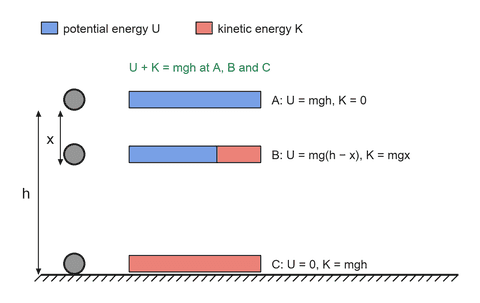
E_A, E_B and E_C are all mgh: the loss in potential energy is exactly equal to the gain in kinetic energy.
Therefore, the total mechanical energy of the freely falling body is mgh at the top, after falling x and at the ground: mechanical energy is conserved.
