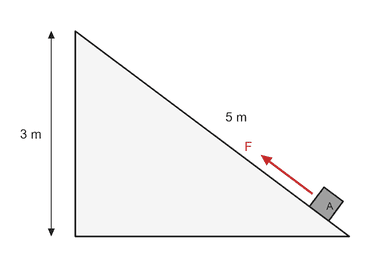
Solution:
Concept: Work done by F uses the distance moved along the slope (the direction of F). The gain in potential energy uses only the vertical height risen. The difference is the work done against friction.
Given: weight = 100 N, F = 100 N along the slope, length of slope = 5 m, height = 3 m.
(a)
Step 1 — Work done by F.
F and the displacement are both along the slope.
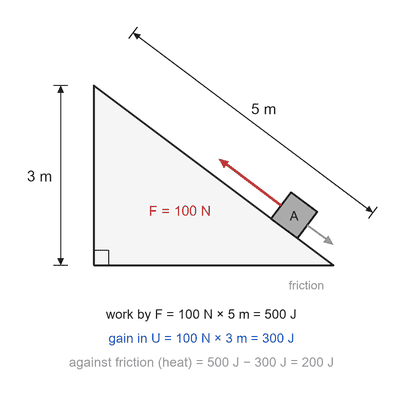
W=100×5=500 J
(b)
Step 2 — Increase in potential energy.
The block (weight 100 N) rises through the vertical height of the slope, 3 m (Fig. 2.15).
ΔU=100×3=300 J
(c)
Step 3 — Account for the difference.
The difference is used in doing work against the force of friction between the block and the slope, and it appears as heat.
500−300=200 J
Step 4 — Compare with a smooth slope.
On a frictionless slope a force of only 100 × 3/5, that is 60 N, would be enough, doing exactly 300 J over 5 m.
Watch out: Use 5 m for the work of F, but 3 m (the vertical rise) for the potential energy.
Therefore, (a) the work done by F is 500 J, (b) the increase in potential energy is 300 J, and (c) the remaining 200 J is spent against friction (as heat).