
Question 1301 markEasy
A body is thrown vertically upwards. Its velocity keeps on decreasing. What happens to its kinetic energy as its velocity becomes zero ?
Confirming your payment
Sign up now and get 250 free tokens.
Work, Energy and Power · Question 130 of 146
A body is thrown vertically upwards. Its velocity keeps on decreasing. What happens to its kinetic energy as its velocity becomes zero ?
Solution:
Concept: Kinetic energy depends on speed (K = ½mv²); potential energy depends on height (U = mgh). Conservation of mechanical energy: when friction and air resistance are negligible, potential energy and kinetic energy change into each other, but their sum U + K stays constant.
Step 1 — See what happens as it rises.
As the body rises it slows down, so its kinetic energy changes into potential energy.
Step 2 — At zero velocity.
When the velocity becomes zero at the highest point, K = ½m × 0², so the kinetic energy is zero; all of it has become gravitational potential energy (air resistance neglected).
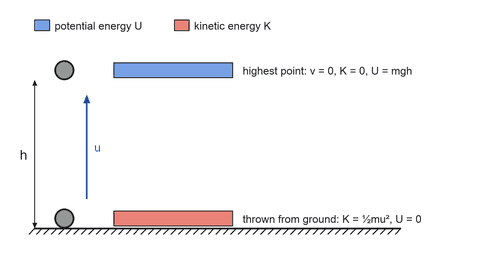
Therefore, the kinetic energy becomes zero when the velocity becomes zero, because it has all changed into potential energy.