
Opening your dashboard
Class 10 Physics Chapter 2 Work, Energy and Power: Practice Questions
46 questions on Chapter 2, each worked through on its own page with the AI tutor. Class 10 Physics, ICSE 2026-27.
46 questions
1–5 marks · Mixed difficulty
- 11 mark
Question 1
Bloom's level: Remember
Which one of the following is not a unit of energy ?
- 21 mark
Question 2
Bloom's level: Remember
The energy stored in food, in petrol and in a dry cell is :
- 31 mark
Question 3
Bloom's level: Understand
In which of the following is the work done by the named force negative ?
- 41 mark
Question 4
Bloom's level: Apply
On a building site, an electric hoist raises a crate of bricks of mass 200 kg to the third floor, 15 m up, in 20 s. What power does the hoist develop ? ( m s⁻²)
- 51 mark
Question 5
Bloom's level: Apply
A fast bowler delivers a 150 g ball that leaves his hand at 20 m s⁻¹. How much kinetic energy has he given to the ball ?
- 61 mark
Question 6
Bloom's level: Analyse
Four bodies are moving as shown :
Body Mass Speed P 2 kg 6 m s⁻¹ Q 8 kg 3 m s⁻¹ R 1 kg 10 m s⁻¹ S 4 kg 4 m s⁻¹ Which body has the greatest kinetic energy but the least momentum ?
- 71 mark
Question 7
Bloom's level: Understand
A stone is dropped from rest from a height H. Neglecting air resistance, when it has fallen half-way (to a height ), its kinetic energy is :
- 81 mark
Question 8
Bloom's level: Evaluate
A swinging pendulum slowly comes to rest. Nisha says, "This proves that energy can be destroyed." Which is the best judgement ?
- 91 mark
Question 9
Bloom's level: Understand
While a rechargeable battery of a mobile phone is being charged, the energy change is from :
- 101 mark
Question 10
Bloom's level: Understand
Read the Assertion (A) and the Reason (R) and choose the correct option.
Assertion (A): The wound-up spring of a toy car possesses potential energy.
Reason (R): A body possesses potential energy because of its changed position or changed shape (configuration).
- 111 mark
Question 11
Bloom's level: Remember
Read the Assertion (A) and the Reason (R) and choose the correct option.
Assertion (A): Work and energy have the same S.I. unit, the joule.
Reason (R): Power is the rate of doing work.
- 121 mark
Question 12
Bloom's level: Analyse
Read the Assertion (A) and the Reason (R) and choose the correct option.
Assertion (A): If the speed of a car is doubled, the distance it travels before stopping, under the same braking force, becomes four times.
Reason (R): The work done by the braking force (force × distance) must equal the kinetic energy of the car, and kinetic energy is proportional to the square of the speed.
- 131 mark
Question 13
Bloom's level: Remember
Express the total mechanical energy E of a body in terms of the two kinds of energy that make it up.
- 142 marks
Question 14
Bloom's level: Apply
Write the relation between power, force and velocity. The engine of a car develops a power of 30 kW while the car moves at a steady 20 m s⁻¹. Find the force exerted by the engine.
- 152 marks
Question 15
Bloom's level: Understand
State the form of mechanical energy (kinetic, potential, or both) in each of the following, with a reason :
(a) water stored in an overhead tank
(b) a stretched catapult (gulel) just before release
(c) a spinning top
(d) a bird flying above a tree
- 162 marks
Question 16
Bloom's level: Apply
A child pulls a toy cart through 10 m along a level floor with a string that makes an angle of 60° with the floor. The tension in the string is 50 N. Find the work done by the child. ()
- 172 marks
Question 17
Bloom's level: Apply
A trekker of mass 60 kg climbs from a camp at a height of 1200 m to a peak at 1500 m. Find the gain in her gravitational potential energy in joule and in kWh. ( m s⁻²; 1 kWh J)
- 182 marks
Question 18
Bloom's level: Apply
A lift and its passengers have a total mass of 800 kg. The lift rises at a steady speed through 30 m in 20 s. Find the power of its motor in kW and in horse power. ( m s⁻²; 1 H.P. = 746 W)
- 192 marks
Question 19
Bloom's level: Understand
State the energy changes that take place in :
(a) a wind turbine producing electricity,
(b) a hair dryer while in use.
- 202 marks
Question 20
Bloom's level: Analyse
A ball of mass 0.5 kg is dropped from rest from a height of 20 m. Neglect air resistance. At what height above the ground is its kinetic energy three times its potential energy ? What is its kinetic energy there ? ( m s⁻²)
- 212 marks
Question 21
Bloom's level: Evaluate
Worker A lifts a 100 kg sack onto a 2 m high platform in 8 s. Worker B lifts a 60 kg sack onto the same platform in 4 s. The supervisor says, "A is more powerful because he did more work." Check this claim. ( m s⁻²)
- 222 marks
Question 22
Bloom's level: Analyse
A 60 W filament bulb gives out only 3 J of light energy every second. Where does the rest of the energy go ? What fraction of the electrical energy is useful ? Does this break the principle of conservation of energy ?
- 234 marks
Question 23
Bloom's level: Apply
A car of mass 1000 kg is moving at 72 km h⁻¹. The brakes apply a steady force of 5000 N.
(a) Find the kinetic energy of the car at 72 km h⁻¹ and at 36 km h⁻¹.
(b) How far does the car travel while slowing down from 72 km h⁻¹ to 36 km h⁻¹ ?
(c) How much farther does it travel before stopping ? Comment on your answers to (b) and (c).
- 244 marks
Question 24
Bloom's level: Apply
Case study: At a water park, a child of mass 30 kg starts from rest at the top of a slide 5 m high and slides down into the pool. ( m s⁻²)
(a) State the energy change as the child slides down.
(b) If there were no friction, what would be the child's speed at the bottom ?
(c) The child's actual speed at the bottom is 8 m s⁻¹. How much energy has been changed into other forms, and into which form mainly ?
- 254 marks
Question 25
Bloom's level: Apply
Case study: A hill village runs a small hydroelectric plant on a stream. Every second, 200 kg of water falls through a height of 12 m onto a turbine connected to a generator. ( m s⁻²)
(a) State the energy changes from the water at the top to the electricity produced.
(b) Find the potential energy given up by the water every second. What power does this represent ?
(c) If only 75% of this energy is changed into electrical energy, find the electrical power. How many 60 W lamps can it light at the same time ?
- 264 marks
Question 26
Bloom's level: Evaluate
Case study: An online advertisement claims: "Our new electric scooter has a dynamo on its wheels that recharges the battery while you ride. It produces more electrical energy than the motor uses, so you will never need to charge it."
(a) State the principle of conservation of energy.
(b) Judge the claim using this principle.
(c) Explain why, in every real machine, the useful energy obtained is less than the energy supplied.
- 274 marks
Question 27
Bloom's level: Analyse
A book of mass 2 kg is on a shelf 2 m above the floor of a room. The floor of the room is 10 m above the ground outside. ( m s⁻²)
(a) Find the potential energy of the book taking (i) the floor and (ii) the ground as the zero level.
(b) The book is moved to a table 0.8 m high. Find its new potential energy with each zero level, and the decrease in each case.
(c) What do your answers show about the value of potential energy and about the change in potential energy ?
- 285 marks
Question 28
Bloom's level: Create
Design an activity to measure your own power when you run up a flight of stairs.
(a) List the quantities you will measure and the instruments you will use.
(b) Write the formula you will use to calculate the power.
(c) Make up a sensible set of readings and calculate the power from them.
(d) State two precautions, and say how you could check whether your power is greater when you run than when you walk.
- 293 marks
Question 29
Bloom's level: Understand
Name the form of energy in each case and explain where the energy comes from or what it is due to :
(a) a hot cup of tea,
(b) a vibrating guitar string,
(c) the uranium fuel in a nuclear power reactor.
- 304 marks
Question 30
Bloom's level: Create
Plan an experiment with a wooden ramp, a toy car, some weights that can be fixed on the car, a small wooden block and a metre scale to show that the kinetic energy of a moving body depends on (a) its speed and (b) its mass. Describe :
(a) how you will set up the apparatus and how you will judge the kinetic energy of the car,
(b) how you will show the effect of speed,
(c) how you will show the effect of mass, and what result you expect in each case.
- 312 marks
Question 31
Nandan tried to push a heavy rock of mass 200 kg for 100 s, but could not move it. Find the work done by Nandan at the end of 100 s.
- 322 marks
Question 32
Compute the speed of a ball of mass 2 kg which has a kinetic energy of 4 J.
- 332 marks
Question 33
Name the form of kinetic energy possessed by :
(i) a moving bullet
(ii) a spinning top
- 342 marks
Question 34
A man pushes a heavy box across a floor. He exerts a force of 80 N and the box moves 4.0 m in 10.0 s in the direction of the force. What useful power does the man develop ?
- 353 marks
Question 35
A body of mass 40 kg has a momentum of 2000 kg m s. Calculate :
(i) the kinetic energy of the body
(ii) the velocity of the body
- 362 marks
Question 36
A crane moves its load diagonally, as shown in the figure. The distances A, B, C and D are marked on the figure.
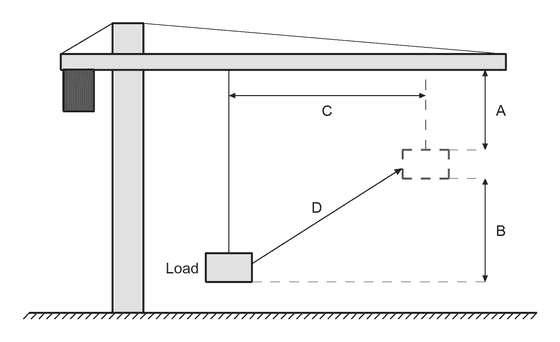
By which of these distances must the weight of the load be multiplied to find the increase in the gravitational potential energy of the load ? Give a reason for your answer.
- 371 mark
Question 37
A force of 40 N acts on a body. The body moves through 3 m in a direction which makes an angle of 60° with the direction of the force. The work done by the force is :
- 381 mark
Question 38
An electric heater uses J of energy. Expressed in kilowatt hour, this energy is :
- 391 mark
Question 39
Assertion (A): When the momentum of a body of constant mass is doubled, its kinetic energy is also doubled.
Reason (R): The kinetic energy of a body of mass is related to its momentum by .
- 402 marks
Question 40
The motor of a crane supplies a useful power of 2.4 kW while it raises a load of mass 400 kg at a steady speed. (Take m s.)
(i) Calculate the work done by the motor on the load in 10 s.
(ii) Calculate the height through which the load is raised in this time.
- 412 marks
Question 41
A body of mass 5 kg is taken from a height of 4 m above the ground to a height of 10 m above the ground. (Take m s.)
(i) Calculate the increase in its gravitational potential energy.
(ii) State the work done by the force of gravity on the body during this rise. Give a reason for its sign.
- 422 marks
Question 42
A torch which has dry cells and a filament bulb is switched on.
(i) State the energy change which takes place in the cells.
(ii) State the energy changes which take place in the bulb. Which of them is the useful change ?
- 432 marks
Question 43
A bird of mass 0.5 kg is flying at a speed of 8 m s at a height of 20 m above the ground. (Take m s.)
(i) Calculate the kinetic energy of the bird.
(ii) Calculate its total mechanical energy, taking the potential energy at the ground as zero.
- 444 marks
Question 44
A cricket ball of mass 160 g moving at 25 m s is caught by a fielder. While stopping the ball, the fielder's hands move back through 0.4 m in the direction of motion of the ball.
(i) Calculate the kinetic energy of the ball just before it is caught.
(ii) State the work done on the ball by the force exerted by the hands in bringing it to rest. Name the theorem you have used.
(iii) Calculate the average force exerted by the hands on the ball. What would this force be if the ball were stopped in one-fourth of this distance ?
- 454 marks
Question 45
The bob of a simple pendulum has a mass of 0.2 kg. It is pulled aside to the point A, which is 0.45 m above its lowest position B, and released from rest. As it swings, it passes through B and then through the point C, which is 0.25 m above B, as shown in the diagram. Neglect air resistance and take the potential energy of the bob at B as zero. (Take m s.)
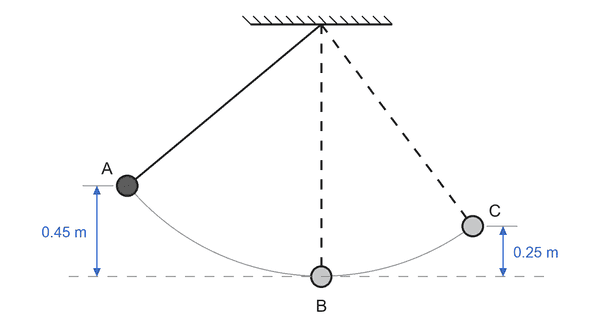
(i) Calculate the potential energy of the bob at A. What is its kinetic energy at A ?
(ii) Calculate the speed of the bob at B.
(iii) Calculate the kinetic energy of the bob at C.
- 463 marks
Question 46
A porter lifts a suitcase of mass 15 kg from the platform on to his head, through a height of 1.6 m. He walks 50 m along the level platform and then climbs a staircase to a foot-bridge which is 4 m above the platform. (Take m s.)
(i) Calculate the work done by the porter against the force of gravity in lifting the suitcase on to his head.
(ii) How much work does he do against the force of gravity on the suitcase while walking along the level platform ? Give a reason.
(iii) Calculate the work done by him against the force of gravity on the suitcase while climbing the staircase. Does this work depend on the length of the staircase ?