
Question 543 marksEasy
It takes 20 s for a person A of mass 50 kg to climb up the stairs, while another person B of same mass does the same in 15 s. Compare the (i) work done, and (ii) power developed by the persons A and B.
Confirming your payment
Sign up now and get 250 free tokens.
Work, Energy and Power · Question 54 of 146
It takes 20 s for a person A of mass 50 kg to climb up the stairs, while another person B of same mass does the same in 15 s. Compare the (i) work done, and (ii) power developed by the persons A and B.
Solution:
Concept: To lift a body of mass m through a vertical height h, a force equal to its weight mg must act through h, so the work done against gravity is W = mgh. Only the vertical height counts, not the path or the time. For equal work, power is inversely proportional to the time (P = W ÷ t).
Given: m = 50 kg each, same stairs; t_A = 20 s, t_B = 15 s.
(i)
Step 1 — Compare the work.
A and B have the same mass and climb the same stairs (same h), so each does work mgh.
(ii)
Step 2 — Compare the power.
The work W is the same, so the ratio of powers is the inverse ratio of the times.
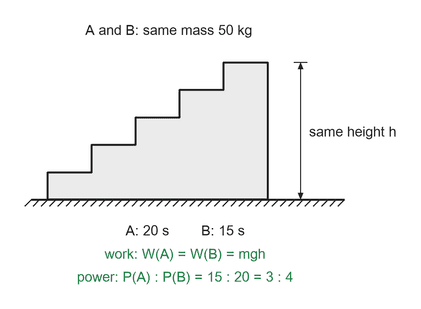
Watch out: The faster person (B, 15 s) has the LARGER power, so the times go in the ratio upside down.
Therefore, (i) the work done by A and B is in the ratio 1 : 1, and (ii) their powers are in the ratio 3 : 4.