
Question 554 marksEasy
A boy weighing 40 kgf climbs up a stair of 30 steps each 20 cm high in 4 minutes and a girl weighing 30 kgf does the same in 3 minutes. Compare :
(i) the work done by them, and
(ii) the power developed by them.
Confirming your payment
Sign up now and get 250 free tokens.
Work, Energy and Power · Question 55 of 146
A boy weighing 40 kgf climbs up a stair of 30 steps each 20 cm high in 4 minutes and a girl weighing 30 kgf does the same in 3 minutes. Compare :
(i) the work done by them, and
(ii) the power developed by them.
Solution:
Concept: To lift a body of mass m through a vertical height h, a force equal to its weight mg must act through h, so the work done against gravity is W = mgh. Only the vertical height counts, not the path or the time. Power is the rate of doing work, P = W ÷ t; its S.I. unit is the watt (1 W = 1 J s⁻¹), and 1 kW = 1000 W, while 1 H.P. = 746 W.
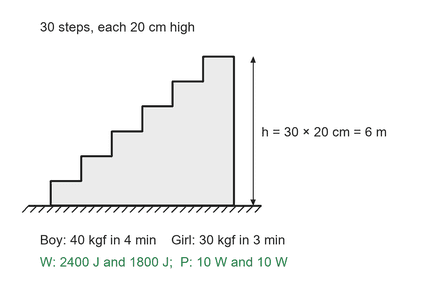
Given: boy 40 kgf in 4 min, girl 30 kgf in 3 min; 30 steps of 20 cm.
Step 1 — Height climbed.
Both climb 30 steps of 20 cm, that is 30 × 0·2 m.
(i)
Step 2 — Compare the work.
The height is the same for both, so the work is in the ratio of their weights.
(ii)
Step 3 — Find each power.
Take g = 10 N kg⁻¹, so 40 kgf = 400 N and 30 kgf = 300 N; the times are 4 min = 240 s and 3 min = 180 s.
Step 4 — Compare the powers.
The two powers are equal.
Watch out: The ratio does not depend on the value of g; any value cancels.
Therefore, (i) the work done by the boy and the girl is in the ratio 4 : 3, and (ii) their powers are in the ratio 1 : 1.