Solution:
Concept: To lift a body of mass m through a vertical height h, a force equal to its weight mg must act through h, so the work done against gravity is W = mgh. Only the vertical height counts, not the path or the time. For equal work, power is inversely proportional to the time.
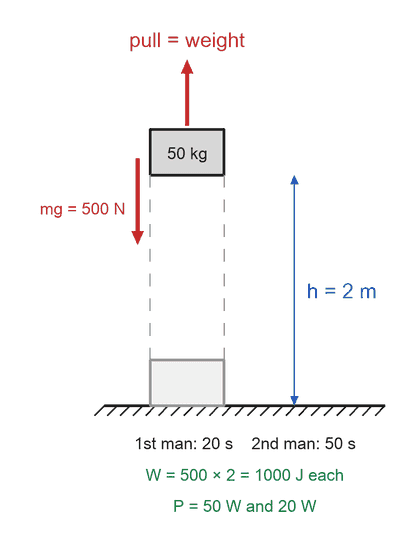
Given: m = 50 kg, h = 2 m, t₁ = 20 s, t₂ = 50 s, g = 10 N kg⁻¹.
(a)(i)
Step 1 — Compare the work.
Both men raise the same box through the same height, so they do the same work.
W1:W2=1:1
(a)(ii)
Step 2 — Compare the power.
For the same work, the power ratio is the inverse ratio of the times.
P2P1=t1t2=2050=25
(b)(i)
Step 3 — Work done by each.
Use W = mgh, with m = 50 kg, g = 10 N kg⁻¹ and h = 2 m.
W=50×10×2=1000 J
(b)(ii)
Step 4 — Power of each.
Divide the work by each man's time.
P1=201000=50 W
P2=501000=20 W
Check: The answers in (b) agree with (a): 50 W : 20 W is 5 : 2.
Therefore, (a) the work is in the ratio 1 : 1 and the power 5 : 2; (b) each man does 1000 J of work, and their powers are 50 W and 20 W.
