Solution:
Concept: To lift a body of mass m through a vertical height h, a force equal to its weight mg must act through h, so the work done against gravity is W = mgh. Only the vertical height counts, not the path or the time. For equal work, power is inversely proportional to the time.
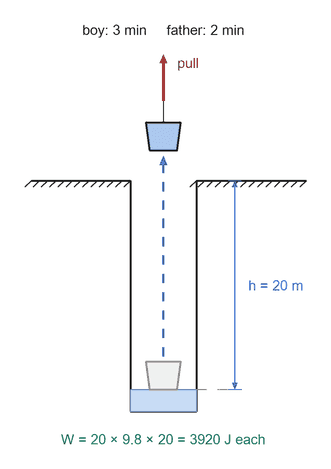
Given: V = 20 litre, depth h = 20 m, boy 3 min, father 2 min, density of water = 10³ kg m⁻³, g = 9·8 N kg⁻¹.
(a)(i)
Step 1 — Compare the work.
Both lift the same bucket of water through the same depth, so the work is the same.
Wboy:Wfather=1:1
(a)(ii)
Step 2 — Compare the power.
For equal work, the power ratio is the inverse ratio of the times.
PfatherPboy=tboytfather=32
(b)
Step 3 — Mass of water.
20 litre = 0·02 m³; multiply by the density (the bucket's own mass is ignored, as in the book).
m=0.02×103=20 kg
Step 4 — Work done by each.
Use W = mgh, with g = 9·8 N kg⁻¹ and h = 20 m.
W=20×9.8×20=3920 J
Watch out: This question gives g = 9·8 N kg⁻¹, not 10.
Therefore, (a) the work is in the ratio 1 : 1 and the power (boy : father) 2 : 3; (b) each does 3920 J of work.
