
Question 1241 markMCQEasy
A spring is compressed, storing potential energy. When the spring is released, it propels an object forward. What change would you notice in the total mechanical energy of the system ?
Confirming your payment
Sign up now and get 250 free tokens.
Work, Energy and Power · Question 124 of 146
A spring is compressed, storing potential energy. When the spring is released, it propels an object forward. What change would you notice in the total mechanical energy of the system ?
(A) It increases
(B) It decreases
(C) It becomes zero
(D) It remains constant
Answer: (D) It remains constant
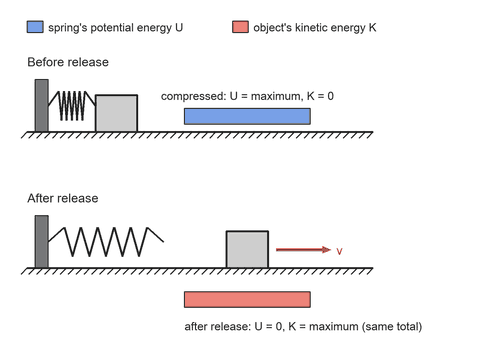
Concept: A compressed spring stores elastic potential energy. When it is released, this energy changes into the kinetic energy of the object; it is not lost. Conservation of mechanical energy: when friction and air resistance are negligible, potential energy and kinetic energy change into each other, but their sum U + K stays constant.
Step 1 — Follow the spring's energy.
As the spring stretches back, its potential energy decreases.
Step 2 — Follow the object's energy.
At the same time the object speeds up, so its kinetic energy increases by exactly the same amount.
Step 3 — Add them.
One form falls as the other rises, so the total mechanical energy stays constant (friction neglected).
Why the other options are wrong:
Therefore, the total mechanical energy of the system remains constant, option (D).