
Question 1251 markMCQEasy
A ball of mass is thrown vertically up with an initial velocity so as to reach height . The correct statement is:
Confirming your payment
Sign up now and get 250 free tokens.
Work, Energy and Power · Question 125 of 146
A ball of mass is thrown vertically up with an initial velocity so as to reach height . The correct statement is:
(A) Potential energy of the ball at the ground is mgh.
(B) Kinetic energy of the ball at the ground is zero.
(C) Kinetic energy of the ball at the highest point is mgh.
(D) Potential energy of the ball at the highest point is mgh.
Answer: (D) Potential energy of the ball at the highest point is mgh.
Concept: Potential energy depends on height (U = mgh, zero at the ground); kinetic energy depends on speed (K = ½mv²). Conservation of mechanical energy: when friction and air resistance are negligible, potential energy and kinetic energy change into each other, but their sum U + K stays constant.
Step 1 — At the ground.
The ball is thrown with its full speed, so K is maximum and U = 0.
Step 2 — At the highest point.
At height h the ball stops for a moment, so K = 0 and all of its energy is potential energy.
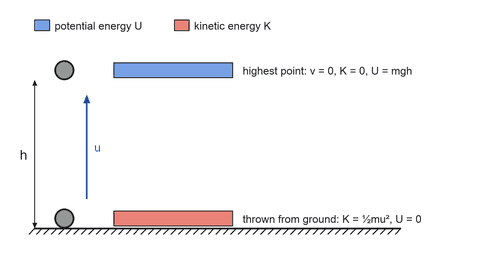
Why the other options are wrong:
Therefore, the correct statement is that the potential energy at the highest point is mgh, option (D).