
Question 984 marksEasy
In what way does the temperature of water at the bottom of a waterfall differ from the temperature at the top ? Explain the reason.
Confirming your payment
Sign up now and get 250 free tokens.
Work, Energy and Power · Question 98 of 146
In what way does the temperature of water at the bottom of a waterfall differ from the temperature at the top ? Explain the reason.
Solution:
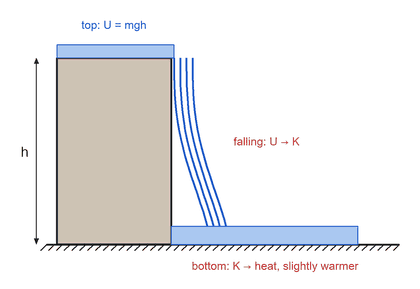
Concept: Falling water loses potential energy and gains kinetic energy; when it is stopped at the bottom, that kinetic energy becomes heat.
Step 1 — At the top.
The water has gravitational potential energy, mgh.
Step 2 — While falling.
This potential energy changes into kinetic energy.
Step 3 — At the bottom.
When the falling water strikes the bottom and is brought to rest, its kinetic energy is converted into heat energy, which raises its temperature slightly.
Step 4 — Estimate the rise.
If all of mgh becomes heat in the water, mgh = mcΔθ, so the rise in temperature is gh ÷ c. For water (c = 4200 J kg⁻¹ K⁻¹) and g = 9·8 m s⁻², a fall of 420 m gives
Watch out: The rise is small (about 1 °C for every 420 m of fall), so it is hard to feel.
Therefore, the water at the bottom of a waterfall is slightly warmer than at the top, because its kinetic energy turns into heat when it is stopped.