
Question 974 marksEasy
A pebble is thrown up. It goes to a height and then comes back on the ground. State the different changes in form of energy during its motion.
Confirming your payment
Sign up now and get 250 free tokens.
Work, Energy and Power · Question 97 of 146
A pebble is thrown up. It goes to a height and then comes back on the ground. State the different changes in form of energy during its motion.
Solution:
Concept: Conservation of mechanical energy: when friction and air resistance are negligible, potential energy and kinetic energy change into each other, but their sum U + K stays constant.
Step 1 — At the moment of throwing.
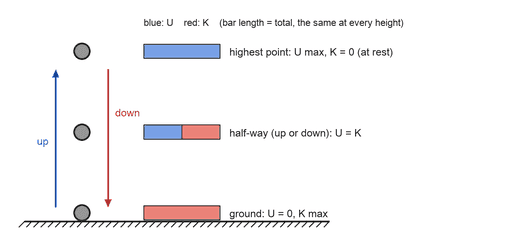
The muscular energy of the hand gives the pebble kinetic energy. At the ground its potential energy is zero.
Step 2 — While going up.
Its speed decreases and its height increases, so kinetic energy changes into potential energy.
Step 3 — At the highest point.
It is momentarily at rest, so its kinetic energy is zero and its potential energy is maximum.
Step 4 — While coming down.
Its speed increases and its height decreases, so potential energy changes back into kinetic energy.
Step 5 — On hitting the ground.
Its kinetic energy is maximum just before impact. On striking the ground and stopping, this kinetic energy changes into heat and sound energy (and a little work in denting the ground).
Watch out: With air resistance neglected, K + U is the same at every point of the flight.
Therefore, the changes are: muscular → K (throw); K → U (going up); U → K (coming down); K → heat and sound (on hitting the ground).