
Question 1023 marksEasy
A body of mass 10 kg falls from a height of 20 m to 8 m. Calculate : (i) the loss in potential energy of the body, and (ii) the total energy possessed by the body at any instant ? (Take m s).
Confirming your payment
Sign up now and get 250 free tokens.
Work, Energy and Power · Question 102 of 146
A body of mass 10 kg falls from a height of 20 m to 8 m. Calculate : (i) the loss in potential energy of the body, and (ii) the total energy possessed by the body at any instant ? (Take m s).
Solution:
Concept: The loss in potential energy depends only on the fall in height. Conservation of mechanical energy: when friction and air resistance are negligible, potential energy and kinetic energy change into each other, but their sum U + K stays constant.
Given: m = 10 kg, from 20 m to 8 m, g = 10 m s⁻².
(i)
Step 1 — Fall in height.
The body falls from 20 m to 8 m.
Step 2 — Loss in potential energy.
Use mg × (fall in height).
(ii)
Step 3 — Total energy.
At the start the body is at rest at 20 m, so all its energy is potential, and this total stays the same at every instant.
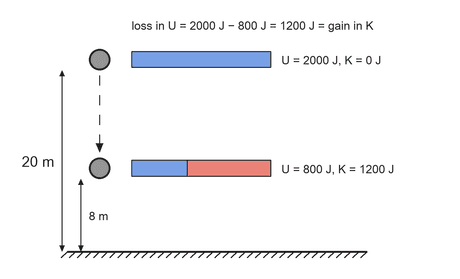
Check: At 8 m, U is 800 J and K is 1200 J (the P.E. lost); together they make 2000 J.
Therefore, (i) the loss in potential energy is 1200 J, and (ii) the total energy at any instant is 2000 J.