
Question 22 marksAsked 2017Easy
If the power of a motor be 100 kW, at what speed can it raise a load of 50,000 N?
Confirming your payment
Sign up now and get 250 free tokens.
Previous Year Questions · Question 2 of 34
If the power of a motor be 100 kW, at what speed can it raise a load of 50,000 N?
Solution:
Concept: Power is the rate of doing work, P = W ÷ t; its S.I. unit is the watt, one joule per second. When a force F moves its point of application at a steady speed v along its own direction, the work done per second is F times the distance moved per second, so P = F v.
Given: P = 100 kW; load = 50,000 N, raised at a steady speed.
Step 1 — Change the power into watt.
Since 1 kW = 1000 W:
Step 2 — Find the force needed.
To raise the load at a steady speed, the motor must pull up with a force equal to the load, so F = 50,000 N.
Step 3 — Rearrange P = F v.
We want the speed, so we divide both sides of P = F v by F:
Step 4 — Substitute the values.
Now we put in P = 100,000 W and F = 50,000 N:
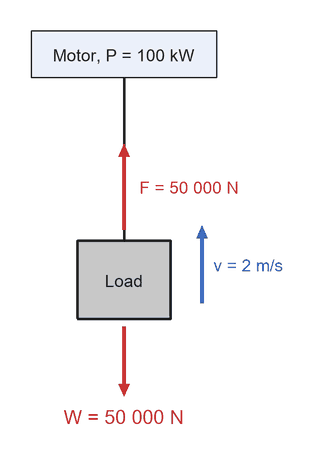
Check: In each second the load rises 2 m, so the motor does 50,000 N × 2 m of work every second:
This is the 100 kW power of the motor.
Watch out: Change kW into W before dividing; 100 ÷ 50,000 would give a speed 1000 times too small.
Therefore, the motor can raise the load at a speed of 2 m s⁻¹.