
Opening your dashboard
Class 10 Physics Chapter 2 Work, Energy and Power: Previous Year Questions
34 questions on Chapter 2, each solved step by step. Class 10 Physics, ICSE 2026-27.
34 questions with solutions
1–4 marks · Mixed difficulty
- 12 marks
Question 1
A boy weighing 40 kgf climbs up a stair of 30 steps each 20 cm high in 4 minutes and a girl weighing 30 kgf does the same in 3 minutes. Compare :-
(i) The work done by them.
(ii) The power developed by them.
Solve with AIWritten solution
Solution:
Concept: In climbing stairs, a person does work against their own weight: W = weight × height climbed.
Power is the rate of doing work, P = W ÷ t; its S.I. unit is the watt, one joule per second. When a force F moves its point of application at a steady speed v along its own direction, the work done per second is F times the distance moved per second, so P = F v.
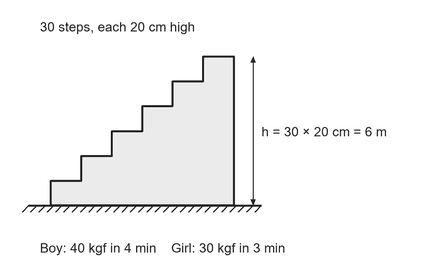
Given: Boy 40 kgf in 4 min, girl 30 kgf in 3 min; 30 steps, each 20 cm high.
Step 1 — Find the height climbed.
Both children climb the same 30 steps, each 20 cm high, so each rises through the same height h. Since 100 cm = 1 m, 20 cm = 0.2 m:
Step 2 — Change the weights into newton.
Taking g = 10 m s⁻², a weight of 1 kgf is 10 N:
Step 3 — Part (i): work done by each.
In climbing, each child does work against their own weight through the height h, so W = weight × h:
Step 4 — Part (i): compare the work.
Dividing the two values gives the ratio:
So the work done by the boy and the girl is in the ratio 4 : 3.
Step 5 — Change the times into seconds.
Power needs the time in seconds, and 1 min = 60 s:
Step 6 — Part (ii): power of each.
Power is the work done divided by the time taken:
Step 7 — Part (ii): compare the power.
Both powers are 10 W, so the ratio is 1 : 1. The boy does more work, but he also takes longer, so both do work at the same rate.
Watch out: The time does not enter the work at all; it is used only for the power. Change kgf to N, cm to m and minutes to seconds first.
Note: with g = 9.8 m s⁻² the values become 2352 J, 1764 J and 9.8 W each; the ratios 4 : 3 and 1 : 1 do not change.
Therefore, (i) work done by the boy : work done by the girl = 4 : 3; (ii) power of the boy : power of the girl = 1 : 1.
- 22 marks
Question 2
If the power of a motor be 100 kW, at what speed can it raise a load of 50,000 N?
Solve with AIWritten solution
Solution:
Concept: Power is the rate of doing work, P = W ÷ t; its S.I. unit is the watt, one joule per second. When a force F moves its point of application at a steady speed v along its own direction, the work done per second is F times the distance moved per second, so P = F v.
Given: P = 100 kW; load = 50,000 N, raised at a steady speed.
Step 1 — Change the power into watt.
Since 1 kW = 1000 W:
Step 2 — Find the force needed.
To raise the load at a steady speed, the motor must pull up with a force equal to the load, so F = 50,000 N.
Step 3 — Rearrange P = F v.
We want the speed, so we divide both sides of P = F v by F:
Step 4 — Substitute the values.
Now we put in P = 100,000 W and F = 50,000 N:
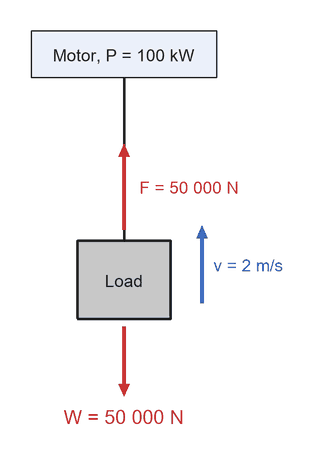
Check: In each second the load rises 2 m, so the motor does 50,000 N × 2 m of work every second:
This is the 100 kW power of the motor.
Watch out: Change kW into W before dividing; 100 ÷ 50,000 would give a speed 1000 times too small.
Therefore, the motor can raise the load at a speed of 2 m s⁻¹.
- 32 marks
Question 3
(i) State and define the S.I. unit of power.
(ii) How is the unit horse power related to the S.I. unit of power ?
Solve with AIWritten solution
Solution:
Concept: Power is the rate of doing work: P = W ÷ t.
Step 1 — Part (i): name the unit.
Power is work done per unit time, so its unit is the unit of work (joule) divided by the unit of time (second). This unit is called the watt (W).
Step 2 — Part (i): define the watt.
The power of an agent is 1 watt if it does 1 joule of work in 1 second (or uses 1 J of energy every second):
Step 3 — Part (ii): relate the horse power.
The horse power (H.P.) is a bigger, older unit of power:
So 1 H.P. is 0.746 kW, a little less than one kilowatt.
Watch out: The watt is a unit of power; the joule and the kilowatt hour are units of work (energy).
Therefore, (i) the S.I. unit of power is the watt: 1 W = 1 J s⁻¹, the power of an agent doing 1 J of work in 1 s; (ii) 1 H.P. = 746 W.
- 42 marks
Question 4
State the energy changes in the following cases while in use:
(i) An electric iron.
(ii) A ceiling fan.
Solve with AIWritten solution
Solution:
Concept: Every device or process takes in energy in one form and gives it out in another. To name the change, first name the form of energy that is supplied, then the useful form that comes out.
Step 1 — Part (i): the electric iron.
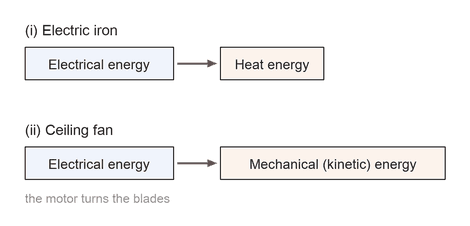
An electric iron takes in electrical energy from the mains. The current flows through its heating element (a nichrome coil), which becomes hot, and this heat passes to the clothes. So the useful output is heat energy.
Step 2 — Part (ii): the ceiling fan.
A ceiling fan also takes in electrical energy. Its electric motor turns the blades, so the useful output is mechanical (kinetic) energy of the rotating blades and of the air they push. A small part is wasted as heat and sound.
Watch out: Name forms of energy (electrical, heat, mechanical), not parts of the device.
Therefore, (i) electric iron: electrical energy → heat energy; (ii) ceiling fan: electrical energy → mechanical (kinetic) energy.
- 52 marks
Question 5
(i) Why is the motion of a body moving with a constant speed around a circular path said to be accelerated?
(ii) Name the unit of physical quantity obtained by the formula . Where K: kinetic energy, V: Linear Velocity.
Solve with AIWritten solution
Solution:
Concept: Velocity has both size and direction, and acceleration is the rate of change of velocity, so a change of direction alone is an acceleration. A body of mass m moving with speed v has kinetic energy K = ½ m v².
Step 1 — Part (i): look at the direction of motion.
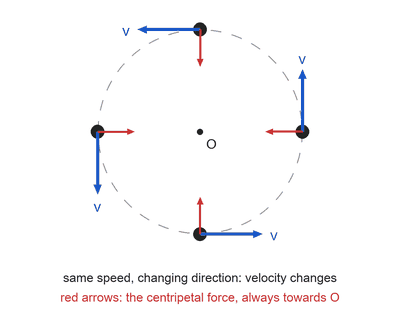
On a circular path the body moves, at each instant, along the tangent to the circle at that point. As it goes round, this tangent keeps turning, so the direction of motion changes at every point.
Step 2 — Part (i): see why this is acceleration.
Velocity has both a size (the speed) and a direction. Even though the speed stays constant, the direction keeps changing, so the velocity keeps changing. A change of velocity per unit time is acceleration, so the motion is accelerated; this acceleration points towards the centre (centripetal acceleration).
Step 3 — Part (ii): write the kinetic energy.
A body of mass m moving with velocity V has kinetic energy:
Step 4 — Part (ii): rearrange for 2K/V².
Multiplying both sides by 2 and then dividing by V² leaves the mass alone:
Step 5 — Part (ii): name the unit.
So 2K/V² is the mass of the body, whose S.I. unit is the kilogram (kg). The units agree, since 1 J = 1 kg m² s⁻²:
Watch out: Constant speed is not constant velocity: a body going round a circle at a steady speed is still accelerated.
Therefore, (i) its direction of motion, and so its velocity, changes at every instant, which is an acceleration (towards the centre); (ii) 2K/V² is the mass, whose unit is the kilogram (kg).
- 63 marks
Question 6
(i) Derive a relationship between S.I. and C.G.S. unit of work.
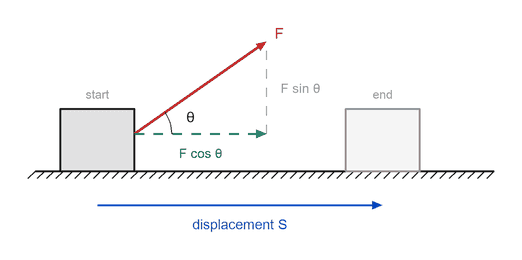
(ii) A force acts on a body and displaces it by a distance S in a direction at an angle θ with the direction of force. What should be the value of θ to get the maximum positive work?
Solve with AIWritten solution
Solution:
Concept: Work is done when a force moves a body. If the force F makes an angle θ with the displacement S, only the part F cos θ acts along the displacement, so W = F S cos θ. Its S.I. unit is the joule: 1 joule is the work done when a force of 1 N moves a body through 1 m in its own direction. The C.G.S. unit of work is the erg (1 dyne × 1 cm).
Step 1 — Part (i): write the two units.
The S.I. unit of work is the joule and the C.G.S. unit is the erg:
Step 2 — Part (i): change newton and metre into C.G.S. units.
Since 1 kg = 1000 g and 1 m = 100 cm, a newton (1 kg m s⁻²) is:
and 1 m = 10² cm.
Step 3 — Part (i): substitute.
We put both into 1 J = 1 N × 1 m:
Step 4 — Part (ii): write the work at an angle.
When the force F makes an angle θ with the displacement S, only its part F cos θ acts along the displacement, so:
Step 5 — Part (ii): make the work greatest.
For a given F and S, W is greatest when cos θ is greatest. The largest value of cos θ is 1, at θ = 0°:
So the body must move in the direction of the force.
Watch out: Θ = 90° gives zero work and θ = 180° gives negative work; the maximum positive work is at θ = 0°.
Therefore, (i) 1 J = 10⁷ erg; (ii) θ = 0°, that is, the body moves in the direction of the force, and then W = F S.
- 72 marks
Question 7
Two bodies A and B have masses in the ratio 5:1 and their kinetic energies are in the ratio 125:9. Find the ratio of their velocities.
Solve with AIWritten solution
Solution:
Concept: A body of mass m moving with speed v has kinetic energy K = ½ m v².
So for two bodies, the ratio of the kinetic energies = (ratio of the masses) × (ratio of the velocities)².
Given: M_A : m_B = 5 : 1 and K_A : K_B = 125 : 9.
Step 1 — Write the ratio of the kinetic energies.
Writing K = ½mv² for A and for B and dividing, the ½ cancels:
Step 2 — Substitute the given ratios.
We put in K_A : K_B = 125 : 9 and m_A : m_B = 5 : 1:
Step 3 — Find the ratio of the squares of the velocities.
Dividing both sides by 5:
Step 4 — Take the square root.
Both velocities are positive, so we take the positive square root:
Check: Putting the answer back, the kinetic energies come out in the given ratio:
Watch out: 25 : 9 is the ratio of the SQUARES of the velocities; take its square root to get the velocities.
Therefore, the velocities are in the ratio v_A : v_B = 5 : 3.
- 83 marks
Question 8
A body of mass 10 kg is kept at a height of 5 m. It is allowed to fall and reach the ground.
(i) What is the total mechanical energy possessed by the body at the height of 2 m assuming it is a frictionless medium?
(ii) What is the kinetic energy possessed by the body just before hitting the ground? Take .
Solve with AIWritten solution
Solution:
Concept: A body of mass m at a height h above the ground has gravitational potential energy U = m g h; when it falls, this energy changes into kinetic energy.
When no friction or air resistance acts, the mechanical energy (potential energy U + kinetic energy K) of a body stays constant: whatever potential energy it loses, it gains as kinetic energy, and the other way round.
Given: M = 10 kg, starting height 5 m (at rest), g = 10 m s⁻², no friction.
Step 1 — Find the energy at the start.
At 5 m the body is at rest, so its kinetic energy is zero and all its energy is potential energy:
Step 2 — Part (i): total mechanical energy at 2 m.
There is no friction, so the mechanical energy stays 500 J all the way down. At 2 m it is shared between potential and kinetic energy:
So the total at 2 m is 200 J + 300 J, that is 500 J.
Step 3 — Part (ii): kinetic energy just before the ground.
Just above the ground the height is zero, so the potential energy is zero and all the 500 J is kinetic energy:

Watch out: Part (i) asks for the TOTAL mechanical energy at 2 m (500 J), not the kinetic energy (300 J) or the potential energy (200 J) there.
Therefore, (i) total mechanical energy at 2 m = 500 J; (ii) kinetic energy just before hitting the ground = 500 J.
- 92 marks
Question 9
Define a kilowatt hour. How is it related to joule?
Solve with AIWritten solution
Solution:
Concept: Energy = power × time. So a unit of power multiplied by a unit of time is a unit of energy.
Step 1 — Define the kilowatt hour.
By definition, one kilowatt hour (kWh) is the energy used (or the work done) by an agent of power 1 kW working for 1 hour. It is the commercial unit of electrical energy: 1 'unit' on an electricity bill is 1 kWh.
Step 2 — Change kW and h into S.I. units.
Since 1 kW is 1000 W, 1 h is 60 × 60 s, that is 3600 s, and energy is power × time:
Watch out: The kilowatt hour is a unit of energy, while the kilowatt is a unit of power.
Therefore, one kilowatt hour is the energy used by an agent of power 1 kW in 1 hour, and 1 kWh = 3.6 × 10⁶ J.
- 102 marks
Question 10
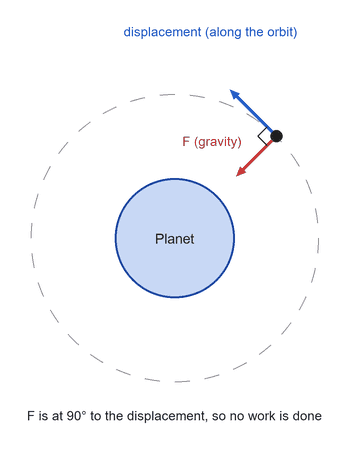
A satellite revolves around a planet in a circular orbit. What is the work done by the satellite at any instant? Give a reason.
Solve with AIWritten solution
Solution:
Concept: Work is done when a force moves a body. If the force F makes an angle θ with the displacement S, only the part F cos θ acts along the displacement, so W = F S cos θ. Its S.I. unit is the joule: 1 joule is the work done when a force of 1 N moves a body through 1 m in its own direction. If the force is at 90° to the displacement, cos 90° = 0 and no work is done.
Step 1 — Find the force on the satellite.
The only force on the satellite is the gravitational pull of the planet. It acts along the radius of the orbit, towards the centre of the planet.
Step 2 — Find the direction of the displacement.
At every instant the satellite moves along the tangent to its circular orbit.
Step 3 — Find the angle between them.
A tangent to a circle is perpendicular to the radius at that point, so the force and the displacement are at θ = 90° at every instant.
Step 4 — Find the work.
We put θ = 90° into the formula for the work. Since cos 90° is zero, the work is zero:
This is why the satellite keeps going round at a constant speed: no work is done, so its kinetic energy does not change.
Watch out: The satellite covers a large distance, but distance alone does not give work; the displacement must have a part along the force.
Therefore, the work done is zero, because the planet's pull (towards the centre) is at 90° to the satellite's displacement (along the tangent) at every instant.
- 112 marks
Question 11
Give one example of each when:
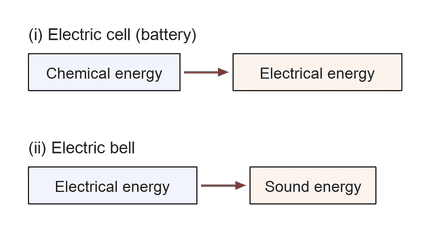
(i) Chemical energy changes into electrical energy.
(ii) Electrical energy changes into sound energy.
Solve with AIWritten solution
Solution:
Concept: Every device or process takes in energy in one form and gives it out in another. To name the change, first name the form of energy that is supplied, then the useful form that comes out. An example is a device whose input is the first form and whose output is the second.
Step 1 — Part (i): chemical energy into electrical energy.
An electric cell (battery), such as the cell in a torch, does this. The chemical reaction between its electrodes and the electrolyte releases energy, which drives a current round the circuit.
Step 2 — Part (ii): electrical energy into sound energy.
An electric bell (or a loudspeaker) does this. The current makes the hammer of the bell strike the gong again and again (or makes the cone of the loudspeaker vibrate), and the vibrations produce sound.
Watch out: Keep the order of the change: a microphone changes sound into electrical energy, which is the reverse of part (ii).
Therefore, (i) an electric cell (battery), as in a torch; (ii) an electric bell (or a loudspeaker).
- 122 marks
Question 12
A crane 'A' lifts a heavy load in 5 seconds, whereas another crane 'B' does the same work in 2 seconds. Compare the power of crane 'A' to that of crane 'B'.
Solve with AIWritten solution
Solution:
Concept: Power is the rate of doing work, P = W ÷ t; its S.I. unit is the watt, one joule per second. When a force F moves its point of application at a steady speed v along its own direction, the work done per second is F times the distance moved per second, so P = F v.
For the same work, power is inversely proportional to the time taken.
Given: Same work; crane A takes 5 s, crane B takes 2 s.
Step 1 — See that the work is the same.
Both cranes lift the same load through the same height, so each does the same work W.
Step 2 — Write the power of each crane.
Power is work divided by time, with t_A = 5 s and t_B = 2 s:
Step 3 — Divide the two powers.
The work W cancels, leaving the times the other way round:
So crane B is 5 ÷ 2 = 2.5 times as powerful as crane A.
Watch out: The crane that takes LONGER has LESS power, so the ratio is 2 : 5, not 5 : 2.
Therefore, power of crane A : power of crane B = 2 : 5.
- 133 marks
Question 13
The figure alongside shows a simple pendulum of mass 200 g. It is displaced from the mean position A to the extreme position B. The potential energy at the position A is zero. At the position B the pendulum bob is raised by 5 m.
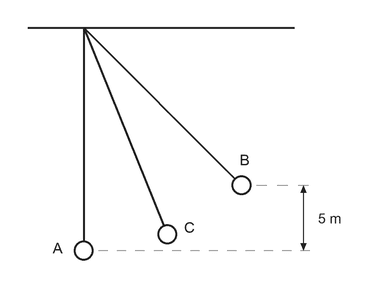
(i) What is the potential energy of the pendulum at the position B?
(ii) What is the total mechanical energy at point C?
(iii) What is the speed of the bob at the position A when released from B?
(Take and there is no loss of energy.)
Solve with AIWritten solution
Solution:
Concept: At an extreme position a pendulum bob is momentarily at rest, so its energy there is all potential energy. When no friction or air resistance acts, the mechanical energy (potential energy U + kinetic energy K) of a body stays constant: whatever potential energy it loses, it gains as kinetic energy, and the other way round.
Given: M = 200 g; B is 5 m above A; U at A = 0; g = 10 m s⁻²; no loss of energy.
Step 1 — Change the mass into kilogram.
The mass must be in kg for the energy to come out in joule:
Step 2 — Part (i): potential energy at B.
B is 5 m above A, where the potential energy is zero:
Step 3 — Part (ii): total mechanical energy at C.
At the extreme position B the bob is at rest for an instant, so its kinetic energy is zero and its total energy is the 10 J of potential energy. There is no loss of energy, so the total is the same at every point of the swing. At C it is 10 J, partly potential and partly kinetic.
Step 4 — Part (iii): kinetic energy at A.
At the mean position A the potential energy is zero, so all 10 J is kinetic energy:
Step 5 — Part (iii): solve for the speed.
We multiply both sides by 2 and divide by m = 0.2 kg, then take the square root:
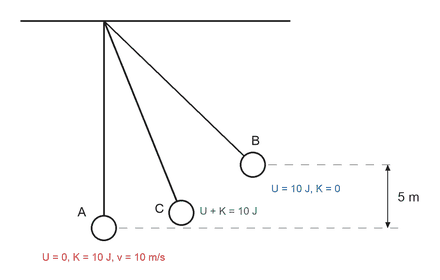
Check: For a fall through h from rest, v = √(2gh):
Watch out: Change 200 g into 0.2 kg before using U = m g h; using 200 would make the energy 1000 times too large.
Therefore, (i) potential energy at B = 10 J; (ii) total mechanical energy at C = 10 J; (iii) speed at A = 10 m s⁻¹.
- 141 mark
Question 14
When the speed of a moving object is doubled, then its kinetic energy:
Solve with AIAnswer
(A) remains the same
(B) decreases
(C) is doubled
- Correct
(D) becomes four times
Answer: (D) becomes four times
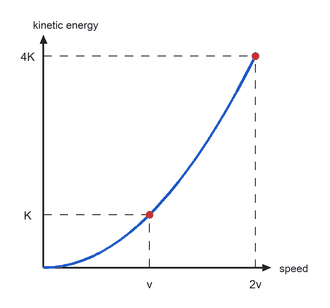
Concept: A body of mass m moving with speed v has kinetic energy K = ½ m v². For a fixed mass, K is proportional to the square of the speed.
Step 1 — Write the kinetic energy at speed v.
For a body of mass m moving with speed v:
Step 2 — Write the kinetic energy at speed 2v.
The mass stays the same and the speed becomes 2v:
Step 3 — Compare.
So the new kinetic energy is four times the old one, because K depends on the square of the speed and 2² = 4.
Watch out: Doubling the speed doubles the momentum (m v), but it makes the kinetic energy four times.
Why the other options are wrong:
- (A) remains the same: kinetic energy depends on the speed, so a change of speed must change it.
- (B) decreases: a larger speed gives a larger kinetic energy, not a smaller one.
- (C) is doubled: this would be true only if K were proportional to v; K goes as v², so it becomes 2² = 4 times.
Therefore, the kinetic energy becomes four times, option (D).
- 151 mark
Question 15
The energy conversion in a washing machine is from ...............
Solve with AIAnswer
(A) magnetic to electrical
- Correct
(B) electrical to mechanical
(C) electrical to magnetic
(D) magnetic to electrical
Answer: (B) electrical to mechanical
Concept: A washing machine runs on an electric motor. An electric motor takes in electrical energy and gives out mechanical energy.
Step 1 — Name the energy supplied.
A washing machine is plugged into the mains, so the energy supplied to it is electrical energy.
Step 2 — Name the useful output.
Its electric motor spins the drum and moves the clothes and water, so the useful output is mechanical (kinetic) energy.

Step 3 — Look at the printed options.
Options (A) and (D) are printed with the same words, 'magnetic to electrical'. Both are wrong, so the repeat does not affect the answer.
Watch out: The motor works by magnetic effects inside it, but the energy taken in is electrical and the energy given out is mechanical.
Why the other options are wrong:
- (A) magnetic to electrical: changing magnetic energy into electrical energy is what a generator (dynamo) does; the washing machine uses electricity, it does not produce it.
- (C) electrical to magnetic: electrical to magnetic is the change in an electromagnet; the washing machine's useful output is motion.
- (D) magnetic to electrical: it is printed with the same words as option (A), so it is wrong for the same reason.
Therefore, the energy conversion in a washing machine is from electrical to mechanical, option (B).
- 162 marks
Question 16
(a) What should be the angle between the direction of force and the direction of displacement, for work to be negative?
(b) Name the physical quantity obtained using the formula , where U is the potential energy and h is the height.
Solve with AIWritten solution
Solution:
Concept: Work is done when a force moves a body. If the force F makes an angle θ with the displacement S, only the part F cos θ acts along the displacement, so W = F S cos θ. Its S.I. unit is the joule: 1 joule is the work done when a force of 1 N moves a body through 1 m in its own direction.
A body of mass m at a height h above the ground has gravitational potential energy U = m g h; when it falls, this energy changes into kinetic energy.
Step 1 — Part (a): see when the work is negative.
In W = F S cos θ, F and S are positive sizes, so the sign of W is the sign of cos θ. cos θ is negative for angles greater than 90° (up to 180°).
Step 2 — Part (a): find the angle.
The work is most clearly negative when the force acts exactly opposite to the displacement, θ = 180°, and cos 180° = −1:
For example, friction on a sliding block acts opposite to its motion and does negative work.

Step 3 — Part (b): divide U by h.
The potential energy of a body of mass m at height h is U = m g h. Dividing both sides by h:
Step 4 — Part (b): name the quantity.
The product m g is the weight of the body (the force of gravity on it), and its S.I. unit is the newton (N).
Watch out: Θ = 90° gives ZERO work, not negative work; the work is negative only for θ above 90°.
Therefore, (a) 180° (in general, any angle more than 90° and up to 180°), with the force opposite to the displacement; (b) U/h = m g, the weight of the body, unit newton (N).
- 172 marks
Question 17
Calculate the power spent by a crane while lifting a load of mass 2000 kg, at velocity of . ()
Solve with AIWritten solution
Solution:
Concept: Power is the rate of doing work, P = W ÷ t; its S.I. unit is the watt, one joule per second. When a force F moves its point of application at a steady speed v along its own direction, the work done per second is F times the distance moved per second, so P = F v.
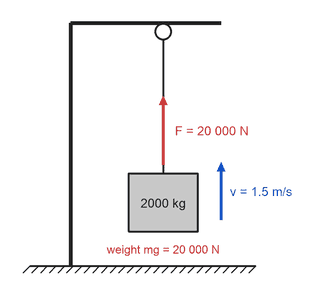
Given: M = 2000 kg, v = 1.5 m s⁻¹, g = 10 m s⁻².
Step 1 — Find the force needed.
To lift the load at a steady velocity, the crane must pull up with a force equal to the load's weight:
Step 2 — Choose the formula.
The force moves its point of application at a steady velocity along its own direction, so:
Step 3 — Substitute the values.
Now we put in F = 20,000 N and v = 1.5 m s⁻¹:
Watch out: The force in P = F v is the weight m g in newton, not the mass 2000 kg.
Therefore, the power spent by the crane is 30,000 W, that is 30 kW.
- 184 marks
Question 18
A car of mass 120 kg is moving at a speed 18 km/h and it accelerates to attain a speed of 54 km/h in 5 seconds. Calculate:
(a) the work done by the engine.
(b) the power of the engine.
Solve with AIWritten solution
Solution:
Concept: By the work–energy theorem, the work done on a body by a force equals the change in its kinetic energy.
A body of mass m moving with speed v has kinetic energy K = ½ m v².
Power is the rate of doing work, P = W ÷ t; its S.I. unit is the watt, one joule per second. When a force F moves its point of application at a steady speed v along its own direction, the work done per second is F times the distance moved per second, so P = F v.
Given: M = 120 kg; speed 18 km/h rises to 54 km/h in t = 5 s.
Step 1 — Change the speeds into m s⁻¹.
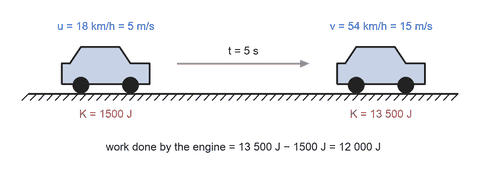
One km/h is 1000 m in 3600 s, which is 5/18 m s⁻¹, so we multiply each speed by 5/18:
Step 2 — Find the starting kinetic energy.
We use K = ½mv², with m = 120 kg and u = 5 m s⁻¹:
Step 3 — Find the final kinetic energy.
Now with v = 15 m s⁻¹:
Step 4 — Part (a): work done by the engine.
By the work–energy theorem, the work done by the engine equals the gain in kinetic energy (friction is neglected):
Step 5 — Part (b): power of the engine.
Power is the work divided by the 5 s taken:
Watch out: Change km/h into m s⁻¹ first, and use the CHANGE in kinetic energy, not the final kinetic energy (13,500 J).
Therefore, (a) work done by the engine = 12,000 J (12 kJ); (b) power of the engine = 2400 W (2.4 kW).
- 191 mark
Question 19
When a bell fixed on a cycle rings, then the energy conversion that takes place is:
Solve with AIAnswer
(A) gravitational potential energy to sound energy
- Correct
(B) kinetic energy to sound energy
(C) sound energy to electrical energy
(D) sound energy to mechanical energy
Answer: (B) kinetic energy to sound energy
Concept: A cycle bell rings when its moving striker hits the gong. Every device or process takes in energy in one form and gives it out in another. To name the change, first name the form of energy that is supplied, then the useful form that comes out.
Step 1 — Name the energy supplied.
The rider's thumb pushes the lever, which sets the striker of the bell moving. The energy of this motion is kinetic energy.
Step 2 — Name the energy given out.
The moving striker hits the gong and makes it vibrate, and the vibrating gong gives out sound energy.
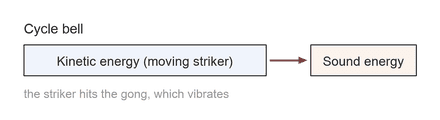
Watch out: Sound is the OUTPUT of the bell, so any option that starts with sound energy has the change the wrong way round.
Why the other options are wrong:
- (A) gravitational potential energy to sound energy: nothing falls from a height in a cycle bell; the striker is moved by the lever, not by gravity.
- (C) sound energy to electrical energy: sound is the output here, not the input; changing sound into electrical energy is what a microphone does.
- (D) sound energy to mechanical energy: this also has the change the wrong way round; the bell produces sound, it does not use sound to move something.
Therefore, the energy conversion is kinetic energy to sound energy, option (B).
- 201 mark
Question 20
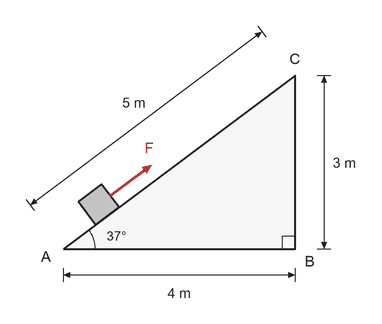
A force ‘F’ moves a load from A to C as shown in the figure below. For the calculation of the work done, which of these lengths would you use as the displacement?
 Solve with AI
Answer
(A) 3m
(B) 4m
- Correct
(C) 5m
(D) 7m
Answer: (C) 5m
Concept: Displacement is the straight-line distance from the starting point to the final point. For the work done by a force, W = F × (displacement in the direction of the force).
Step 1 — Find where the load starts and ends.
The load starts at A and ends at C. It moves straight along the slope AC, which is also the direction of the force F.
Step 2 — Find the length AC.
AC is the hypotenuse of the right-angled triangle ABC, with AB = 4 m and BC = 3 m, so by Pythagoras:
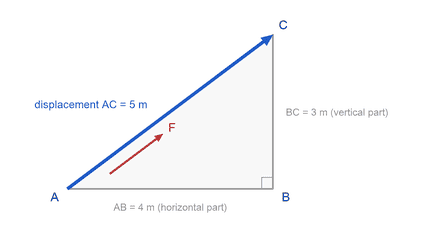
Step 3 — Use it for the work.
The force and the displacement are both along AC (θ = 0°), so W = F × AC, with the displacement 5 m.
Watch out: The 3 m rise is used for the work done against gravity (m g h), not for the work done by F along the slope.
Why the other options are wrong:
- (A) 3m: 3 m is BC, only the vertical rise of the load.
- (B) 4m: 4 m is AB, only the horizontal distance; the load does not move along AB.
- (D) 7m: 7 m is AB + BC, the length of the path A → B → C, which the load does not follow.
Therefore, the displacement used is AC = 5 m, option (C).
- 212 marks
Question 21
Sumit does 600 J of work in 10 min and Amit does 300 J of work in 20 min. Calculate the ratio of the powers delivered by them.
Solve with AIWritten solution
Solution:
Concept: Power is the rate of doing work, P = W ÷ t; its S.I. unit is the watt, one joule per second. When a force F moves its point of application at a steady speed v along its own direction, the work done per second is F times the distance moved per second, so P = F v.
Given: Sumit: 600 J in 10 min; Amit: 300 J in 20 min.
Step 1 — Change the times into seconds.
Since 1 min = 60 s:
Step 2 — Find Sumit's power.
Power is work done divided by time:
Step 3 — Find Amit's power.
In the same way:
Step 4 — Find the ratio.
Dividing the two powers:
Sumit does twice the work in half the time, so his power is 2 × 2 = 4 times Amit's.
Watch out: Power needs both the work and the time; comparing the work alone (2 : 1) or the time alone gives the wrong ratio.
Therefore, power of Sumit : power of Amit = 4 : 1.
- 223 marks
Question 22
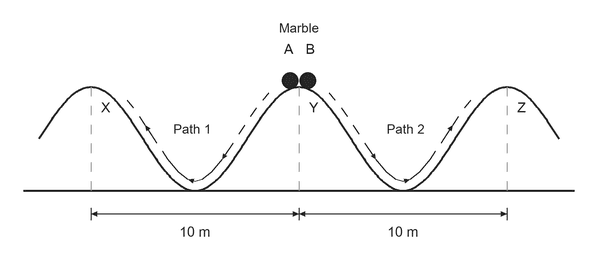
Two identical marbles A and B are rolled down along Path 1 and Path 2 respectively. Path 1 is frictionless and Path 2 is rough.
(a) Which marble will surely reach the next peak?
(b) Along which path/s the mechanical energy will be conserved?
(c) Along which path/s is the law of conservation of energy obeyed?
Solve with AIWritten solution
Solution:
Concept: When no friction or air resistance acts, the mechanical energy (potential energy U + kinetic energy K) of a body stays constant: whatever potential energy it loses, it gains as kinetic energy, and the other way round. Friction changes some mechanical energy into heat. The law of conservation of energy: energy can neither be created nor destroyed; it only changes from one form to another, so the total energy (counting heat and sound too) always stays the same.
Step 1 — Read the figure.
Both marbles start together at the top of peak Y. Marble A rolls along Path 1 (frictionless) towards peak X, and marble B along Path 2 (rough) towards peak Z. The three peaks are at the same height.
Step 2 — Part (a): follow marble A.
On Path 1 no friction acts, so A loses no mechanical energy. Its potential energy at Y changes into kinetic energy in the valley and back into potential energy as it climbs, so it rises to the same height again and reaches peak X.
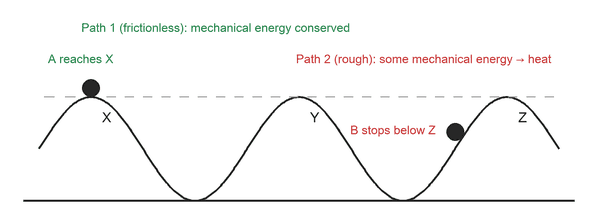
Step 3 — Part (a): follow marble B.
On the rough Path 2, friction changes part of B's mechanical energy into heat. B cannot climb back to the height of Y, so it stops (and rolls back) below peak Z. So only marble A is sure to reach the next peak.
Step 4 — Part (b): where mechanical energy is conserved.
Mechanical energy stays constant only where no friction acts, that is along Path 1 only.
Step 5 — Part (c): where the law of conservation of energy holds.
The mechanical energy lost by B on Path 2 is not destroyed; it becomes heat (and a little sound), so the total energy is unchanged. The law therefore holds along both Path 1 and Path 2.
Watch out: The statements 'mechanical energy is conserved' and 'energy is conserved' are different statements: the first needs no friction, the second is true always.
Therefore, (a) marble A (on the frictionless Path 1); (b) along Path 1 only; (c) along both Path 1 and Path 2.
- 231 mark
Question 23
What is the correct energy transformation during burning of a candle?
Solve with AIAnswer
(A) heat → kinetic + potential
(B) heat → chemical + light
- Correct
(C) chemical → heat + light
(D) mechanical → chemical + heat
Answer: (C) chemical → heat + light
Concept: Every device or process takes in energy in one form and gives it out in another. To name the change, first name the form of energy that is supplied, then the useful form that comes out. A fuel stores chemical energy, which burning releases.
Step 1 — Name the energy stored.
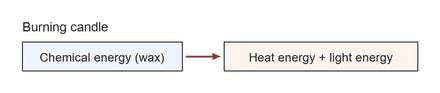
Wax is a fuel, and the energy given out by the candle comes from the chemical energy stored in the wax.
Step 2 — Name the energy given out.
When the wax burns, the flame is hot and it glows, so the energy appears as heat and light.
Watch out: Heat is an OUTPUT of a burning candle, not its source of energy.
Why the other options are wrong:
- (A) heat → kinetic + potential: heat is given out by the candle, not supplied to it, and the candle does not give out its energy as motion or height.
- (B) heat → chemical + light: this has the change the wrong way round; the chemical energy of the wax is used up, not produced.
- (D) mechanical → chemical + heat: no mechanical energy is supplied to a candle; its energy comes from the chemical energy of the wax.
Therefore, burning a candle changes chemical energy into heat and light, option (C).
- 244 marks
Question 24
Richa weighing 40 kgf leaves point P on her skateboard and reaches point Q on the ground with velocity 10 . Calculate.
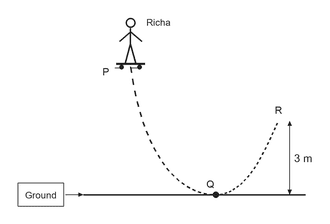
(a) the kinetic energy of Richa at point Q
(b) the vertical height of point P above the ground. (use g as 10 and neglect friction)
(c) the kinetic energy of Richa at point R. (While moving from Q to R, she loses 500 J of energy against friction.)
Solve with AIWritten solution
Solution:
Concept: A weight of 1 kgf is the weight of a 1 kg mass, so a body weighing 40 kgf has a mass of 40 kg.
A body of mass m moving with speed v has kinetic energy K = ½ m v².
A body of mass m at a height h above the ground has gravitational potential energy U = m g h; when it falls, this energy changes into kinetic energy.
When no friction or air resistance acts, the mechanical energy (potential energy U + kinetic energy K) of a body stays constant: whatever potential energy it loses, it gains as kinetic energy, and the other way round. Energy lost against friction must also be counted when friction acts.
Given: Weight 40 kgf; speed at Q = 10 m s⁻¹; R is 3 m above the ground; 500 J lost from Q to R; g = 10 m s⁻²; no friction from P to Q.
Step 1 — State what we take from the question.
Richa 'leaves' P, so we take her to start from rest at P. Her weight is 40 kgf, so her mass is m = 40 kg. From the figure, R is 3 m above the ground.
Step 2 — Part (a): kinetic energy at Q.
At Q her speed is 10 m s⁻¹, so:
Step 3 — Part (b): use conservation from P to Q.
There is no friction from P to Q, so the potential energy she has at P (at rest) becomes the kinetic energy at Q, on the ground:
Step 4 — Part (b): find the height of P.
Dividing both sides by m g:
Step 5 — Part (c): potential energy at R.
At R she is 3 m above the ground:
Step 6 — Part (c): share out the energy from Q to R.
The 2000 J she has at Q becomes the potential energy at R, the kinetic energy at R and the 500 J lost against friction:
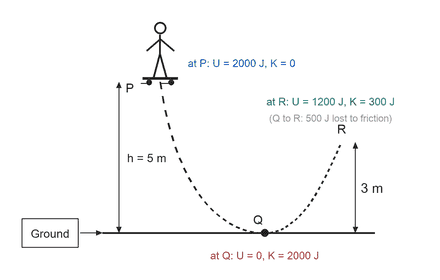
Watch out: At R she is 3 m above the ground, so subtract BOTH the 1200 J of potential energy and the 500 J lost to friction from 2000 J.
Therefore, (a) kinetic energy at Q = 2000 J; (b) height of P = 5 m; (c) kinetic energy at R = 300 J.
- 251 mark
Question 25
An object is thrown vertically up. It reaches the highest point and then comes down. The work done by the force of gravity on the object is:
Solve with AIAnswer
(A) positive for both the way up and way down
(B) negative for both the way up and way down
- Correct
(C) negative for the way up and positive for the way down
(D) positive for the way up and negative for the way down
Answer: (C) negative for the way up and positive for the way down
Concept: Work is done when a force moves a body. If the force F makes an angle θ with the displacement S, only the part F cos θ acts along the displacement, so W = F S cos θ. Its S.I. unit is the joule: 1 joule is the work done when a force of 1 N moves a body through 1 m in its own direction. So the work is positive when the force and the displacement are in the same direction (θ = 0°) and negative when they are opposite (θ = 180°).
Step 1 — Note the direction of gravity.
The force of gravity m g on the object always acts downwards, on the way up and on the way down.
Step 2 — The way up.
The object moves up while gravity acts down, so θ = 180° and cos 180° = −1. The work done by gravity is negative; gravity takes away kinetic energy and the object slows down.
Step 3 — The way down.
Now the object moves down, along gravity, so θ = 0° and cos 0° = 1. The work done by gravity is positive; the object speeds up.
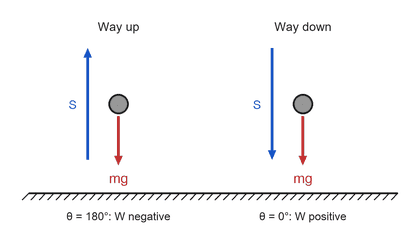
Watch out: The sign of the work depends on the direction of motion compared with the force, not on whether the object speeds up or how high it is.
Why the other options are wrong:
- (A) positive for both the way up and way down: on the way up the displacement is opposite to gravity, so the work there cannot be positive.
- (B) negative for both the way up and way down: on the way down the displacement is along gravity, so the work there is positive.
- (D) positive for the way up and negative for the way down: this swaps the two signs.
Therefore, the work done by gravity is negative for the way up and positive for the way down, option (C).
- 261 mark
Question 26
10 eV is ............... .
Solve with AIAnswer
- Correct
(A) J
(B) J
(C) J
(D) J
Answer: (A) J
Concept: The electron volt (eV) is a very small unit of energy used on the atomic and subatomic scale: 1 eV = 1.6 × 10⁻¹⁹ J.
Step 1 — Recall the size of the electron volt.
One electron volt is the energy gained by an electron accelerated through a potential difference of 1 volt:
Step 2 — Multiply by 10.
Ten electron volts are ten times as much energy:
Watch out: Multiply by 1.6 × 10⁻¹⁹ to change eV into joule; dividing by it gives the number of eV in a given number of joules.
Why the other options are wrong:
- (B) J: this is the value of 1 eV, not of 10 eV.
- (C) J: this is 10 ÷ (1.6 × 10⁻¹⁹), the number of electron volts in 10 J; it is not an energy in joule.
- (D) J: this is 1 ÷ (1.6 × 10⁻¹⁹), the number of electron volts in 1 J; it is not 10 eV.
Therefore, 10 eV is J, option (A).
- 273 marks
Question 27
State the energy conversions taking place:
(a) during photosynthesis
(b) in a thermocouple
(c) during bursting a cracker
Solve with AIWritten solution
Solution:
Concept: Every device or process takes in energy in one form and gives it out in another. To name the change, first name the form of energy that is supplied, then the useful form that comes out.
Step 1 — Part (a): photosynthesis.
Green leaves absorb light energy from the sun and use it to make food (glucose) from carbon dioxide and water. The energy is stored in the food as chemical energy.
Step 2 — Part (b): a thermocouple.
A thermocouple is a loop of two different metals joined at two junctions. When one junction is heated and the other is kept cold, a current flows, so heat energy changes into electrical energy.
Step 3 — Part (c): bursting a cracker.
The chemicals in a cracker react very quickly. The chemical energy stored in them is given out as heat, light and sound energy (and some kinetic energy of the flying pieces).
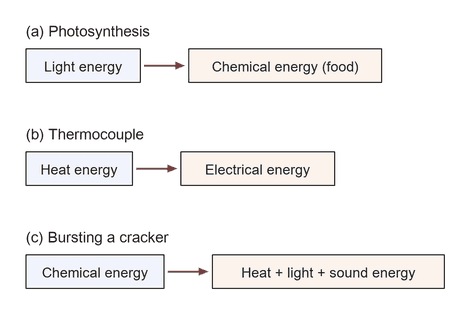
Watch out: A thermocouple changes heat INTO electricity; an electric heater does the reverse.
Therefore, (a) light energy → chemical energy; (b) heat energy → electrical energy; (c) chemical energy → heat, light and sound energy.
- 284 marks
Question 28
An inclined plane makes an angle of 30° with the horizontal as shown in the figure. A box of mass 20 kg is taken from point A to point B along the inclined plane of length 2 m.
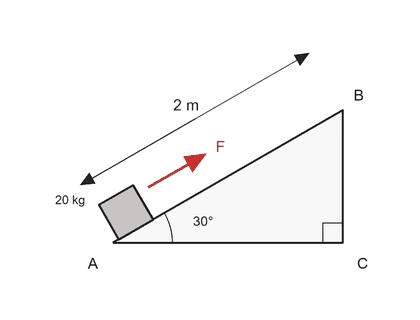
(a) Calculate the potential energy gained by the box.
(b) If 10 J of work is done against friction, in moving the box from A to B then calculate the force F needed to pull the block from A to B. [g = 10 ]
Solve with AIWritten solution
Solution:
Concept: The potential energy gained depends only on the vertical height risen: U = m g h. Work is done when a force moves a body. If the force F makes an angle θ with the displacement S, only the part F cos θ acts along the displacement, so W = F S cos θ. Its S.I. unit is the joule: 1 joule is the work done when a force of 1 N moves a body through 1 m in its own direction.
Given: M = 20 kg; slope AB = 2 m at 30° to the horizontal; 10 J of work against friction; g = 10 m s⁻².
Step 1 — State what we take from the question.
We take the box to be pulled slowly, so it gains no kinetic energy; all the work done by F goes into potential energy and into the work against friction.
Step 2 — Find the height risen.
In the right-angled triangle ABC, BC is opposite the 30° angle, so the height risen is h = AB sin 30°:
Step 3 — Part (a): potential energy gained.
We use U = m g h, with m = 20 kg and h = 1 m:
Step 4 — Part (b): total work done by F.
The work done by F is the potential energy gained plus the 10 J done against friction:
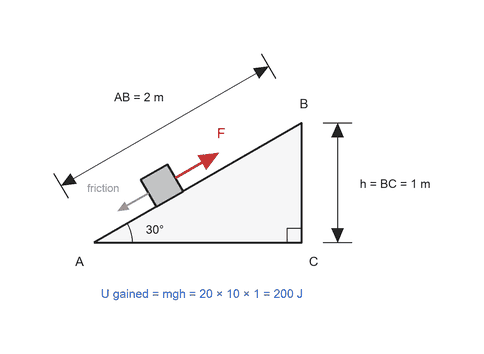
Step 5 — Part (b): find the force.
F acts along the slope and moves the box 2 m along it, so W_F = F × 2 m:
Without friction, 200 J ÷ 2 m = 100 N would be enough; the extra 5 N overcomes friction.
Watch out: Use the vertical height h = 1 m in m g h, not the 2 m length of the slope.
Therefore, (a) potential energy gained = 200 J; (b) force F = 105 N.
- 291 mark
Question 29
The energy transformation taking place during photosynthesis in plants is:
Solve with AIAnswer
(A) heat to chemical
(B) chemical to light
- Correct
(C) light to chemical
(D) chemical to heat
Answer: (C) light to chemical
Concept: Every device or process takes in energy in one form and gives it out in another. To name the change, first name the form of energy that is supplied, then the useful form that comes out. In photosynthesis, plants use sunlight to make food.
Step 1 — Name the energy taken in.
In photosynthesis, green leaves absorb light energy from the sun.
Step 2 — Name the energy stored.
They use it to make food (glucose) from carbon dioxide and water, and the energy is stored in the food as chemical energy.
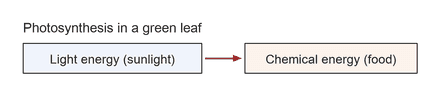
Watch out: Photosynthesis STORES energy in food; burning and respiration release it.
Why the other options are wrong:
- (A) heat to chemical: plants use the light of the sun, not its heat, to make food.
- (B) chemical to light: this is the reverse kind of change, as in a firefly or a burning candle; photosynthesis stores energy instead of giving out light.
- (D) chemical to heat: this happens in burning or respiration, when food or fuel is used up; photosynthesis makes food.
Therefore, photosynthesis changes light energy into chemical energy, option (C).
- 301 mark
Question 30
A fast-moving cyclist stops pedalling on reaching a hilly track. If he continues to move with the acquired energy, then assuming no loss of energy:
Solve with AIAnswer
(A) his kinetic energy remains constant at all times.
(B) his potential energy remains constant at all times.
(C) his total mechanical energy continuously increases.
- Correct
(D) his total mechanical energy remains constant.
Answer: (D) his total mechanical energy remains constant.
Concept: When no friction or air resistance acts, the mechanical energy (potential energy U + kinetic energy K) of a body stays constant: whatever potential energy it loses, it gains as kinetic energy, and the other way round.
Step 1 — See what acts on the cyclist.
He has stopped pedalling and no energy is lost, so no energy is supplied to him or taken away; his mechanical energy is conserved.
Step 2 — Going up the hill.
As he climbs, his height increases, so his potential energy increases. This energy comes from his kinetic energy, so he slows down.

Step 3 — Add the two parts.
The kinetic energy falls by exactly as much as the potential energy rises, so the sum K + U stays the same all the time.
Watch out: The separate kinetic and potential energies change; only their SUM stays constant.
Why the other options are wrong:
- (A) his kinetic energy remains constant at all times: his kinetic energy falls as he climbs (he slows down) and rises again if he rolls down.
- (B) his potential energy remains constant at all times: his potential energy changes with his height on the hilly track.
- (C) his total mechanical energy continuously increases: it cannot increase, because he has stopped pedalling and no energy is supplied to him.
Therefore, his total mechanical energy remains constant, option (D).
- 313 marks
Question 31
(a) Name the unit of work done, used in subatomic scale.
(b) To which class of lever does a pair of scissors belong?
(c) A stone is tied to a string and displaced from A to B by application of constant force F in three different ways as shown in the diagram below.

Arrange the three cases in ascending order of the work done by the force. (Given AJB is a semi-circle, θ < 90° and AB = 20 m)
Solve with AIWritten solution
Solution:
Concept: Work is done when a force moves a body. If the force F makes an angle θ with the displacement S, only the part F cos θ acts along the displacement, so W = F S cos θ. Its S.I. unit is the joule: 1 joule is the work done when a force of 1 N moves a body through 1 m in its own direction. A force at 90° to the motion does no work.
Given: AJB is a semicircle, AB = 20 m, θ < 90°.
Step 1 — Part (a): the unit on the subatomic scale.
The work done (energy) on the subatomic scale is measured in electron volt (eV): the energy gained by an electron accelerated through 1 volt, 1 eV = 1.6 × 10⁻¹⁹ J.
Step 2 — Part (b): the class of lever.
In a pair of scissors the fulcrum (the rivet joining the blades) lies between the effort (applied at the handles) and the load (the material being cut, at the blades). So it is a class I lever.
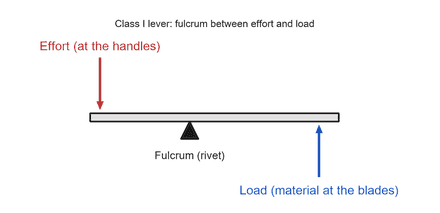
Step 3 — Part (c): Case 1, along the semicircle.
The string pulls the stone along the radius, towards the centre of the semicircle, while the stone moves along the tangent at every point. So the force is at 90° to the motion at every instant:
Step 4 — Part (c): Case 2, along AB.
The force acts along AB, the direction of the 20 m displacement, so θ = 0°:
Step 5 — Part (c): Case 3, at θ to AB.
Only the part F cos θ of the force acts along AB:
Since θ is less than 90°, cos θ lies between 0 and 1, so W₃ is more than 0 but less than 20F.
Step 6 — Part (c): arrange the cases.
Putting the three values in order:
So W₁ < W₃ < W₂.
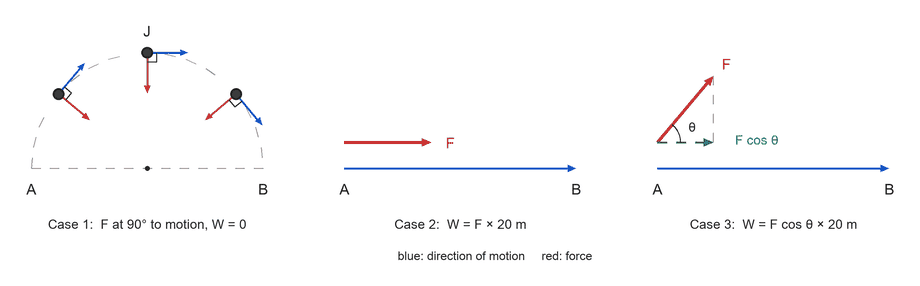
Watch out: In Case 1 the stone travels the longest distance (the semicircle, about 31.4 m), yet the force does the least work (zero), because it is always at 90° to the motion.
Note: in Case 1, F is taken as the pull of the string, of constant size and always towards the centre, as the figure shows. If F kept one fixed direction instead, its work would depend only on the displacement AB.
Therefore, (a) the electron volt (eV); (b) a class I lever; (c) Case 1 < Case 3 < Case 2.
- 324 marks
Question 32
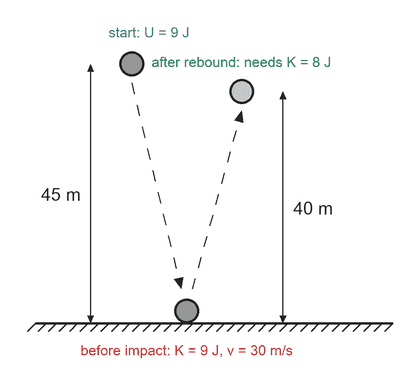
A ball of mass 20 g falls from a height of 45 m. It rebounds from the ground to a height of 40 m. Calculate :
(a) initial potential energy of the ball.
(b) the speed of the ball at which it hits the ground.
(c) the loss in kinetic energy on striking the ground.
[g = 10 ]
Solve with AIWritten solution
Solution:
Concept: A body of mass m at a height h above the ground has gravitational potential energy U = m g h; when it falls, this energy changes into kinetic energy.
A body of mass m moving with speed v has kinetic energy K = ½ m v².
When no friction or air resistance acts, the mechanical energy (potential energy U + kinetic energy K) of a body stays constant: whatever potential energy it loses, it gains as kinetic energy, and the other way round.
Given: M = 20 g; falls from 45 m; rebounds to 40 m; g = 10 m s⁻²; air resistance neglected.
Step 1 — Change the mass into kilogram.
The mass must be in kg for the energy to come out in joule:
Step 2 — Part (a): initial potential energy.
At 45 m the ball has potential energy U = m g h:
Step 3 — Part (b): kinetic energy just before impact.
Air resistance is neglected, so all 9 J has become kinetic energy just before the ball hits the ground:
Step 4 — Part (b): solve for the speed.
We multiply both sides by 2, divide by m = 0.02 kg and take the square root:
Step 5 — Part (c): kinetic energy just after the bounce.
To rise to 40 m, the ball must leave the ground with kinetic energy equal to the potential energy it has at 40 m:
Step 6 — Part (c): the loss on striking.
The loss is the kinetic energy just before striking minus the kinetic energy just after:
This 1 J changes mainly into heat and sound at the impact.
Check: For a fall from rest through h, v = √(2gh):
Watch out: The kinetic energy just AFTER the bounce is found from the rebound height (40 m), not from the starting height.
Therefore, (a) initial potential energy = 9 J; (b) speed on hitting the ground = 30 m s⁻¹; (c) loss in kinetic energy = 1 J.
- 331 mark
Question 33
The energy transformation taking place in a Thermocouple is:
Solve with AIAnswer
- Correct
(A) Heat energy to electrical energy
(B) Heat energy to mechanical energy
(C) Electrical energy to heat energy
(D) Electrical energy to mechanical energy
Answer: (A) Heat energy to electrical energy
Concept: Every device or process takes in energy in one form and gives it out in another. To name the change, first name the form of energy that is supplied, then the useful form that comes out.
Step 1 — Name the energy supplied.
A thermocouple is a loop of two different metals (for example copper and iron) joined at two junctions. One junction is heated, so the energy supplied is heat energy.
Step 2 — Name the energy given out.
While one junction is hot and the other cold, a current flows in the loop and a galvanometer in it deflects. So the output is electrical energy.
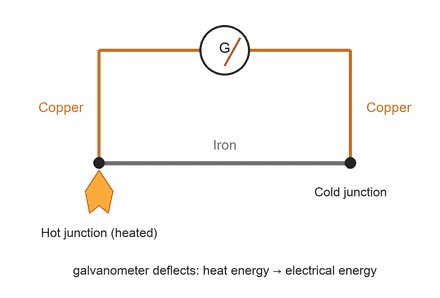
Watch out: A thermocouple produces electricity from heat; an electric heater does the reverse.
Why the other options are wrong:
- (B) Heat energy to mechanical energy: changing heat into mechanical energy is what a heat engine (such as a steam engine) does; a thermocouple has no moving parts.
- (C) Electrical energy to heat energy: this is the reverse change, as in an electric iron or heater.
- (D) Electrical energy to mechanical energy: changing electrical energy into mechanical energy is what an electric motor does.
Therefore, a thermocouple changes heat energy into electrical energy, option (A).
- 341 mark
Question 34
The unit of the physical quantity expressed by equation is: (p is momentum and m is mass)
Solve with AIAnswer
(A) newton
- Correct
(B) joule
(C) watt
(D) joule per kilogram
Answer: (B) joule
Concept: Momentum is p = m v and kinetic energy is K = ½ m v²; so p²/2m is the kinetic energy written in terms of momentum.
Step 1 — Write momentum in terms of mass and velocity.
The momentum of a body of mass m moving with velocity v is p = m v.
Step 2 — Substitute into p²/2m.
Putting p = m v into the expression and cancelling one m:
Step 3 — Name the quantity and its unit.
The expression ½ m v² is the kinetic energy, and the S.I. unit of energy is the joule. The units agree:
Watch out: Do not forget to square the momentum: p²/2m has the unit kg m² s⁻², the joule.
Why the other options are wrong:
- (A) newton: the newton is the unit of force, kg m s⁻²; p²/2m has one more metre, kg m² s⁻².
- (C) watt: the watt is the unit of power, J s⁻¹; p²/2m has no 'per second' left over.
- (D) joule per kilogram: joule per kilogram is energy per unit mass (such as ½ v²); p²/2m still contains one factor of mass, so it is energy itself.
Therefore, the unit of p²/2m is the joule, option (B).