Solution:
Concept: When no friction or air resistance acts, the mechanical energy (potential energy U + kinetic energy K) of a body stays constant: whatever potential energy it loses, it gains as kinetic energy, and the other way round. Friction changes some mechanical energy into heat. The law of conservation of energy: energy can neither be created nor destroyed; it only changes from one form to another, so the total energy (counting heat and sound too) always stays the same.
Step 1 — Read the figure.
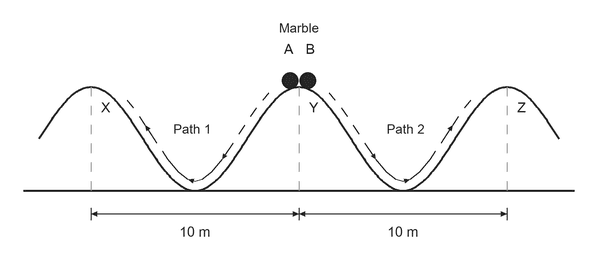
Both marbles start together at the top of peak Y. Marble A rolls along Path 1 (frictionless) towards peak X, and marble B along Path 2 (rough) towards peak Z. The three peaks are at the same height.
Step 2 — Part (a): follow marble A.
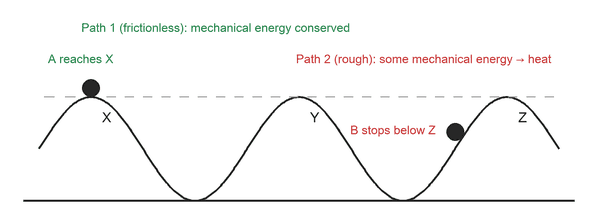
On Path 1 no friction acts, so A loses no mechanical energy. Its potential energy at Y changes into kinetic energy in the valley and back into potential energy as it climbs, so it rises to the same height again and reaches peak X.
Step 3 — Part (a): follow marble B.
On the rough Path 2, friction changes part of B's mechanical energy into heat. B cannot climb back to the height of Y, so it stops (and rolls back) below peak Z. So only marble A is sure to reach the next peak.
Step 4 — Part (b): where mechanical energy is conserved.
Mechanical energy stays constant only where no friction acts, that is along Path 1 only.
Step 5 — Part (c): where the law of conservation of energy holds.
The mechanical energy lost by B on Path 2 is not destroyed; it becomes heat (and a little sound), so the total energy is unchanged. The law therefore holds along both Path 1 and Path 2.
Watch out: The statements 'mechanical energy is conserved' and 'energy is conserved' are different statements: the first needs no friction, the second is true always.
Therefore, (a) marble A (on the frictionless Path 1); (b) along Path 1 only; (c) along both Path 1 and Path 2.