
Question 231 markMCQAsked 2025Easy
What is the correct energy transformation during burning of a candle?
Confirming your payment
Sign up now and get 250 free tokens.
Previous Year Questions · Question 23 of 34
What is the correct energy transformation during burning of a candle?
(A) heat → kinetic + potential
(B) heat → chemical + light
(C) chemical → heat + light
(D) mechanical → chemical + heat
Answer: (C) chemical → heat + light
Concept: Every device or process takes in energy in one form and gives it out in another. To name the change, first name the form of energy that is supplied, then the useful form that comes out. A fuel stores chemical energy, which burning releases.
Step 1 — Name the energy stored.
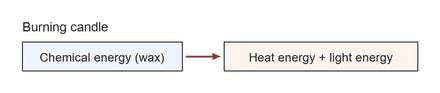
Wax is a fuel, and the energy given out by the candle comes from the chemical energy stored in the wax.
Step 2 — Name the energy given out.
When the wax burns, the flame is hot and it glows, so the energy appears as heat and light.
Watch out: Heat is an OUTPUT of a burning candle, not its source of energy.
Why the other options are wrong:
Therefore, burning a candle changes chemical energy into heat and light, option (C).