Solution:
Concept: A weight of 1 kgf is the weight of a 1 kg mass, so a body weighing 40 kgf has a mass of 40 kg.
A body of mass m moving with speed v has kinetic energy K = ½ m v².
A body of mass m at a height h above the ground has gravitational potential energy U = m g h; when it falls, this energy changes into kinetic energy.
When no friction or air resistance acts, the mechanical energy (potential energy U + kinetic energy K) of a body stays constant: whatever potential energy it loses, it gains as kinetic energy, and the other way round. Energy lost against friction must also be counted when friction acts.
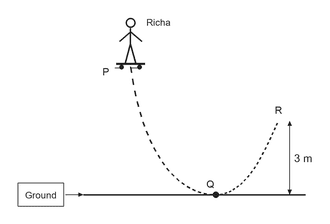
Given: Weight 40 kgf; speed at Q = 10 m s⁻¹; R is 3 m above the ground; 500 J lost from Q to R; g = 10 m s⁻²; no friction from P to Q.
Step 1 — State what we take from the question.
Richa 'leaves' P, so we take her to start from rest at P. Her weight is 40 kgf, so her mass is m = 40 kg. From the figure, R is 3 m above the ground.
Step 2 — Part (a): kinetic energy at Q.
At Q her speed is 10 m s⁻¹, so:
KQ=21mv2=21×40×102 J=2000 J
Step 3 — Part (b): use conservation from P to Q.
There is no friction from P to Q, so the potential energy she has at P (at rest) becomes the kinetic energy at Q, on the ground:
mgh=KQ
Step 4 — Part (b): find the height of P.
Dividing both sides by m g:
h=40×102000 m=5 m
Step 5 — Part (c): potential energy at R.
At R she is 3 m above the ground:
UR=40×10×3 J=1200 J
Step 6 — Part (c): share out the energy from Q to R.
The 2000 J she has at Q becomes the potential energy at R, the kinetic energy at R and the 500 J lost against friction:
KQ=UR+KR+500 J
KR=(2000−1200−500) J=300 J
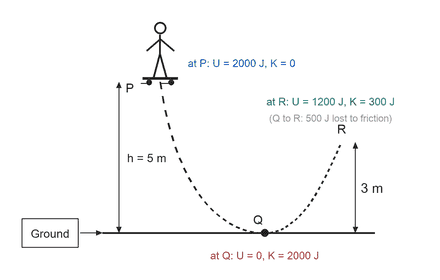
Watch out: At R she is 3 m above the ground, so subtract BOTH the 1200 J of potential energy and the 500 J lost to friction from 2000 J.
Therefore, (a) kinetic energy at Q = 2000 J; (b) height of P = 5 m; (c) kinetic energy at R = 300 J.