
Question 184 marksAsked 2023Medium
A car of mass 120 kg is moving at a speed 18 km/h and it accelerates to attain a speed of 54 km/h in 5 seconds. Calculate:
(a) the work done by the engine.
(b) the power of the engine.
Confirming your payment
Sign up now and get 250 free tokens.
Previous Year Questions · Question 18 of 34
A car of mass 120 kg is moving at a speed 18 km/h and it accelerates to attain a speed of 54 km/h in 5 seconds. Calculate:
(a) the work done by the engine.
(b) the power of the engine.
Solution:
Concept: By the work–energy theorem, the work done on a body by a force equals the change in its kinetic energy.
A body of mass m moving with speed v has kinetic energy K = ½ m v².
Power is the rate of doing work, P = W ÷ t; its S.I. unit is the watt, one joule per second. When a force F moves its point of application at a steady speed v along its own direction, the work done per second is F times the distance moved per second, so P = F v.
Given: M = 120 kg; speed 18 km/h rises to 54 km/h in t = 5 s.
Step 1 — Change the speeds into m s⁻¹.
One km/h is 1000 m in 3600 s, which is 5/18 m s⁻¹, so we multiply each speed by 5/18:
Step 2 — Find the starting kinetic energy.
We use K = ½mv², with m = 120 kg and u = 5 m s⁻¹:
Step 3 — Find the final kinetic energy.
Now with v = 15 m s⁻¹:
Step 4 — Part (a): work done by the engine.
By the work–energy theorem, the work done by the engine equals the gain in kinetic energy (friction is neglected):
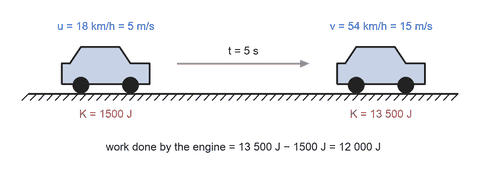
Step 5 — Part (b): power of the engine.
Power is the work divided by the 5 s taken:
Watch out: Change km/h into m s⁻¹ first, and use the CHANGE in kinetic energy, not the final kinetic energy (13,500 J).
Therefore, (a) work done by the engine = 12,000 J (12 kJ); (b) power of the engine = 2400 W (2.4 kW).