
Question 191 markMCQAsked 2024Easy
When a bell fixed on a cycle rings, then the energy conversion that takes place is:
Confirming your payment
Sign up now and get 250 free tokens.
Previous Year Questions · Question 19 of 34
When a bell fixed on a cycle rings, then the energy conversion that takes place is:
(A) gravitational potential energy to sound energy
(B) kinetic energy to sound energy
(C) sound energy to electrical energy
(D) sound energy to mechanical energy
Answer: (B) kinetic energy to sound energy
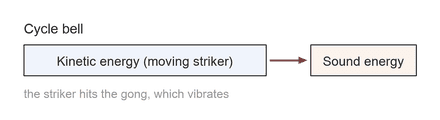
Concept: A cycle bell rings when its moving striker hits the gong. Every device or process takes in energy in one form and gives it out in another. To name the change, first name the form of energy that is supplied, then the useful form that comes out.
Step 1 — Name the energy supplied.
The rider's thumb pushes the lever, which sets the striker of the bell moving. The energy of this motion is kinetic energy.
Step 2 — Name the energy given out.
The moving striker hits the gong and makes it vibrate, and the vibrating gong gives out sound energy.
Watch out: Sound is the OUTPUT of the bell, so any option that starts with sound energy has the change the wrong way round.
Why the other options are wrong:
Therefore, the energy conversion is kinetic energy to sound energy, option (B).