
Question 201 markMCQAsked 2024Easy
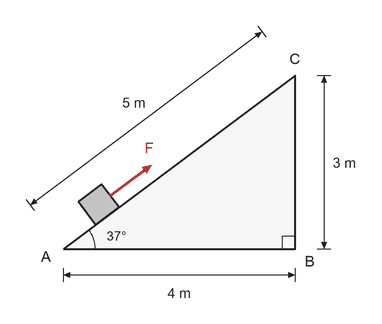
A force ‘F’ moves a load from A to C as shown in the figure below. For the calculation of the work done, which of these lengths would you use as the displacement?
Confirming your payment
Sign up now and get 250 free tokens.
Previous Year Questions · Question 20 of 34
A force ‘F’ moves a load from A to C as shown in the figure below. For the calculation of the work done, which of these lengths would you use as the displacement?
(A) 3m
(B) 4m
(C) 5m
(D) 7m
Answer: (C) 5m
Concept: Displacement is the straight-line distance from the starting point to the final point. For the work done by a force, W = F × (displacement in the direction of the force).
Step 1 — Find where the load starts and ends.
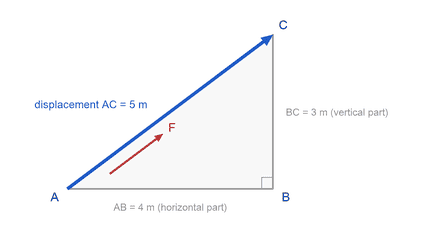
The load starts at A and ends at C. It moves straight along the slope AC, which is also the direction of the force F.
Step 2 — Find the length AC.
AC is the hypotenuse of the right-angled triangle ABC, with AB = 4 m and BC = 3 m, so by Pythagoras:
Step 3 — Use it for the work.
The force and the displacement are both along AC (θ = 0°), so W = F × AC, with the displacement 5 m.
Watch out: The 3 m rise is used for the work done against gravity (m g h), not for the work done by F along the slope.
Why the other options are wrong:
Therefore, the displacement used is AC = 5 m, option (C).