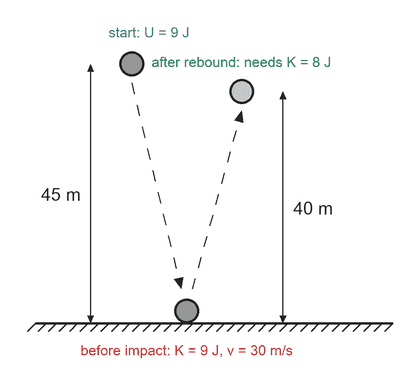
A ball of mass 20 g falls from a height of 45 m. It rebounds from the ground to a height of 40 m. Calculate
Question 324 marksAsked 2026Medium
A ball of mass 20 g falls from a height of 45 m. It rebounds from the ground to a height of 40 m. Calculate :
(a) initial potential energy of the ball.
(b) the speed of the ball at which it hits the ground.
(c) the loss in kinetic energy on striking the ground.
[g = 10 m s−2]
Solution:
Concept: A body of mass m at a height h above the ground has gravitational potential energy U = m g h; when it falls, this energy changes into kinetic energy.
A body of mass m moving with speed v has kinetic energy K = ½ m v².
When no friction or air resistance acts, the mechanical energy (potential energy U + kinetic energy K) of a body stays constant: whatever potential energy it loses, it gains as kinetic energy, and the other way round.
Given: M = 20 g; falls from 45 m; rebounds to 40 m; g = 10 m s⁻²; air resistance neglected.
Step 1 — Change the mass into kilogram.
The mass must be in kg for the energy to come out in joule:
m=100020 kg=0.02 kg
Step 2 — Part (a): initial potential energy.
At 45 m the ball has potential energy U = m g h:
U1=0.02×10×45 J=9 J
Step 3 — Part (b): kinetic energy just before impact.
Air resistance is neglected, so all 9 J has become kinetic energy just before the ball hits the ground:
21mv2=9 J
Step 4 — Part (b): solve for the speed.
We multiply both sides by 2, divide by m = 0.02 kg and take the square root:
v2=0.022×9=900 m2 s−2v=900=30 m s−1
Step 5 — Part (c): kinetic energy just after the bounce.
To rise to 40 m, the ball must leave the ground with kinetic energy equal to the potential energy it has at 40 m:
K2=0.02×10×40 J=8 J
Step 6 — Part (c): the loss on striking.
The loss is the kinetic energy just before striking minus the kinetic energy just after:
loss=(9−8) J=1 J
This 1 J changes mainly into heat and sound at the impact.
Check: For a fall from rest through h, v = √(2gh):
v=2×10×45=30 m s−1
Watch out: The kinetic energy just AFTER the bounce is found from the rebound height (40 m), not from the starting height.
Therefore, (a) initial potential energy = 9 J; (b) speed on hitting the ground = 30 m s⁻¹; (c) loss in kinetic energy = 1 J.