Solution:
Concept: Work is done when a force moves a body. If the force F makes an angle θ with the displacement S, only the part F cos θ acts along the displacement, so W = F S cos θ. Its S.I. unit is the joule: 1 joule is the work done when a force of 1 N moves a body through 1 m in its own direction. A force at 90° to the motion does no work.
Given: AJB is a semicircle, AB = 20 m, θ < 90°.
Step 1 — Part (a): the unit on the subatomic scale.
The work done (energy) on the subatomic scale is measured in electron volt (eV): the energy gained by an electron accelerated through 1 volt, 1 eV = 1.6 × 10⁻¹⁹ J.
Step 2 — Part (b): the class of lever.
In a pair of scissors the fulcrum (the rivet joining the blades) lies between the effort (applied at the handles) and the load (the material being cut, at the blades). So it is a class I lever.
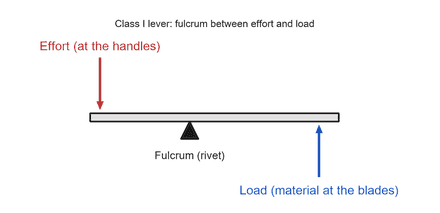
Step 3 — Part (c): Case 1, along the semicircle.
The string pulls the stone along the radius, towards the centre of the semicircle, while the stone moves along the tangent at every point. So the force is at 90° to the motion at every instant:
W1=FScos90∘
W1=0
Step 4 — Part (c): Case 2, along AB.
The force acts along AB, the direction of the 20 m displacement, so θ = 0°:
W2=F×20 m×cos0∘=20F
Step 5 — Part (c): Case 3, at θ to AB.
Only the part F cos θ of the force acts along AB:
W3=F×20 m×cosθ=20Fcosθ
Since θ is less than 90°, cos θ lies between 0 and 1, so W₃ is more than 0 but less than 20F.
Step 6 — Part (c): arrange the cases.
Putting the three values in order:
0<20Fcosθ<20F
So W₁ < W₃ < W₂.
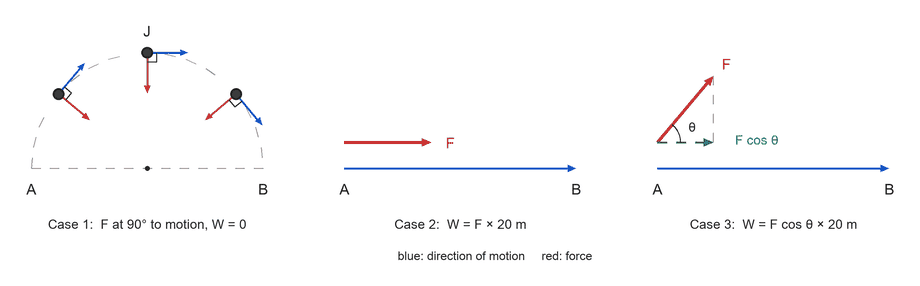
Watch out: In Case 1 the stone travels the longest distance (the semicircle, about 31.4 m), yet the force does the least work (zero), because it is always at 90° to the motion.
Note: in Case 1, F is taken as the pull of the string, of constant size and always towards the centre, as the figure shows. If F kept one fixed direction instead, its work would depend only on the displacement AB.
Therefore, (a) the electron volt (eV); (b) a class I lever; (c) Case 1 < Case 3 < Case 2.

