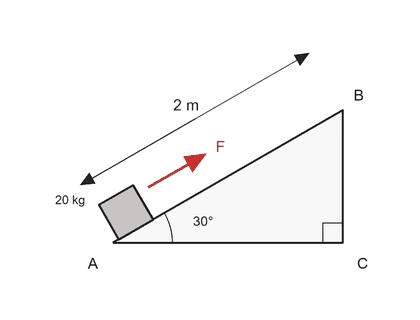
Solution:
Concept: The potential energy gained depends only on the vertical height risen: U = m g h. Work is done when a force moves a body. If the force F makes an angle θ with the displacement S, only the part F cos θ acts along the displacement, so W = F S cos θ. Its S.I. unit is the joule: 1 joule is the work done when a force of 1 N moves a body through 1 m in its own direction.
Given: M = 20 kg; slope AB = 2 m at 30° to the horizontal; 10 J of work against friction; g = 10 m s⁻².
Step 1 — State what we take from the question.
We take the box to be pulled slowly, so it gains no kinetic energy; all the work done by F goes into potential energy and into the work against friction.
Step 2 — Find the height risen.
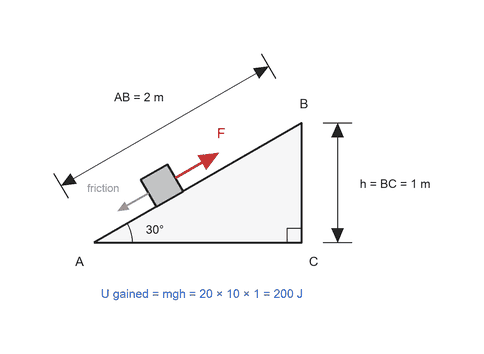
In the right-angled triangle ABC, BC is opposite the 30° angle, so the height risen is h = AB sin 30°:
h=2×sin30∘ m=2×21 m=1 m
Step 3 — Part (a): potential energy gained.
We use U = m g h, with m = 20 kg and h = 1 m:
U=20×10×1 J=200 J
Step 4 — Part (b): total work done by F.
The work done by F is the potential energy gained plus the 10 J done against friction:
WF=(200+10) J=210 J
Step 5 — Part (b): find the force.
F acts along the slope and moves the box 2 m along it, so W_F = F × 2 m:
F×2 m=210 J
F=2210 N=105 N
Without friction, 200 J ÷ 2 m = 100 N would be enough; the extra 5 N overcomes friction.
Watch out: Use the vertical height h = 1 m in m g h, not the 2 m length of the slope.
Therefore, (a) potential energy gained = 200 J; (b) force F = 105 N.