
Question 141 markMCQAsked 2023Easy
When the speed of a moving object is doubled, then its kinetic energy:
Confirming your payment
Sign up now and get 250 free tokens.
Previous Year Questions · Question 14 of 34
When the speed of a moving object is doubled, then its kinetic energy:
(A) remains the same
(B) decreases
(C) is doubled
(D) becomes four times
Answer: (D) becomes four times
Concept: A body of mass m moving with speed v has kinetic energy K = ½ m v². For a fixed mass, K is proportional to the square of the speed.
Step 1 — Write the kinetic energy at speed v.
For a body of mass m moving with speed v:
Step 2 — Write the kinetic energy at speed 2v.
The mass stays the same and the speed becomes 2v:
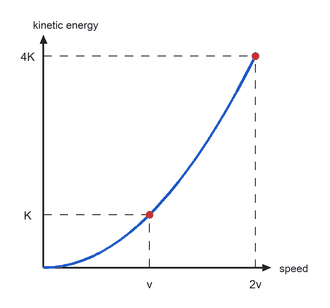
Step 3 — Compare.
So the new kinetic energy is four times the old one, because K depends on the square of the speed and 2² = 4.
Watch out: Doubling the speed doubles the momentum (m v), but it makes the kinetic energy four times.
Why the other options are wrong:
Therefore, the kinetic energy becomes four times, option (D).