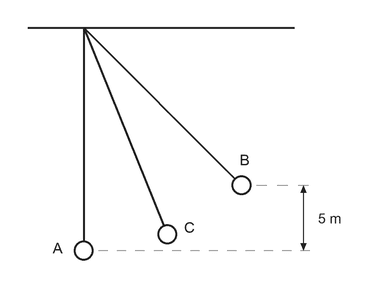
The figure alongside shows a simple pendulum of mass 200 g.
Question 133 marksAsked 2020Medium
The figure alongside shows a simple pendulum of mass 200 g. It is displaced from the mean position A to the extreme position B. The potential energy at the position A is zero. At the position B the pendulum bob is raised by 5 m.
(i) What is the potential energy of the pendulum at the position B?
(ii) What is the total mechanical energy at point C?
(iii) What is the speed of the bob at the position A when released from B?
(Take g=10m s−2 and there is no loss of energy.)
Solution:
Concept: At an extreme position a pendulum bob is momentarily at rest, so its energy there is all potential energy. When no friction or air resistance acts, the mechanical energy (potential energy U + kinetic energy K) of a body stays constant: whatever potential energy it loses, it gains as kinetic energy, and the other way round.
Given: M = 200 g; B is 5 m above A; U at A = 0; g = 10 m s⁻²; no loss of energy.
Step 1 — Change the mass into kilogram.
The mass must be in kg for the energy to come out in joule:
m=1000200 kg=0.2 kg
Step 2 — Part (i): potential energy at B.
B is 5 m above A, where the potential energy is zero:
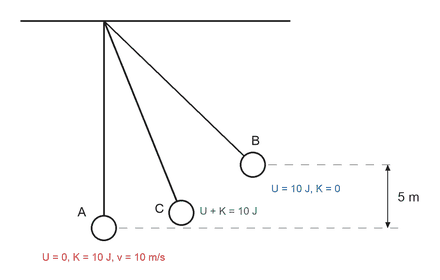
UB=mgh=0.2×10×5 J=10 J
Step 3 — Part (ii): total mechanical energy at C.
At the extreme position B the bob is at rest for an instant, so its kinetic energy is zero and its total energy is the 10 J of potential energy. There is no loss of energy, so the total is the same at every point of the swing. At C it is 10 J, partly potential and partly kinetic.
Step 4 — Part (iii): kinetic energy at A.
At the mean position A the potential energy is zero, so all 10 J is kinetic energy:
21mv2=10 J
Step 5 — Part (iii): solve for the speed.
We multiply both sides by 2 and divide by m = 0.2 kg, then take the square root:
v2=0.22×10=100 m2 s−2v=100=10 m s−1
Check: For a fall through h from rest, v = √(2gh):
v=2×10×5=10 m s−1
Watch out: Change 200 g into 0.2 kg before using U = m g h; using 200 would make the energy 1000 times too large.
Therefore, (i) potential energy at B = 10 J; (ii) total mechanical energy at C = 10 J; (iii) speed at A = 10 m s⁻¹.